- Details
- Written by: IT Pro
- Category: Blog
- Hits: 3660
Cyber conflict between states is rarely a single “event.” For IT professionals, it shows up as shifting pressure on the same fundamentals: identity systems, internet-facing infrastructure, third-party exposure, and the ability to keep critical services operating while leaders ask for answers fast. In 2026, the most important change is not a brand-new technique; it’s the speed, scale, and ambiguity of how familiar techniques get applied when geopolitics heats up.
This article is written for defenders and operators: security teams, network and cloud engineers, SOC analysts, incident responders, and IT leaders who have to translate headlines into practical posture decisions. It focuses on what trends are likely to shape risk, what signals to watch, and how to build resilience that holds up whether your organization is a direct target or collateral spillover.
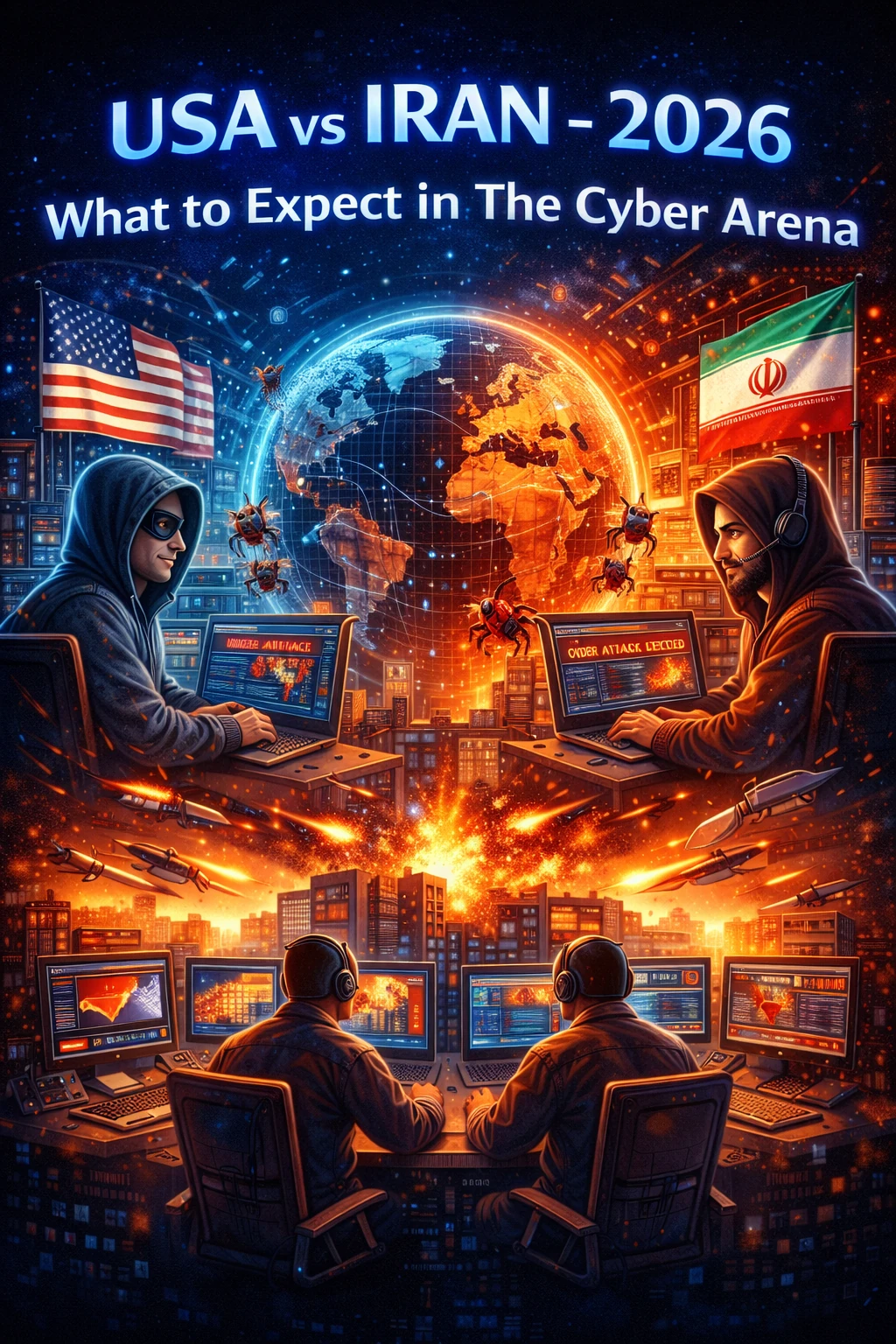
The cyber arena in 2026: friction, not fireworks
When tension rises between major actors, cyber activity typically expands in two directions at once. One direction is “loud” activity designed to disrupt, intimidate, or signal capability. The other is “quiet” activity focused on access: credential theft, persistence, and positioning inside networks that might matter later. Defenders often over-prepare for the loud part and under-prepare for the quiet part because the quiet part looks like routine noise until it suddenly becomes a crisis.
The practical takeaway for 2026 is this: assume you will see more opportunistic targeting that exploits common weaknesses, alongside carefully chosen, higher-effort intrusions aimed at sectors tied to national security, research, sanctions, regional conflict dynamics, and critical services. Many organizations that feel “non-political” can still become relevant through supply chains, shared vendors, shared identity platforms, or simple adjacency to a targeted ecosystem.
What is likely to stay the same
The fundamentals of compromise are stubbornly consistent, even as tooling evolves. In 2026, expect the following patterns to remain persistent:
- Credential-driven intrusion: password spraying, reuse, phishing, token theft, and MFA bypass attempts remain the fastest path to impact when identity systems are not hardened.
- Exploitation of internet-facing edges: VPN gateways, remote access appliances, email infrastructure, and management interfaces continue to be high-value because they bridge the external internet to trusted internal paths.
- Living-off-the-land and stealthy persistence: actors who want staying power will blend into normal admin behavior, leaning on legitimate tools, scheduled tasks, and cloud-native features instead of noisy malware.
- Targeting that follows geopolitics: when diplomatic or military pressure changes, cyber attention often follows organizations that are symbolically or operationally tied to the moment, including vendors, contractors, NGOs, media, and researchers.
- Influence blended with intrusion: data theft, selective leaks, impersonation, and narrative manipulation remain attractive because they can cause outsized real-world effects without needing destructive outcomes.
None of these are new. What changes is the tempo and how quickly routine suspiciousness becomes operational urgency.
What is likely to change in 2026
The biggest shift is not that defenders must learn entirely new categories of attacks. Instead, defenders must assume that familiar tactics will be executed with better targeting, higher throughput, and stronger psychological pressure on staff and leadership.
In 2026, expect more of the following:
- AI-assisted social engineering at scale: more convincing spear-phish, better-written lures, and faster iteration on what “works” against a specific org’s culture and workflows. This is less about sci-fi deepfakes and more about attackers reducing the cost of personalization.
- Cloud identity as the primary battlefield: defenders who still think in terms of “perimeter breach” will be surprised by incidents that start with OAuth consent abuse, session token theft, conditional access gaps, or mis-scoped administrative privileges.
- More pressure on managed providers and shared platforms: MSPs, SaaS admin consoles, CI/CD pipelines, and common IT tooling are attractive when the goal is reach and leverage rather than a single network.
- Disruption as a signaling tool: DDoS and other service-denial patterns can increase when an actor wants to demonstrate capability or create operational distraction while quieter access activity continues elsewhere.
- Faster pivot from access to consequence: once access is obtained, “time-to-impact” shrinks if the actor’s objective is immediate pressure rather than long-term espionage.
How conflict dynamics show up in enterprise telemetry
Most IT organizations will never see a dramatic “nation-state attack” banner. What you will see is telemetry that shifts in volume and intent: more authentication anomalies, a rise in failed logons against exposed services, increased probing of remote access infrastructure, and more impersonation attempts against help desks and administrators.
If you operate a SOC or run security operations, consider the kinds of operational questions leadership asks during geopolitical spikes: “Are we being targeted?” “Is our industry in the blast radius?” “Could we still deliver our core services if something happens tonight?” Your readiness is measured by how quickly you can answer those questions with evidence and action, not by how many alerts you can generate.
Where defenders should expect pressure
While any organization can be swept up by opportunistic scanning, certain categories consistently draw attention during heightened tension:
- Critical infrastructure and public services: operations where downtime has public impact and response time is constrained.
- Defense-adjacent supply chains: contractors, engineering partners, research labs, and manufacturers whose data has strategic value.
- Energy, industrial, and OT-linked environments: organizations that bridge IT and operational networks, especially with aging equipment or thin segmentation.
- Media, civil society, and academia: targets for data theft, intimidation, or narrative operations.
- Financial services and fintech: targets for disruption, fraud adjacency, and secondary effects through third parties.
Even if your organization is not in these categories, your vendors might be. The spillover path is often indirect.
What to expect from the playbooks
It helps to think in playbooks rather than “tools.” Tools change quickly; playbooks remain recognizable. In 2026, the playbooks defenders should anticipate include:
Access and persistence playbook. The goal is reliable presence inside accounts, endpoints, or cloud tenants, often without triggering obvious malware signatures. Defenders feel this as suspicious sign-ins, unusual admin actions, mailbox rules, token reuse, or stealthy lateral movement.
Disruption and distraction playbook. The goal is service instability, public pressure, or operational distraction. Defenders feel this as traffic floods, application-layer pressure, abuse of exposed services, or attempts to overwhelm monitoring and response capacity.
Data theft and leverage playbook. The goal is to obtain communications, sensitive documents, or identifiable records that can be exploited for influence, embarrassment, negotiation leverage, or downstream targeting. Defenders feel this as unusual bulk access, suspicious exports, suspicious administrative APIs, or abnormal access patterns in collaboration platforms.
Third-party pivot playbook. The goal is reach. Defenders feel this as suspicious activity that originates from “trusted” integrations, shared accounts, vendor access paths, or inherited administrative permissions.
Defensive priorities that matter in 2026
If you do only one thing after reading this, make it this: prioritize controls that reduce the likelihood of credential-driven compromise and shorten the time from detection to containment. Those two goals cover a large percentage of real-world outcomes, including many high-profile incidents.
The following priorities are not exciting, but they are the difference between a tense week and an existential outage:
- Harden identity end-to-end: reduce reliance on legacy authentication, enforce strong MFA where appropriate, tighten conditional access, and treat administrative identities as a separate security tier with stricter controls.
- Make external exposure boring: aggressively manage patching and configuration for internet-facing services, reduce unnecessary exposed management interfaces, and ensure rapid response paths exist for urgent edge vulnerabilities.
- Improve detection fidelity, not alert volume: focus on high-signal detections for identity anomalies, admin privilege changes, suspicious mailbox rules, unusual cloud API usage, and lateral movement patterns that matter.
- Build containment muscle: pre-stage actions such as account lock-down, token revocation, privileged session termination, and rapid network segmentation changes that can be executed under pressure.
- Make backups and recovery real: ensure recovery objectives reflect business reality, test restores, and separate recovery access from everyday credentials.
- Protect the help desk and the human workflow: strengthen identity verification for password resets, admin approvals, and “urgent” requests. In many incidents, the help desk becomes the shortest path to admin access.
- Know your third-party blast radius: inventory critical vendor access, restrict permissions, monitor integration behavior, and maintain contingency plans when a vendor becomes the incident.
Operational technology and critical services: resilience over perfection
For OT and hybrid environments, the goal is not to copy-paste enterprise IT controls. The goal is to design resilience into the workflow: segmentation, strict change control, visibility into remote access, and the ability to keep safety and essential operations stable even if IT is degraded.
In practice, resilience includes simple but disciplined habits: separating administrative paths, limiting remote access to defined choke points, monitoring for configuration drift, and ensuring operational teams know how to run safely during partial outages.
Incident response in 2026: the “business tempo” problem
The technical work of incident response is hard, but in 2026 the harder part is tempo. Leaders will expect faster clarity. Partners and regulators may expect faster notifications. Customers may expect faster reassurance. Attackers may attempt to exploit that tempo with pressure tactics, timed disruptions, or selective data exposure.
IT professionals can reduce chaos by pre-building decision paths:
- Pre-approve containment actions that you can take without a lengthy chain of approvals.
- Define “service priorities” so teams know what must be kept alive first when resources are stretched.
- Establish communication hygiene for internal coordination so rumor does not outpace facts.
- Practice tabletop scenarios that involve not just security staff but also IT operations, legal, communications, and leadership.
What success looks like for defenders
In a cyber environment shaped by geopolitical rivalry, success is not “no one ever tries.” Success looks like:
- suspicious access attempts fail more often than they succeed
- when something succeeds, it is detected quickly with high confidence
- containment is decisive and repeatable under stress
- core services can be restored without improvising identity and access
- leadership receives clear, evidence-based status updates rather than speculation
The uncomfortable truth of 2026 is that you cannot control geopolitical tension. You can control how prepared your environment is for the predictable consequences: increased scanning, higher-pressure identity attacks, more attempts to exploit shared platforms, and more urgency around uptime and trust. The organizations that do best are the ones that make routine hygiene non-negotiable and response actions muscle memory.
Closing perspective for 2026 planning
“USA vs Iran” makes a dramatic headline, but most defenders experience it as a change in risk weather: more storms, faster changes, and less warning. Plan for continuity under stress. Assume your exposure is not only your own network but also your identity layer, your cloud tenant, your vendors, and your downstream dependencies.
If you treat 2026 as an opportunity to simplify, harden, and rehearse, you will be ready for this rivalry’s cyber spillover and for the many other threats that look different on the surface but attack the same underlying weaknesses.
- Details
- Written by: IT Pro
- Category: Blog
- Hits: 3100
In a modern conflict, “availability” becomes a strategic asset. When kinetic threats and cyber operations overlap, IT teams inherit a dual mandate: keep services running while assuming that power, connectivity, vendors, and even identity systems can degrade without notice. In a 2026 scenario involving the United States and Iran, risk is not limited to malware or DDoS. It includes real-world disruption that can ripple into your stack through electricity loss, telecom failures, cloud region instability, sanctions constraints, and a surge of influence operations aimed at confusing responders.
This article is written for IT professionals who need a practical, defensive perspective. It does not provide tactical military guidance. Instead, it explains why ballistic-missile range classes matter for infrastructure planning, and how to design operational resilience when “normal conditions” can’t be assumed.
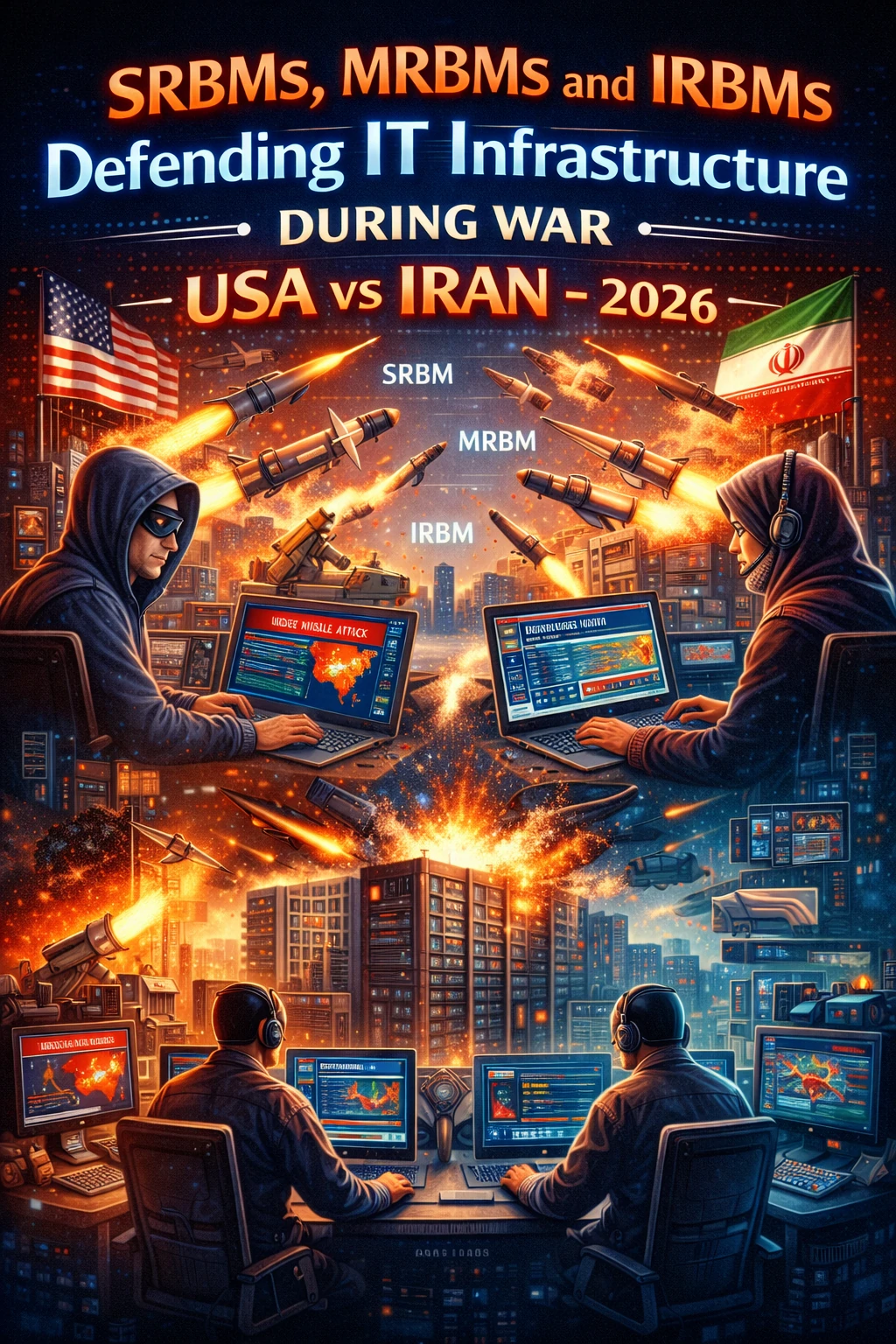
What SRBMs, MRBMs, and IRBMs mean in plain terms
SRBM, MRBM, and IRBM are range categories for ballistic missiles. Definitions vary slightly by organization, but the industry-common framing is: short-range ballistic missiles (SRBMs) measured in the hundreds to roughly one thousand kilometers of maximum range, medium-range ballistic missiles (MRBMs) in the one-thousand to three-thousand kilometer class, and intermediate-range ballistic missiles (IRBMs) in the three-thousand to roughly fifty-five-hundred kilometer class. The details matter less than the operational implication: these ranges define which facilities can be threatened from which launch areas, and how quickly disruption can propagate across regions.
From an IT lens, the key takeaway is not the physics lesson. It’s the planning horizon. Different ranges imply different warning windows, different geographies at risk, and different “blast radius” for downstream dependencies such as power grids, fiber routes, landing stations, satellite uplinks, airports, ports, and logistics corridors that your organization quietly depends on.
Why missile taxonomy matters to IT continuity planning
Many enterprises plan for cyber incidents as if the environment stays stable: power is available, carriers route around issues, and staff can travel. Wartime conditions break those assumptions. Even limited regional strikes can trigger broader effects: rolling blackouts, telecom congestion, partial internet filtering, damaged last-mile facilities, and “just-in-time” parts delays. Your services can fail without being directly targeted.
Missile range categories are a proxy for geographic exposure. If your business continuity design assumes a single “safe” neighboring region, an IRBM-class reach changes the calculus. If your recovery plan assumes staff can physically reach a site, SRBM-class regional volatility can invalidate that. The more your organization depends on a tight cluster of facilities, the more you need to design for geographic independence rather than geographic proximity.
The wartime threat model for IT teams
In a USA–Iran escalation scenario, IT risk typically arrives through multiple channels at once. You should model them as a combined stress test rather than separate incidents:
- Physical disruption to utilities and transit that affects data centers, offices, carrier hotels, and cloud connectivity.
- Cyber operations targeting availability and trust such as DDoS, wiper-like destructive activity, ransomware-as-chaos, and opportunistic exploitation of exposed systems.
- Influence and deception including deepfake voice/video, fake “emergency” change requests, and spoofed vendor communications.
- Supply chain and compliance constraints including sanctions, export controls, payment friction, and abrupt vendor policy changes.
- Human and operational strain including staffing shortages, fatigue, disrupted comms, and leadership pressure for rapid decisions.
The objective is resilience under compound failure: keep “minimum viable operations” alive while preventing a crisis response from becoming the breach vector.
Build for degraded conditions, not perfect recovery
Many recovery strategies assume you can rebuild fast if you have backups. In wartime, rebuilding can be slow because the environment is unstable. You want architectures that continue operating safely in a reduced mode. That means explicitly defining what “essential” looks like: which user groups, which transactions, which APIs, which integrations, and which data freshness requirements you can relax without breaking legal or safety obligations.
A strong pattern is a tiered service model: core identity, core communications, and core transaction systems receive the highest redundancy and the simplest dependencies. Everything else becomes optional or deferred. If you cannot describe your minimum viable operations in one page that a non-technical executive can understand, your organization will improvise under pressure, and improvisation is where security controls are bypassed.
Resilient architecture: geographic independence and dependency pruning
Wartime continuity is less about “multi-region” marketing diagrams and more about dependency realism. Ask two blunt questions: can one region operate without the other, and can you survive if a critical vendor is unreachable?
- Geodiversity that actually isolates failure means separating power grids, carrier routes, DNS providers, and management planes where practical. If your “secondary” rides the same upstream dependencies as your primary, you have a false sense of resilience.
- Multi-path connectivity means at least two carriers, tested failover, and a plan for congestion. Include private connectivity options where possible, but also assume that private links can degrade.
- Local survivability means sites can run safely if WAN is impaired: cached auth where appropriate, local DNS resolvers, local software repos, and offline break-glass procedures that don’t require cloud console access.
- Dependency pruning means removing non-essential third-party scripts, analytics tags, and fragile integrations from critical user flows. In a crisis, fewer moving parts is a security feature.
Backups that survive both ransomware and chaos
In conflict-driven incident waves, ransomware and destructive malware often aim at the same thing: deny recovery. Your backup strategy must assume attackers will try to delete snapshots, steal credentials, and corrupt recovery confidence. Treat backups as a separate product with its own security architecture.
- Immutability and isolation using write-once controls where available, separate admin domains, and minimal standing privileges for backup operators.
- Recovery rehearsals that restore into a clean environment and validate applications end-to-end, not just that files exist. A restore you haven’t tested is a hope, not a control.
- Tiered recovery data including offline copies for crown jewels and “fast restore” copies for essential services. If bandwidth becomes constrained, you need choices.
- Key management continuity ensuring encryption keys and HSM access remain available during outages, with tightly governed emergency access paths.
Identity becomes the frontline: make takeover hard under pressure
Wartime conditions amplify social engineering. Attackers exploit urgency: “emergency access,” “urgent vendor fix,” “security team needs your token,” “CEO approved,” “military situation requires immediate action.” Your best defense is to make the secure path faster than the insecure path.
- Phishing-resistant MFA for privileged roles, with strict device posture requirements where feasible. Reduce reliance on push approvals that can be fatigued.
- Privileged access management that time-bounds admin rights, logs all elevation, and makes “just give me admin” an auditable exception.
- Break-glass accounts that are truly isolated, tested, and governed with crisis procedures that do not depend on a single person or a single communication channel.
- Change control under crisis using pre-approved emergency runbooks, dual control for sensitive actions, and a strict policy on “instructions via chat.”
Network and application resilience: assume hostile traffic and brittle transit
In an escalation, you may see both sophisticated intrusion attempts and loud opportunistic scanning. You also may see “friendly fire” problems: legitimate user traffic spikes, carrier reroutes, and upstream packet loss that looks like an attack. Engineer for clarity and graceful degradation.
- DDoS readiness with tested runbooks, upstream scrubbing where available, and the ability to switch traffic profiles to protect core endpoints.
- Rate limiting and load shedding at the edge and in services, so your systems fail predictable rather than collapse.
- Segmentation so that compromise of a public-facing app does not become lateral movement into backups, identity, or OT networks.
- Patch and exposure discipline focused on internet-facing assets, remote management interfaces, and high-impact vulnerabilities. If it is reachable, assume it will be tested.
OT, facilities, and “invisible IT” that suddenly matters
During conflict, the systems that keep your compute alive become prime failure points: building management systems, generators, fuel logistics, HVAC controls, access systems, cameras, badge services, and even printer fleets that quietly run embedded software. These are often under-inventoried and over-trusted.
The goal is not to turn IT into an industrial control expert overnight. The goal is to make sure facilities can run safely if networks are impaired, and to prevent OT systems from becoming a bridge into enterprise identity and backups. Establish clear boundaries, document manual fallbacks, and ensure that vendor remote access is strictly controlled and monitored.
Incident response that still works when communications are unreliable
A conflict environment forces a shift from “incident response” to “incident response plus crisis management.” You need technical containment, but also executive decision paths, legal review, customer communications, and workforce safety decisions happening in parallel. Adopt a recognized lifecycle model, then harden it for disruption.
Prepare out-of-band communications that do not rely on your primary email and chat platforms. Pre-stage contact trees, vendor escalation paths, and internal authentication for “who is really on the other end.” Decide in advance what you will do if your primary identity provider is down, if your ticketing system is unavailable, or if your cloud console access is impaired.
Tabletop exercises should include uncomfortable constraints: partial power loss, no Slack/Teams, leadership traveling, conflicting information, and a simultaneous legal/compliance requirement. This is where you discover whether your plan is a document or a capability.
Defending trust: deepfakes, spoofed vendors, and “helpdesk theater”
In wartime narratives, attackers target trust as much as they target servers. A spoofed “carrier outage notice” can trick staff into reconfiguring DNS. A deepfake voice can push a rushed payment or credential reset. A fake “emergency patch” can deliver malware through your own change process.
Countermeasures are procedural and technical: verified call-backs using known numbers, signed change requests, strict policies against accepting secrets over phone, and a “two-channel verification” rule for high-impact actions. Make it culturally acceptable for engineers to slow down a risky request, even when executives are stressed.
Sanctions and supply chain reality: security controls can be blocked by policy
In a USA–Iran context, sanctions and compliance measures can affect how you buy services, renew subscriptions, pay vendors, and ship hardware. Even if your organization is far from the region, you can be impacted through third parties, payment processors, and cloud policy enforcement. Your continuity plan should include legal and procurement partners, because “we can’t renew that security service right now” is an operational risk, not just a finance issue.
Keep an updated inventory of critical vendors, contract renewal dates, and regional dependencies. Maintain alternate suppliers for essentials where feasible, and ensure you have access to installation media, license keys, and configuration backups that do not depend on a single portal.
A practical wartime readiness posture for IT teams
The best wartime posture is boring, disciplined, and repeatable. It favors simple architectures, minimized privileges, rehearsed recovery, and clear lines of authority. It assumes that you may need to operate safely while partially disconnected and under sustained pressure.
- Align leadership on “minimum viable operations” and document what gets degraded first.
- Validate that backups are immutable, isolated, and restorable into a clean environment.
- Reduce privileged standing access and enforce phishing-resistant authentication for admins.
- Stress-test your dependency chain: DNS, IdP, cloud console access, carriers, and SaaS control planes.
- Prepare out-of-band comms and verified call-back procedures for high-risk requests.
- Segment networks so public-facing compromise cannot reach backups, identity, or OT systems.
- Run crisis-oriented tabletop exercises with realistic constraints and decision pressure.
Closing perspective: resilience is a security outcome
SRBMs, MRBMs, and IRBMs are military terms, but their practical meaning for IT is about geography, timing, and cascading failure. In a 2026 USA–Iran wartime scenario, infrastructure disruption and cyber activity can arrive together, and the organizations that cope best are the ones that already engineered for uncertainty. When you can keep core services stable under stress, you reduce the payoff of attacks, limit operational panic, and protect decision-making when clarity is hardest to find.
- Details
- Written by: IT Pro
- Category: Blog
- Hits: 3042
Late January 2026 has brought a dense fog of public reporting, official messaging, and fast-moving regional dynamics around Iran. For IT professionals, the uncomfortable truth is that uncertainty itself is a risk multiplier. Whether escalation materializes as a short burst of activity, a prolonged standoff, or a de-escalation that still leaves tensions high, the cyber environment tends to behave the same way: activity spikes, attackers take advantage of distraction, and seemingly “ordinary” security gaps become high-impact failures under crisis pressure.
This piece is deliberately defensive. It is not an operational playbook for offensive actions, and it does not assume certainty about events. Instead, it examines the IT mission sets that typically emerge on all sides of a geopolitical flashpoint, how those mission sets translate into enterprise risk, and what practical controls most reliably reduce blast radius. The audience is IT pros: security engineers, SOC analysts, sysadmins, cloud architects, network engineers, and leaders who will be asked to give confident answers in a moment where confidence is hard to earn.
The Cyber Reality of a Kinetic Crisis
When geopolitical tension rises, cyber risk changes less in “category” than in “tempo.” Attackers do not suddenly invent a new internet. They accelerate what already works: credential abuse, identity persistence, known-vulnerability exploitation, third-party compromise, and influence campaigns that weaponize confusion. The most common organizational failure mode is not a single catastrophic breach; it is a pile-up of concurrent incidents—fraud, DDoS noise, phishing, vendor outages, and disinformation—each small enough to seem manageable until they collide.
Crisis conditions also compress decision loops. A security team may have excellent standards “on paper,” but still fail if approvals are slow, escalation paths are unclear, or change-control exceptions multiply. The difference between a contained incident and a prolonged outage often comes down to whether identity governance and recovery procedures hold up when executives are demanding speed.
“Both Sides” in IT Terms: The Mission Sets
In modern conflict, the digital environment is a parallel theater with objectives that map cleanly to traditional goals. The actors vary—state services, contractors, aligned groups, opportunists, and criminals—but the mission sets repeat. Thinking in mission sets helps defenders anticipate what pressure will look like without guessing which logo is behind it.
- Intelligence collection at speed: access to communications, planning, logistics, and decision-making. In enterprise terms, this often manifests as identity compromise, mailbox access, cloud tenant abuse, and data harvesting from collaboration platforms.
- Operational disruption: limiting the reliability of services that shape mobility, communications, energy delivery, finance, and confidence. The IT shape is outages, destructive malware in some cases, and sustained recovery friction.
- Information effects: shaping narratives, demoralizing opponents, and creating social distrust using leaks, impersonation, and synthetic media. For organizations, this becomes brand risk, fraud enablement, and costly internal confusion.
- Deterrence and signaling: visible actions calibrated to send a message without escalating beyond a chosen threshold. In practice, this can look like selective disruptions or carefully timed leaks designed for maximum attention.
- Asymmetric retaliation: pressure applied through indirect digital routes when direct response is constrained. Target selection may include perceived supporters, partners, suppliers, and high-visibility commercial entities.
The defender takeaway is that you do not need to know exactly who is “on the keyboard” to reduce risk. You need to be ready for the behaviors those mission sets produce: identity abuse, availability attacks, and influence-driven incidents that blur technical and non-technical response.
The Iran-Linked Pattern: Identity, Access, and Persistence
Public advisories and industry reporting have repeatedly emphasized an Iran-linked pattern that is especially relevant in a crisis window: credential access methods that are scalable, coupled with persistence mechanisms that are easy to overlook. For many organizations, the highest-risk time is not the initial intrusion but the period after the first “cleanup,” when attackers return via identity footholds that survived.
The practical defensive lens is to assume a broad ecosystem of actors and approaches. Some operations are quiet and patient, prioritizing access and data. Others are loud and performative, optimized for attention. Still others resemble criminal tradecraft—because criminal services and state-aligned priorities can overlap during high-tension periods.
Why identity becomes the battlefield
Identity is the shortest path to business impact. Once an attacker can authenticate as a real user or workload identity, many “perimeter” controls become irrelevant. Cloud-first environments are particularly exposed because so much operational authority is expressed through tokens, roles, conditional access policies, and delegated privileges. The best-prepared teams treat their identity provider and cloud control plane as crown jewels, with higher monitoring fidelity than traditional network controls.
- Credential access noise: password spraying, brute-force attempts, and credential stuffing tend to spike in crisis periods because they are cheap, fast, and often successful against organizations with legacy password hygiene.
- MFA workflow abuse: “push fatigue” style abuse and manipulations of MFA registration can turn multi-factor from a shield into a liability when helpdesks are stressed and exceptions become normal.
- Persistence through legitimate paths: changes to MFA devices, creation of new app registrations, additions of OAuth grants, new forwarding rules, and delegated access can provide long-lived re-entry without malware.
The Counter-Pressure: What a High-Resource Adversary Environment Looks Like
In a major escalation, “the other side” of the cyber equation may involve actors with high resources, broad intelligence, and disciplined operational security. From a defender’s standpoint, that means fewer obvious signals and more activity that looks like normal admin behavior until it is too late. It also means a stronger chance of multi-domain pressure: influence narratives, supply chain disruptions, and targeted outages coordinated with real-world events to maximize confusion.
The most important posture shift for IT teams is to treat crisis readiness as a resilience problem, not a detection contest. You may not “catch” everything early. Your win condition is rapid containment and reliable recovery without making the situation worse through rushed changes or unclear communications.
Likely Target Sets: Who Gets Hit, Even If They’re Not “Involved”
In geopolitical tension, targeting logic expands. Organizations may be targeted because they are directly relevant, because they are symbolically valuable, because they share infrastructure with relevant organizations, or because they are simply easy. Even out-of-region enterprises can be pulled in through third-party dependencies and shared platforms.
IT teams should assume elevated risk if they touch any of the following domains, either directly or through suppliers: energy and utilities, telecommunications, financial services, transportation, government contractors, media and communications platforms, higher education and research, and managed service providers. Healthcare and local government often become collateral targets because disruption is easy and attention is high.
The “shared dependency” trap
Many organizations underestimate how much they share with everyone else: identity providers, email and productivity suites, DNS and registrar accounts, CDN/WAF services, payment processors, remote management tooling, VPN concentrators, and endpoint update channels. A crisis can expose these dependencies when providers become overloaded, when attackers concentrate on a few widely used services, or when organizations rush changes that create misconfigurations.
Cloud and SaaS Under Stress: The Quiet Compromise Problem
Cloud and SaaS are double-edged in crisis periods. They can provide elasticity and continuity, but they also concentrate authority. A single compromised identity may expose mailboxes, file shares, chat logs, access keys, CI/CD pipelines, and admin consoles across the environment. Worse, the compromise may look like “business as usual” in logs unless you have high-quality baselines and alerting.
The highest-value defensive improvements here are governance and visibility: least privilege, separation of duties, stronger controls for app registrations and OAuth grants, and alerting on tenant-wide configuration changes. If you only add endpoint protections, you may miss the control-plane failures that matter most.
- Token and session risk: once an attacker has durable sessions, revoking access becomes harder than simply resetting passwords.
- Abuse of trusted apps: “legitimate” app permissions can enable data access and persistence without deploying malware.
- Mailbox and collaboration manipulation: forwarding rules, hidden inbox rules, and delegated access can create ongoing visibility into executive communications.
- Admin deception: in crisis periods, attackers often use urgency to push exceptions, bypass approvals, or trick support teams into granting access.
OT/ICS and Critical Infrastructure: Where IT Meets Safety and Uptime
Industrial environments are frequently discussed during geopolitical escalation because disruption has visible impact. For defenders, the important reality is that OT is rarely compromised through a dramatic “direct” attack on a controller. It is more commonly reached through the connective tissue: remote access pathways, vendor tooling, engineering workstations, historian servers, and the IT-to-OT integration points built for convenience.
OT teams and IT teams often share a single enemy: assumptions. Assumptions that networks are isolated, that credentials are unique, that remote access is temporary, that backups will restore cleanly, and that “visibility equals security.” Crisis conditions punish assumptions because troubleshooting becomes hurried and exceptions become permanent.
OT defensive priorities that survive a crisis
- Remote access governance: limit who can connect, from where, and under what approval and monitoring conditions. Treat vendor access as privileged access.
- Segmentation and choke points: ensure OT networks have deliberate control points, not accidental flatness.
- Asset visibility that is operationally safe: maintain accurate inventories without disrupting fragile environments.
- Recovery realism: validate that restoration procedures work under constraints, including limited staff and disrupted external connectivity.
Availability Attacks: DDoS, DNS, and the Business of Distraction
During high-tension periods, availability incidents surge because they generate immediate, visible pain. They also create distraction. A sustained DDoS event can consume every engineering hour, push rushed changes into production, and open space for quieter compromises elsewhere. This is why availability defense is not just “a networking problem”; it is part of incident response discipline.
DNS and registrar security deserve special attention. Domain-level compromise can be more damaging than a server breach because it can redirect users, intercept email flows, and undermine trust. The defenders who fare best in crisis periods are those who treat DNS and registrar accounts like privileged infrastructure: strong authentication, limited admin access, strict change control, and clear recovery procedures.
What “good” looks like for availability readiness
- Pre-established escalation: a tested path to your ISP, CDN/WAF provider, and DNS provider with clear after-hours contacts.
- Protected authentication endpoints: rate limiting and bot controls for login and password reset workflows.
- Change control under pressure: the ability to respond without making “temporary” configuration shortcuts permanent.
Information Effects: Leaks, Impersonation, and Synthetic Media
The information environment is inseparable from IT during crisis periods. Leaks may be used as influence tools rather than purely extortion tools. Impersonation may target helpdesks, finance teams, and executives. Synthetic media can add a layer of plausible confusion to already fast-moving events. Security teams that treat this as “someone else’s problem” end up stuck in reactive mode when reputational damage and fraud intersect with technical response.
A resilient organization builds verification into workflows. High-impact requests should not be validated through channels that are easy to impersonate. If approvals depend on a single phone call, a single chat message, or a single email thread, you should assume an attacker will eventually exploit that dependency—especially in a crisis where urgency is socially acceptable.
Controls that reduce influence-driven business risk
- Stronger email authenticity posture: use domain protection and policy enforcement so attackers have a harder time abusing your brand for phishing and fraud.
- Out-of-band verification for money and access: require robust verification for payment changes, vendor bank updates, privileged access grants, and emergency account recovery.
- Comms-Sec alignment: security, legal, and communications should share a framework for handling leaks, partial truths, and manipulated context.
- Helpdesk hardening: support teams need protected procedures, not just awareness, because they become a high-value gateway during “urgent” incidents.
The Supply Chain Reality: Vendors, MSPs, and Shared Tools
In a crisis-driven threat environment, suppliers and service providers are not just dependencies—they are shared attack surfaces. Organizations that rely on MSPs, remote monitoring and management tooling, external identity integrations, and SaaS marketplaces should assume heightened attention on those pathways. Attackers pursue leverage. A single compromise that grants access to multiple downstream customers is far more efficient than compromising each customer directly.
The defensive answer is not to eliminate suppliers. It is to reduce trust by default. “Zero trust” is often marketed as a product category; in reality, it is an organizational habit of requiring verification, limiting blast radius, and instrumenting access. Your vendor posture in a crisis is defined less by questionnaires and more by technical guardrails: least privilege, segmentation, and strong monitoring for the accounts vendors use.
Supplier risk controls that work in practice
- Vendor accounts are privileged accounts: treat them as such with stronger authentication, tighter scope, and explicit monitoring.
- Separate tooling planes: isolate management tooling from production workloads where possible.
- Tenant boundary protections: for MSPs, enforce per-customer isolation and prevent cross-tenant lateral movement by design.
- Emergency revocation playbook: have a quick way to suspend vendor access without breaking your ability to operate.
Defensive Blueprint for IT Pros: Controls by Layer
Crisis hardening is most effective when it is layered and selective. The goal is not to “do everything.” The goal is to reduce attacker options and increase your ability to contain and recover. The following themes consistently deliver the best return, especially during periods of heightened geopolitical risk.
Identity and access
- Use stronger MFA for privileged roles and sensitive business functions where feasible, with a preference for phishing-resistant approaches.
- Reduce standing privilege and move toward just-in-time elevation for administrative actions.
- Audit and reduce OAuth grants, app registrations, and delegated access that are not essential to operations.
- Harden account recovery and helpdesk processes so urgency cannot bypass verification.
- Increase monitoring for identity anomalies: unusual sign-ins, risky locations, unfamiliar devices, and sudden permission changes.
Endpoint and server resilience
- Confirm EDR coverage and logging on endpoints and servers that matter most, including admin workstations.
- Limit local admin rights and restrict the tools that can perform remote execution.
- Prioritize patching of internet-facing services and remote access infrastructure, then focus on high-value internal systems.
- Maintain clean rebuild capability with validated images and a plan that does not depend on a single person’s memory.
Network and remote access
- Reduce exposed remote access surfaces and enforce stricter authentication and monitoring for those that remain.
- Segment high-value systems so a single compromised identity cannot reach everything.
- Implement egress controls and DNS protections that reduce covert exfiltration and command-and-control flexibility.
- Ensure that emergency access paths are logged and reviewed, not treated as “invisible.”
Cloud control plane and SaaS governance
- Lock down who can create app registrations, modify tenant-wide policies, or grant high-impact permissions.
- Enable and retain audit logs for identity, mail, file access, and admin operations with a retention window that supports investigations.
- Use conditional access and device posture where appropriate, with careful testing to avoid self-inflicted outages.
- Reduce the number of global admins and protect “break glass” accounts with strong safeguards and monitoring.
Backups and recovery
- Validate offline or immutable backups with real restore tests, not assumptions.
- Protect backup administration as a separate privileged domain with additional monitoring and stronger access controls.
- Document recovery decision-making so restoration can happen quickly without chaos and blame cycles.
- Plan for partial restoration and degraded-mode operations in case dependencies are also impacted.
SOC Operations in a Crisis Window: Triage Without Losing the Plot
In crisis periods, the SOC’s greatest enemy is not the attacker—it is alert fatigue and misprioritization. If every alert becomes “high,” nothing is high. The best SOC posture is to predefine what matters most, instrument it well, and accept that some noise will be ignored by design.
High-signal detection tends to cluster around identity, privilege, and unexpected changes. A typical “quiet compromise” story includes authentication anomalies, privilege escalation events, creation of persistence-friendly artifacts, and unusual access to data repositories. The more your triage is built around these narratives, the less you will be manipulated by distractions like low-impact scanning.
Operational discipline that protects SOC effectiveness
- Create an identity-first watch view: surface unusual sign-in patterns, privilege changes, risky app grants, and mailbox forwarding behaviors in a single high-priority view.
- Protect your own tooling: SIEM, ticketing systems, and SOAR platforms are part of the battle space—ensure strong authentication, restricted admin roles, and robust logging.
- Separate containment from investigation: in many incidents, fast containment is the business win; investigation depth can follow after immediate risk is reduced.
- Pre-negotiate business trade-offs: define what systems can be isolated without executive debate every time; debate is a luxury during active incidents.
- Document decisions: written decisions prevent re-litigation during stress and help leadership understand why actions were taken.
Incident Response: Technical Actions and Human Coordination
The most damaging incidents in a crisis period are often made worse by internal misalignment. Security knows one thing, IT operations knows another, legal is cautious, communications is reactive, and leadership wants certainty. The attacker does not need to be perfect when your organization is conflicted and slow.
A resilient incident response posture focuses on a few principles: maintain trusted communications, preserve evidence without paralyzing response, contain quickly, and recover cleanly. It also assumes that influence and fraud can be part of the same incident as technical compromise.
IR readiness elements that matter most under geopolitical stress
- War room model: define who is in the core response team and how they communicate if primary systems are degraded.
- Vendor coordination: know how to rapidly engage cloud providers, identity providers, and critical SaaS vendors with the right account context.
- Fraud and security alignment: treat account compromise and payment diversion as one continuum of risk.
- Controlled communications: avoid contradictory internal messages; clarity prevents panic-driven mistakes.
- Legal and regulatory awareness: ensure leadership understands reporting obligations, data handling constraints, and how disclosures will be managed.
What IT Leaders Should Tell Executives Right Now
Leaders often ask for predictions: “Will we be targeted?” The honest, useful answer is to reframe the question: “What are the most likely failure modes, and what have we done to reduce them?” Executives need to know what is being protected, how quickly you can contain an incident, and whether recovery is reliable.
A strong executive update is not a threat-intel slideshow. It is a clear view of risk reduction and readiness. Emphasize identity posture, backup and recovery validation, provider escalation readiness, and the organization’s ability to operate in degraded mode if external dependencies are disrupted.
- We are reducing credential and identity risk: stronger authentication, fewer privileged accounts, tighter app permissions, and better anomaly monitoring.
- We have a clear containment posture: we know what we can isolate quickly and who can authorize isolation.
- We have validated recovery: backups are tested, rebuild procedures are current, and the plan survives staff constraints.
- We have escalation paths: contacts for DNS/registrar, CDN/WAF, cloud providers, and key vendors are current and tested.
- We are ready for influence and fraud: verification workflows exist for high-impact actions and communications are coordinated.
For Organizations with Limited Resources: The Minimal Viable Hardening
Not every organization has a SOC, an IR retainer, or a deep bench of engineers. In a crisis risk window, the minimal viable posture is still meaningful. It prioritizes controls that reduce the most common compromise paths and preserve your ability to recover.
- Strengthen authentication for email and admin accounts; protect the accounts that can reset other accounts.
- Patch internet-facing services and remote access tools; remove anything you do not need.
- Enable logging and keep it long enough to investigate; at minimum, retain identity and admin audit logs.
- Back up critical data in a way that cannot be overwritten by a compromised admin account; test restores.
- Define a short list of “shutdown switches” that can stop damage quickly, such as disabling a compromised account or isolating a system.
Closing View: Prepare for the Patterns, Not the Headlines
The most responsible IT posture in late January 2026 is to avoid certainty about what will happen next, while acting decisively on what is already consistent across crises. Cyber activity accelerates. Identity becomes the battleground. Availability incidents surge. Influence campaigns collide with fraud. Supply chains become leverage points. Recovery capability becomes a competitive advantage.
If your organization can defend identity, observe control-plane changes, contain quickly, and restore cleanly, you can withstand most crisis-driven cyber effects—regardless of which direction events move. Build for resilience, keep your changes disciplined, and treat your people and processes as part of the security system.
- Details
- Written by: IT Pro
- Category: Blog
- Hits: 3658
The “average user” in 2026 is no longer just a home PC on a simple network. It’s a constantly authenticated person: phones, passkeys, cloud accounts, social logins, smart TVs, smart locks, banking apps, delivery apps, work SSO on personal devices, and a long trail of sessions that stay alive for days. For IT professionals, that shift matters because most user-impacting incidents no longer start with “malware on a Windows box.” They start with identity, persuasion, and session theft—and they finish with account takeover, fraud, and downstream compromise that looks like legitimate behavior.
This article focuses on the biggest threats that regularly hit everyday users in 2026, and what those threats mean for the controls, messaging, and incident playbooks you manage. The goal is practical risk framing, not sensationalism.
The year identity became the primary attack surface
A growing chunk of consumer harm now happens without traditional “infection.” Attackers pursue credentials, reset pathways, authentication prompts, OAuth grants, and active sessions. If they can make the login look normal—or reuse an existing session—many security signals don’t fire. For IT teams, this is the same story you see in enterprise identity attacks, simply scaled to consumer platforms and personal devices.
Key takeaway for IT pros: most “average user” compromise paths now resemble identity incidents: socially engineered authentication, stolen tokens, and trusted app abuse. Traditional AV-only thinking will miss the first and most important stage.
AI-amplified phishing and “hyper-personal” lures
Phishing is not new, but 2026 makes it faster, cleaner, and more targeted. Attackers can cheaply generate polished messages in any language, mimic a company’s tone, and tailor content to a person’s job role, recent purchases, or social connections. The result is fewer obvious red flags and a higher success rate—especially when the message drives the victim to a “normal” flow like login, payment verification, or package tracking.
For average users, the most damaging variations are the ones that lead to account takeover or payment fraud rather than a traditional malware drop. For IT professionals, the main shift is training and detection: users are less likely to spot “bad grammar,” and defenders need to emphasize verification habits over superficial cues.
- Convincing password-reset and account-recovery prompts that route victims into attacker-controlled pages.
- Impersonation of delivery services, banks, streaming platforms, and customer support chat.
- Recruitment, invoice, and “document shared with you” messages aimed at hybrid work users.
- Localized lures that match regional brands, dialects, and holidays.
Deepfake voice and video scams that move money
Deepfakes in 2026 are most dangerous when they are used as a short “trust bridge,” not as a perfect movie-quality impersonation. A quick voice note that sounds like a family member, a “manager” calling to approve a transfer, or a video snippet that adds urgency can override a user’s skepticism long enough to trigger payment, share a code, or approve an authentication prompt.
This is especially effective against users who already communicate via voice notes and short calls. For IT teams, the defense is less about teaching people to “spot deepfakes” and more about enforcing verification protocols for money movement and sensitive changes—out-of-band confirmation, known contact methods, and clear escalation paths.

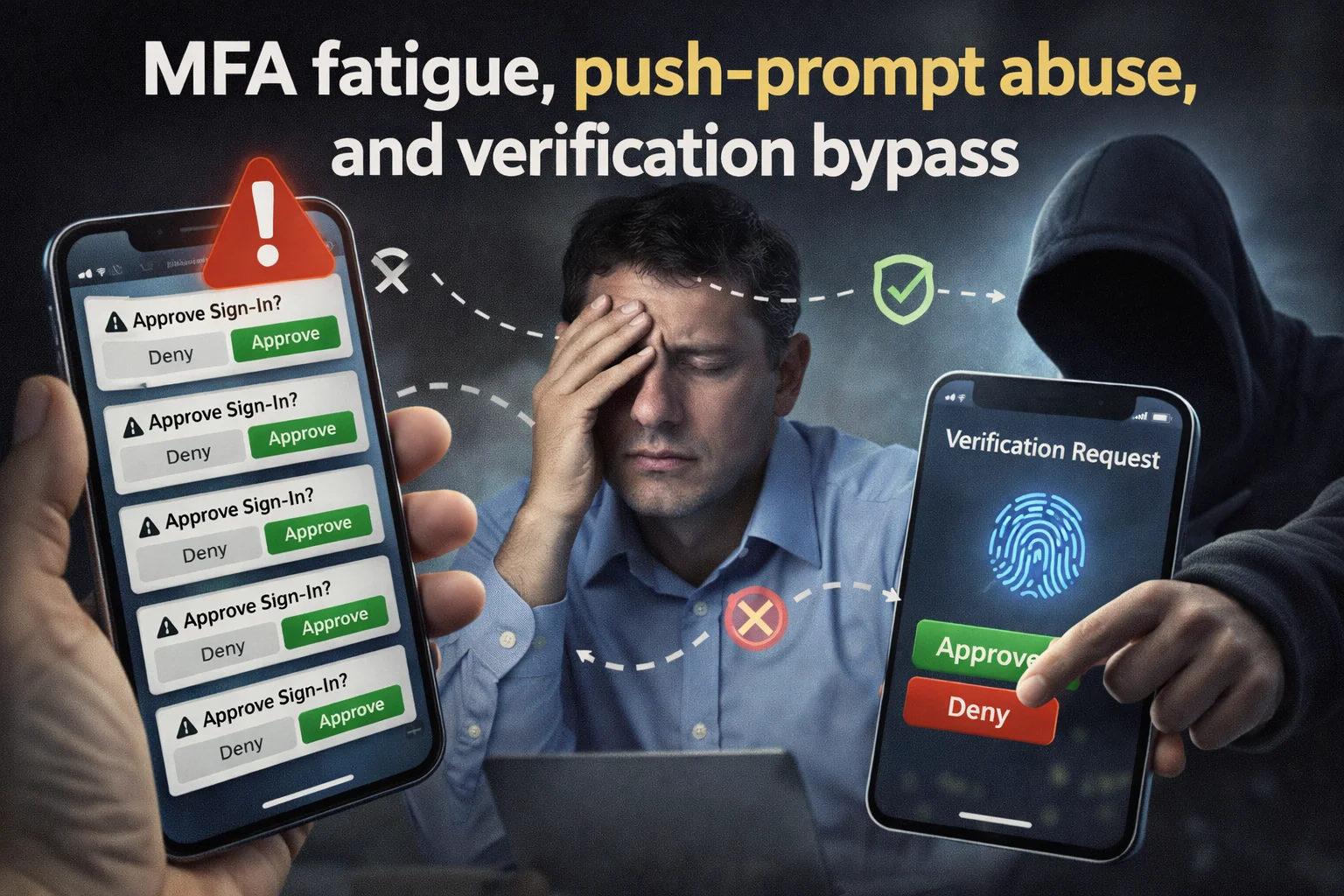
MFA fatigue, push-prompt abuse, and verification bypass
Multi-factor authentication raises the bar, but common consumer implementations create new failure modes. Users who receive repeated prompts may accept one just to make the notifications stop. Others can be pushed into “verification loops” during a support scam, where they believe the prompts are part of a legitimate fix. In parallel, attackers increasingly target account recovery flows, which are often weaker than the primary MFA path.
For IT pros, this has two implications. First, user guidance must clearly define when an MFA prompt is expected and when it is a warning sign. Second, recovery processes and helpdesk scripts need the same security attention as the login page.
Session token theft and “logged-in” compromise
One of the most consequential trends for average users is the theft of active sessions rather than passwords. If an attacker can obtain session cookies or tokens, they may bypass MFA entirely because the victim is already authenticated. This is particularly damaging on email accounts, cloud storage, messaging platforms, and creator dashboards where a single takeover can cascade into more victims.
From an IT perspective, this looks like legitimate access from a different device or geography, often followed by rapid changes: new forwarding rules, new recovery emails, new authorized apps, or the export of data. Consumers rarely notice until money is gone or friends start receiving scam messages.
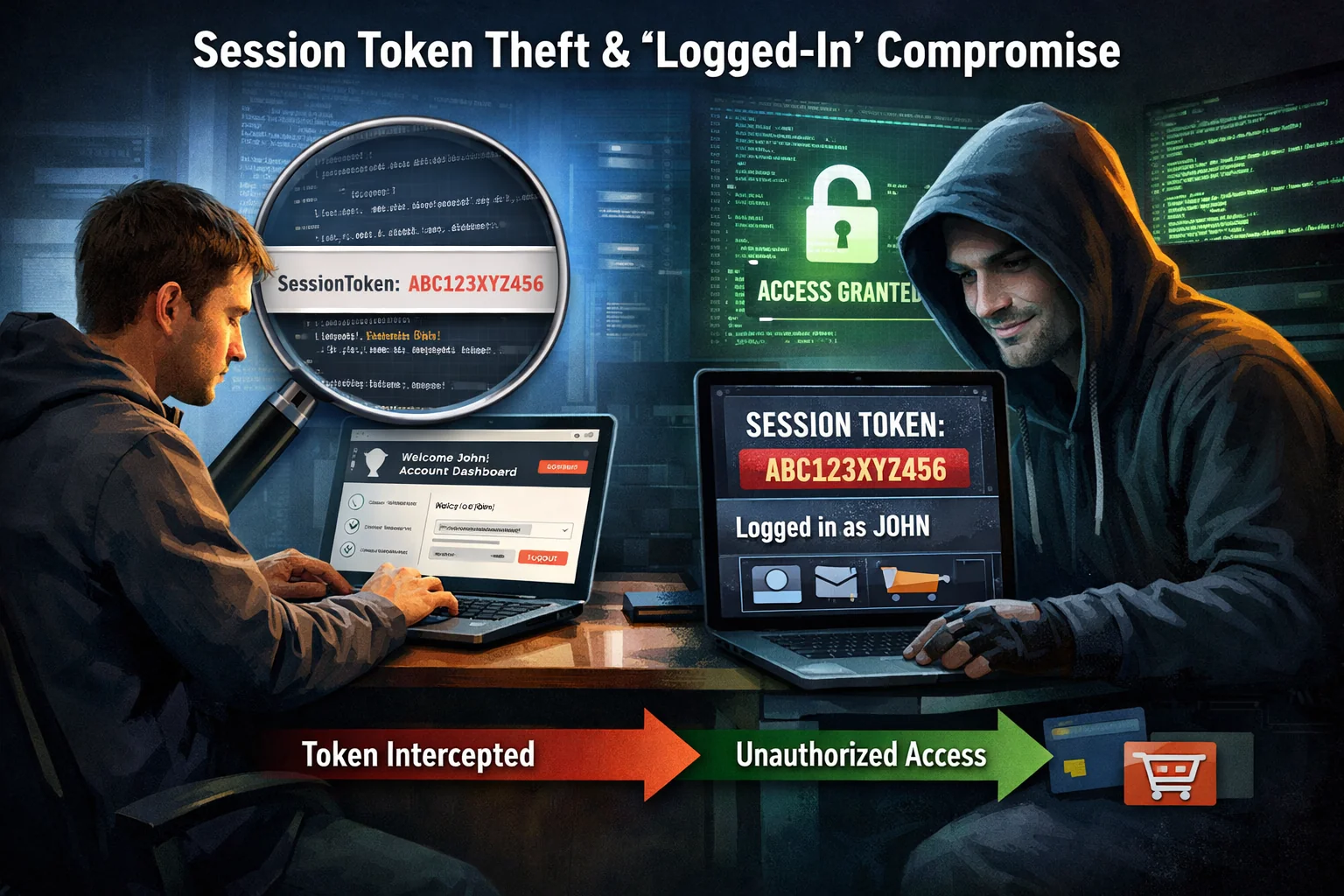
Practical defensive framing: coach users to treat “account settings” as a security dashboard. Many compromises reveal themselves through new sessions, new devices, new rules, and newly connected apps.
Credential stuffing and the long tail of data breaches
Data breaches remain a steady fuel source for consumer harm. Even when passwords are old, people reuse patterns, and attackers automate login attempts across major services. The average user experiences this as unexplained login alerts, locked accounts, fraudulent orders, or drained loyalty points. The “big breach” is not the whole story in 2026—the long tail of recycled credentials is.
For IT professionals, the consumer angle is a reminder that password hygiene messaging alone is not enough. Encourage passkeys where possible, enforce strong rate limiting and bot detection where you own services, and treat breach exposure as an ongoing condition rather than a one-time event.
Malicious and over-privileged browser extensions
Browser extensions are still one of the easiest ways to reach users at scale, because they sit inside the most trusted interface a user has: the browser. In 2026, the biggest risks come from extensions that are acquired by new owners, updated with risky code, or quietly request broader permissions over time. Even “legit” extensions can be problematic when they access everything a user sees and types.
For average users, the result can be credential theft, ad injection, shopping redirection, or data harvesting. For IT teams, the parallel is obvious: extension control policies, allowlists, and “least privilege” permissions matter not just in managed browsers but as general guidance for secure computing.
- Extensions that request access to all sites or read/modify page content broadly.
- “PDF,” “coupon,” “video downloader,” and “productivity” tools with hidden tracking behavior.
- Compromised updates that change behavior after months of being harmless.
QR code scams and mobile-first redirection
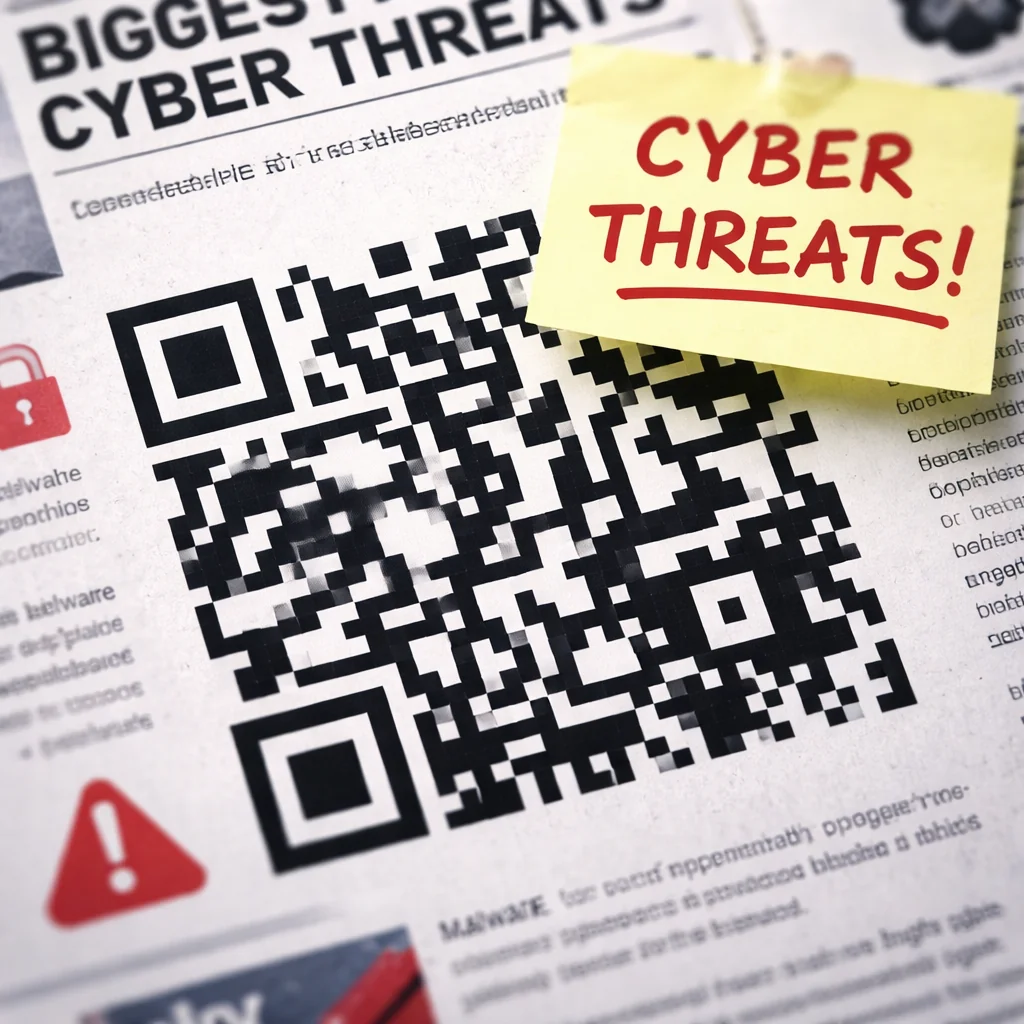
QR codes remain a convenient delivery mechanism for scams because they bypass the user’s visual inspection of a URL and push them onto a phone—where the address bar is smaller, the user is more hurried, and the context is often physical (parking, restaurant menus, events, shipping notices). In 2026, QR-driven attacks frequently funnel users into credential capture, payment pages, or fake support portals.
For IT pros, this is a training opportunity: “scan safely” is a real skill now. Users should be taught to pause, verify the destination, and prefer official apps or typed URLs for sensitive actions.
Customer support impersonation and “helpdesk theater”
Support scams have evolved into slick multi-channel operations: ads, fake support sites, caller ID spoofing, chat widgets, and scripted “verification.” The average user’s risk is highest when they are already stressed—locked out of an account, facing a suspicious charge, or receiving alarming notifications. Scammers exploit urgency and the expectation that “support will guide me.”
For IT professionals, the broader lesson is process design. Secure support workflows are a product feature, and consumer education should emphasize official entry points, not phone numbers found via search results or ads.
Mobile malware, risky sideloading, and “utility app” traps
Smartphones remain the primary computing device for many users, which makes them the primary fraud device too. In 2026, risk concentrates around unofficial app sources, “free” utilities, modded apps, and apps that request excessive permissions. Even without describing attacker techniques, the defensive reality is simple: apps with broad access can become surveillance tools, steal sensitive information, or enable account takeover through notification or accessibility abuse in some ecosystems.
For IT teams, mobile security guidance should be explicit and practical: install from official stores, review permissions, remove unused apps, and keep OS updates current. If your environment supports it, extend modern endpoint thinking to mobile devices.
Financial fraud: instant payments, card-not-present, and account linking
The average user’s biggest tangible losses often come from fraud, not from “hackers taking files.” Faster payment rails and frictionless linking between services increase convenience and reduce the time available to detect scams. Attackers pressure users into quick transfers, exploit stolen account sessions, or abuse newly linked payment methods.
For IT professionals supporting consumers (or designing consumer-facing systems), fraud controls and user warnings are security controls. Notifications, transaction holds for risky patterns, strong device binding, and clear recovery paths reduce harm more than generic “be careful” advice.
Account takeover of social platforms and the “trusted friend” blast radius
Social and messaging accounts are high-value because they provide ready-made trust. Once an account is hijacked, attackers can message the victim’s contacts with believable requests, “emergency” stories, or links that appear safe because they come from someone known. Average users are often both victims and unwitting amplifiers.
For IT pros, this is the consumer version of lateral movement. The defense is layered: strong authentication, monitoring for suspicious session changes, and user education that treats unexpected requests for money or codes as a verification moment, even if the message appears to come from a familiar person.
IoT and smart home exposure: convenience without visibility
Smart devices keep expanding into homes: cameras, doorbells, speakers, TVs, thermostats, and routers with companion apps. The common consumer risk is not Hollywood-style hacking; it’s weak defaults, long-neglected updates, reused passwords, and cloud account compromise that grants remote access. Users often lack a simple inventory of what they own, what’s exposed, and what accounts are linked.
IT professionals can translate enterprise basics into home guidance: update regularly, reduce exposed services, separate guest networks where possible, and prefer vendors with consistent security support lifecycles.
Public Wi-Fi risks and rogue hotspots
Public Wi-Fi remains a risk amplifier because users tend to lower their guard in transit: airports, cafés, hotels, conferences. Even when modern HTTPS reduces some dangers, users can still be routed into malicious portals, tricked into connecting to lookalike networks, or nudged into unsafe “login to continue” flows that steal credentials.
For IT pros, the guidance is consistent: encourage trusted connectivity (cellular when practical), use secure VPN policies where appropriate, and emphasize that authentication should happen only on known official domains or apps.
Ransomware “consumer style”: extortion, cloud data, and personal disruption
While large-scale ransomware headlines tend to focus on enterprises, average users still face extortion scenarios in different forms: loss of access to personal files, cloud storage compromise, and account lockouts that disrupt family photos, important documents, and day-to-day services. In 2026, personal disruption is often the pressure point: users are pushed to pay quickly because they want immediate restoration or fear reputational harm.
For IT professionals advising users, the most effective countermeasure remains resilient recovery: backups that actually restore, account recovery readiness, and the habit of separating critical content from single points of failure.
What IT professionals should emphasize in 2026 user guidance
Security awareness programs often fail when they become a list of scary examples. Average users need simple, repeatable habits that map to real threats. In 2026, that usually means strengthening identity, reducing session persistence, and improving verification around money and account changes.
- Promote passkeys and strong MFA where available, and explain what an unexpected prompt means.
- Make account settings a routine check: sessions, devices, recovery options, forwarding rules, connected apps.
- Normalize “pause and verify” for urgent requests, especially anything involving payments or codes.
- Reduce attack surface by removing unused extensions and apps, limiting permissions, and updating devices.
- Encourage resilient recovery: safe backups, secure password managers, and documented recovery steps.
A practical way to talk about risk without overwhelming users
Users tune out when they feel blamed or when threats seem endless. A better approach is to explain that most modern attacks try to do one of three things: impersonate a trusted party, steal an active login session, or pressure the user into a high-speed decision. If users can spot those patterns, they can interrupt most of the damage.
For IT professionals, that framing also supports better operational outcomes. It aligns user education with what your telemetry and incident response actually see: anomalous sign-ins, suspicious account changes, new app authorizations, and unexpected financial actions. When your messaging matches reality, users report faster and responders act with greater confidence.
Closing perspective: defend the person, not just the device
The biggest cyber threats to average users in 2026 are increasingly “human interface” threats: deception, identity abuse, and session compromise. Devices still matter, but the decisive battlefield is the account, the authentication flow, and the user’s moment-to-moment decisions under pressure. IT professionals who adapt their guidance and controls to that reality will reduce real harm—not just detect more alerts.
- Details
- Written by: IT Pro
- Category: Blog
- Hits: 3562
Ransomware in 2026 is still “ransomware,” but the center of gravity keeps moving. For many organizations, the headline event is no longer just encrypted files and a dramatic ransom note. The more consistent outcome is business disruption: stalled operations, broken identity systems, unreachable applications, and data pushed into extortion pipelines that can outlive the incident itself. The attackers are still motivated by money, still exploiting predictable weaknesses, and still relying on a marketplace of access, tooling, and affiliates. What’s different is the pace, the optionality, and the pressure: threat actors can profit even when encryption never happens, and defenders are increasingly judged on how quickly they can contain impact and keep the organization running.
This article is written for IT professionals who have to translate ransomware risk into systems design, operational discipline, and executive outcomes. It focuses on the shifts that matter for 2026 planning, and the fundamentals that continue to decide whether an intrusion becomes a crisis.
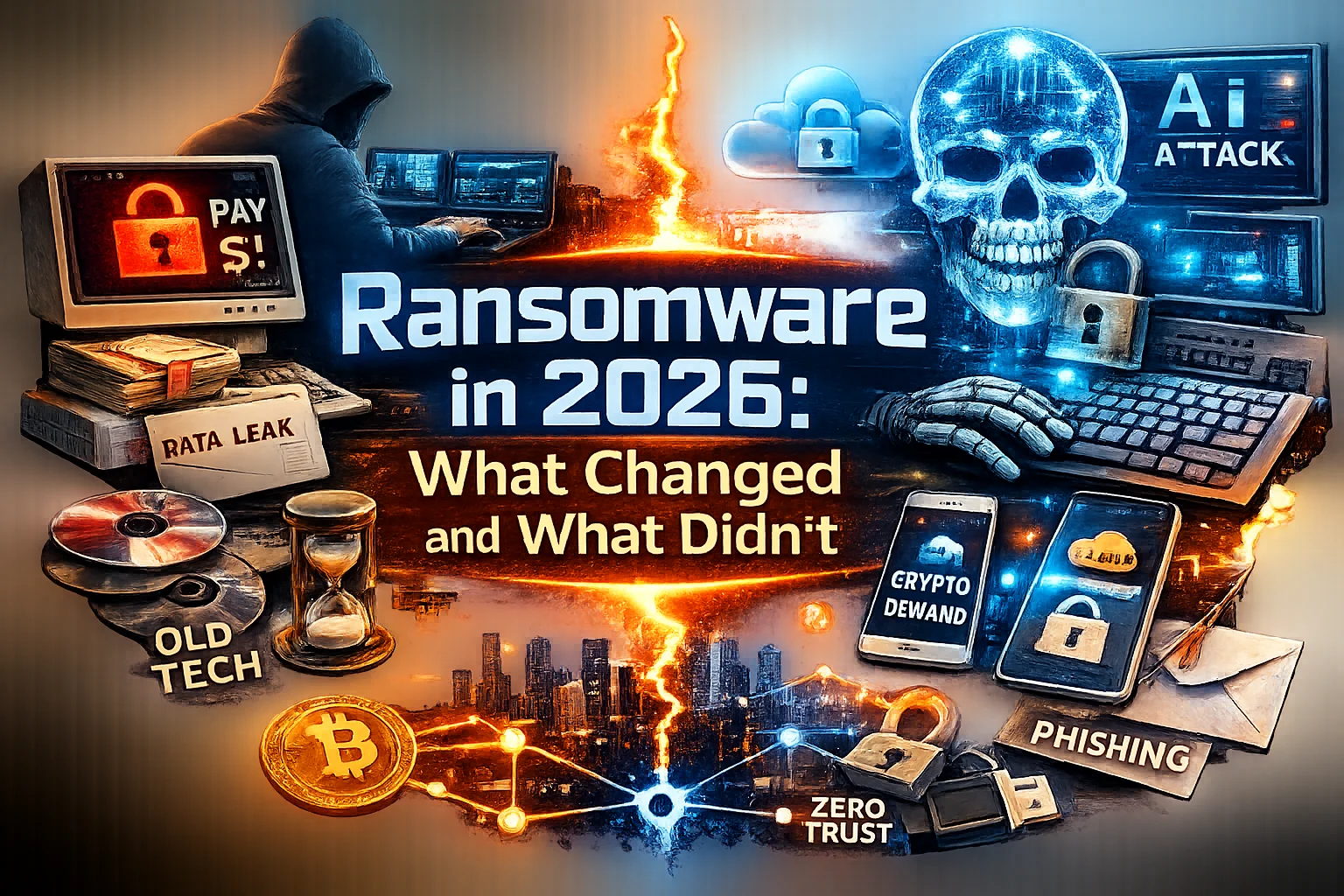
The biggest change: ransomware is now a menu of outcomes
The classic “encrypt everything” play is no longer the only (or even the preferred) route for many crews. Modern campaigns commonly blend multiple pressure points: data theft, disruption, threats to notify regulators or customers, harassment of leadership, and selective destruction that slows recovery. Encryption remains dangerous because it’s visible and immediately painful, but attackers have learned that visibility cuts both ways: loud encryption draws fast response, law enforcement attention, and often a hardened refusal to pay.
In 2026, it’s safer to assume an extortion operation can succeed with partial access. If an actor can steal sensitive data, compromise the identity plane, and demonstrate the ability to interrupt operations, they can negotiate from a position of leverage even if endpoint encryption is blocked. For defenders, this changes the win condition. “We stopped encryption” is not the same as “we stopped the incident.”
The economics shifted: paying became harder to justify, not always less costly
The ransomware economy is under pressure from multiple directions: improved resilience, more organizations refusing to pay, increased tracing and takedowns, and policy proposals that raise the legal and reputational cost of sending money to criminals. Payment volume has shown signs of decline, but “decline” is not “defeat.” Attackers adapt by changing affiliates, switching brands, targeting smaller organizations, or leaning harder on data extortion and operational disruption.
For IT leaders, the practical takeaway is that you should plan for fewer “clean” resolutions. Even when an organization refuses payment and restores from backups, the hidden costs often remain: forensic services, rebuild labor, delayed projects, customer churn, regulatory scrutiny, and the internal morale hit that follows a prolonged outage. Budgeting only for the ransom is an outdated model; budgeting for response capacity and restoration speed is the modern one.
What didn’t change: initial access is still the fulcrum
However sophisticated the endgame looks, ransomware still needs an entry point. In practice, most enterprise incidents are still built on a small set of repeatable access patterns: exploited vulnerabilities, credential theft and reuse, insecure remote access, weak identity governance, and unmanaged or poorly monitored devices. The tooling evolves, but the “why it worked” remains familiar.
That’s why the most effective ransomware programs in 2026 look deceptively unglamorous. They are patching programs that close exposure faster than adversaries can weaponize it. They are identity programs that reduce the blast radius of stolen credentials. They are asset programs that eliminate unknown internet-facing systems. They are operational programs that treat backups like production services and routinely prove recovery works.
Ransomware-as-a-Service matured, then fractured, then matured again
The RaaS model continues because it aligns incentives: core developers provide malware, infrastructure, leak sites, and “brand,” while affiliates bring access and operational tradecraft. Law enforcement disruptions and ecosystem distrust can temporarily fragment the landscape, but market incentives pull it back together. When a major crew is disrupted, it rarely removes demand; it redistributes it. Affiliates migrate. New brands appear. Old codebases re-emerge under new names. The net effect is a churn that complicates tracking, but doesn’t reduce risk.
For defenders, this means IOC-driven “whack-a-mole” can’t be the primary strategy. Your program must assume capability is fungible: if one brand is blocked, another can reuse the same access. The durable controls are those that deny privilege escalation, restrict lateral movement, and make data exfiltration conspicuous and expensive.
Business disruption became the default success metric
Many ransomware operations now measure success by disruption, not just encryption. Disruption may include:
- Identity outages that lock out administrators and users at the worst possible time.
- Virtualization platform impacts that turn one compromise into hundreds of unavailable workloads.
- Backup and recovery sabotage that converts “restore and move on” into “rebuild and pray.”
- Targeting help desks and support workflows to slow containment and create confusion.
- Selective destruction of configuration, scripts, or management planes that are hard to reconstruct.
This is why modern ransomware readiness is a resiliency discipline as much as a security discipline. If your ability to operate depends on a small set of management systems, identity services, and virtualization tooling, then those are not just “IT components.” They are critical infrastructure, and ransomware actors treat them that way.
Identity is the battlefield, and “good enough” MFA isn’t always good enough
Ransomware crews reliably chase admin rights because admin rights collapse time-to-impact. Identity compromise can come from classic phishing and infostealers, from password reuse, from weak service account governance, from help desk social engineering, or from “shadow admin” sprawl that no one owns. Even with MFA, there are common failure modes: legacy protocols that bypass modern controls, poorly governed break-glass accounts, unscoped admin privileges, and stale exceptions created to fix yesterday’s outage.
The 2026 posture shift is to treat identity controls as an engineered system, not a policy statement. That means tightening how privileged access is granted, how it is monitored, and how it is recovered during an incident. It also means assuming an adversary will attempt to subvert your response by attacking the same identity tools you need to fight back.
Practical identity hardening themes that keep paying off:
- Phishing-resistant MFA for privileged users and high-value systems, with a plan to remove legacy authentication paths.
- Tiered administration that separates workstation admin, server admin, and directory/admin plane privileges.
- Just-in-time or time-bound privilege where feasible, with approvals and strong logging.
- Service account lifecycle ownership: rotation, scoping, vaulting, and decommissioning.
- Help desk verification procedures that assume attackers will attempt to “reset their way” into your environment.
The cloud and SaaS reality: ransomware risk followed the data, not the servers
In 2026, many organizations run hybrid operations where core business data lives in SaaS platforms, collaboration suites, cloud storage, and managed services. Ransomware actors don’t need to “own the data center” to create maximum pain; they need to reach the data and the identity layer that governs it.
Two uncomfortable truths drive modern planning:
- Misconfiguration and over-permissioning can make cloud-scale data theft faster than on-prem theft.
- Native retention and recycle bin features are not a full backup strategy, especially under active adversary pressure.
Cloud ransomware readiness looks like visibility, scoping, and recovery:
- Centralized logging and alerting for identity events and large-scale data movement.
- Conditional access policies that reduce risky authentication paths.
- Separation of duties between tenant administration, security administration, and identity administration.
- Immutable or logically isolated backups for SaaS content that matter to the business.
- Recovery drills that prove you can restore the data your executives will demand first.
AI changed the top of the funnel: social engineering is faster, cheaper, and more personalized
AI didn’t magically replace the ransomware playbook, but it amplified the most scalable parts of it: reconnaissance, impersonation, lure writing, multilingual outreach, and persuasion. The practical impact is that more organizations see credible, targeted messages that look internal, match the recipient’s context, and arrive through multiple channels. This increases the odds of credential compromise and reduces the time defenders have to notice and react.
The right defensive posture is less about trying to “spot perfect fakes” and more about making a single compromised user insufficient for catastrophic access. When identity controls, device hygiene, and privilege boundaries are strong, AI-enhanced phishing becomes another noisy signal rather than a guaranteed breach path.
Data theft and leak pressure: plan for the long tail
Data extortion introduces a long tail that encryption alone didn’t always create. Even after restoration, the organization may face ongoing negotiation threats, potential data publication, customer notifications, contract consequences, and brand damage. This is where security and IT need tight alignment with legal, privacy, communications, and executive leadership.
A mature 2026 program treats “exfiltration readiness” as a first-class capability:
- Knowing where sensitive data actually lives, including copies, exports, and “temporary” shares that became permanent.
- Monitoring unusual access patterns and bulk movement, especially from privileged accounts and service principals.
- Token and credential revocation processes that are fast and practiced, not improvised under stress.
- Clear decision pathways for notifications, regulatory obligations, and customer communications.
Recovery became a competitive advantage: resilience is now part of security posture
In 2026, ransomware resilience is judged by “time to contain” and “time to restore,” not just “did we get hit.” Organizations with strong segmentation, protected backups, and rehearsed rebuild paths can turn a major incident into a contained outage. Those without them often experience extended paralysis and cascading failure.
Recovery posture that consistently performs well:
- Backups that are isolated from the identity plane used for daily operations, with immutability where possible.
- Regular restore tests that include the systems you actually need to run the business, not just file shares.
- “Golden path” rebuild playbooks for core services (directory services, virtualization management, remote access gateways, monitoring, ticketing).
- Pre-staged clean admin workstations and emergency access methods that don’t depend on compromised tooling.
- Documented dependencies: knowing what must come up first for everything else to work.
The mindset shift is important: ransomware is not only a security event; it is a continuity event. IT, infrastructure, and application teams are central actors in the outcome.
What changed in defense: disruption tooling improved, but only where fundamentals exist
Endpoint detection and response, managed detection, and automated containment have improved in real-world impact. Many organizations can now disrupt suspicious activity earlier than they could a few years ago. But the “ceiling” of those tools is defined by the environment: unmanaged devices, inconsistent logging, excessive privileges, and fragmented ownership reduce the value of even excellent detection.
For IT professionals, the practical message is that defensive tooling and IT hygiene are coupled. A modern SOC is much more effective when:
- Asset inventory is accurate enough to know what “normal” means.
- Endpoint coverage is broad, including servers, privileged workstations, and remote devices.
- Privileged access is rare, visible, and time-limited rather than ubiquitous and permanent.
- Network paths between tiers are intentional, not historical accidents.
- Logging pipelines remain available during an incident, with an out-of-band way to access them.
Law enforcement pressure and policy proposals changed the risk calculus
Disruptions of major ransomware operations, plus increasing scrutiny around payments and incident reporting, have made the ecosystem less stable for criminals and more complicated for victims. The result is not a “safe” world, but a world where attackers must work harder to maintain trust and cash out, and where victim organizations face more stakeholder questions about decisions made during crisis.
In practical terms, this drives three 2026 requirements:
- Documented decision-making processes for incident response, including who can authorize extraordinary actions.
- Preparedness for rapid reporting expectations and coordination with authorities where appropriate.
- Executive-level alignment on the organization’s stance toward payment and negotiation, before an incident forces the issue.
The 2026 blueprint: a ransomware program that survives reality
A strong 2026 ransomware posture is not a single product or a single project. It is a set of capabilities that reduce the probability of initial access, reduce the blast radius of compromise, and increase the speed and confidence of recovery. If you have to prioritize, prioritize the capabilities that most directly change outcomes during the first hours of an incident.
Core capabilities that repeatedly determine outcomes:
- Exposure management: rapid patching for internet-facing assets, disciplined configuration, and removal of unknown services.
- Identity hardening: strong authentication for privileged access, limited admin sprawl, and clear break-glass governance.
- Segmentation by consequence: isolate identity systems, backup infrastructure, virtualization management, and critical applications.
- Backup integrity: isolated/immutable backups, protected credentials, and frequent restore validation.
- Detection and response: high-confidence alerts on privilege escalation, lateral movement, and bulk data movement.
- Recovery engineering: rehearsed rebuild paths and known dependencies for core services.
- Operational readiness: tabletop exercises that include IT operations, not only security teams.
If your organization has limited capacity, focus on turning the biggest single points of failure into engineered systems. Ransomware attackers love environments where one credential opens every door, where one management system controls every workload, and where one backup admin can be used to delete recovery. Remove those single points of failure and you force attackers into slower, noisier operations.
Metrics that matter to leaders: measure outcomes, not activity
Executives rarely need a list of blocked malware events. They need to know whether ransomware becomes an existential event or a manageable outage. Useful 2026 metrics are those that map to outcome:
- Time to patch critical exposures on internet-facing assets.
- Percentage of privileged identities with phishing-resistant authentication.
- Coverage of endpoints and servers by security telemetry and response tooling.
- Recovery time objective performance in real restore tests for critical systems.
- Time to revoke sessions/tokens and rotate credentials in an emergency workflow.
- Evidence that backup repositories are isolated and protected by separate identity controls.
These metrics create productive conversations. They reveal which investments buy down risk, and which “controls” are merely paperwork.
A realistic closing thought for 2026 planning
Ransomware is still one of the clearest examples of an adversary forcing the business to pay for technical debt in real time. What changed is the flexibility attackers have and the speed at which they can turn small cracks into major disruption. What did not change is that the organizations that fare best are the ones that treat identity, patching, segmentation, backups, and recovery as engineered services—not best-effort tasks.
If you’re building your 2026 roadmap, aim for a posture where a compromise is survivable by design: limited privilege, constrained movement, visible data access, and proven recovery. That’s the difference between a difficult week and a defining disaster.

 11914
11914  IT Pro