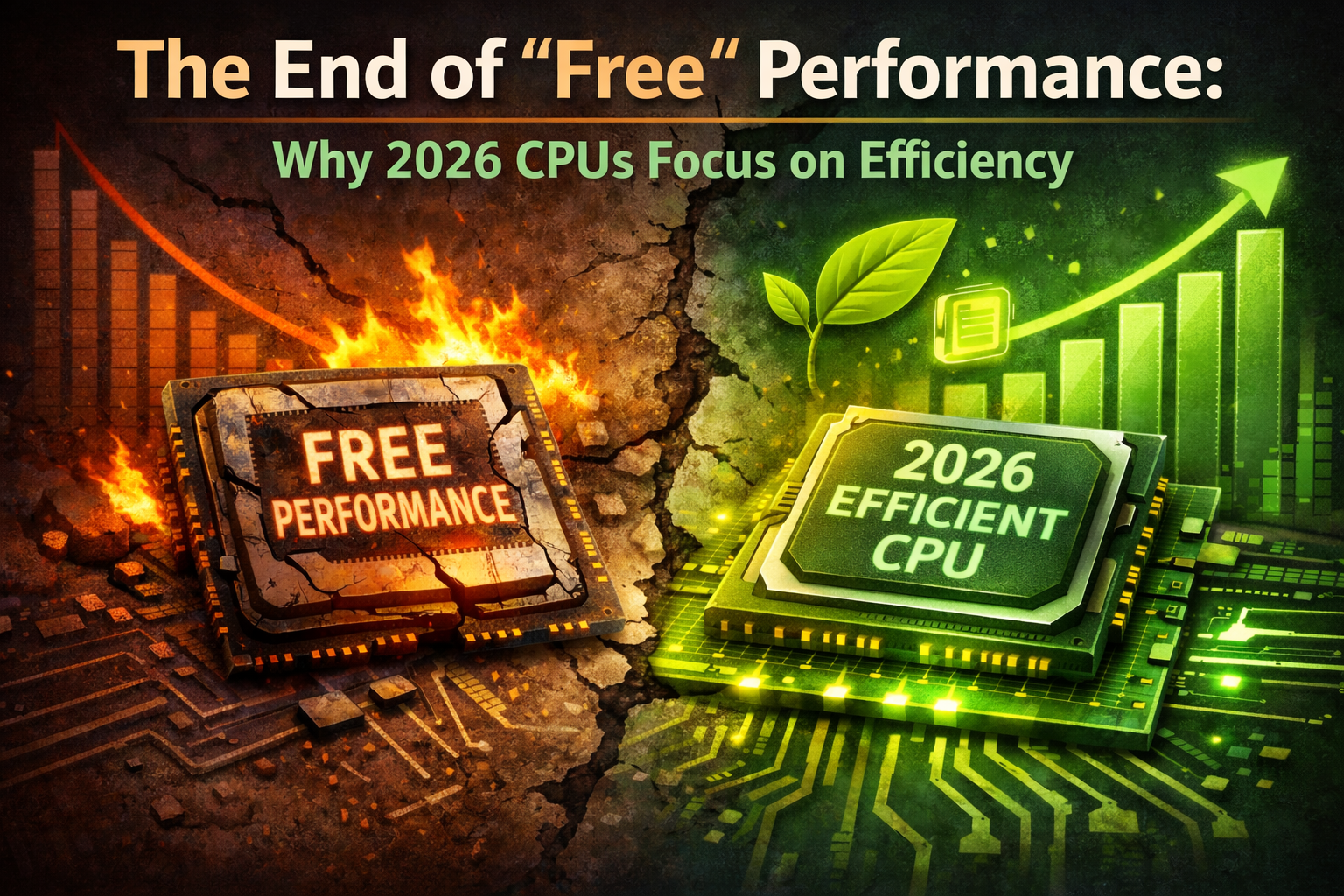
The End of “Free” Performance: Why 2026 CPUs Focus on Efficiency
For years, many infrastructure and endpoint refresh cycles benefited from a quiet assumption: if you waited long enough, the next CPU generation would deliver noticeably better performance at roughly the same power envelope, with little operational drama. Clock speeds crept up, IPC improved, nodes shrank, and “free” performance showed up as lower job times, snappier VDI, and extra headroom for virtualization density. In 2026, that old rhythm feels different. The industry’s headline story is less about raw peak speed and more about the uncomfortable reality of power budgets, thermal limits, platform complexity, and cost-per-watt becoming the primary constraint.
For IT professionals, this shift is not academic. It changes how you evaluate CPUs, how you size capacity, how you tune workloads, and how you justify purchases. Efficiency is no longer a nice-to-have that follows performance. It is becoming the gatekeeper that decides whether performance gains are usable, affordable, and deployable at scale.
Why “Free” Performance Stopped Feeling Free
The phrase “free performance” was never literally free. It meant that within a familiar TDP class and a familiar chassis, you could typically expect a meaningful uplift without needing a redesign of your rack power plan, workstation cooling, or laptop battery expectations. That bargain is breaking down because the easy wins are gone and the constraints are piling up.
Modern CPUs can still deliver impressive peak numbers, but extracting those peaks increasingly requires high boost power, aggressive turbo behavior, and short-lived bursts that are highly dependent on cooling, motherboard settings, firmware policies, and workload shape. In practice, the real-world experience becomes less predictable: two systems with the same CPU model can behave very differently depending on power limits, sustained cooling capacity, and vendor defaults.
At the same time, total platform power is now a front-line concern. The CPU does not live alone. Memory channels, PCIe lanes feeding accelerators and storage, NICs, and increasingly complex motherboard VRMs all compete for power and thermal headroom. Even when a CPU is “within spec,” the overall platform might not be within the reality of your rack, your branch office electrical limits, or your laptop fleet’s battery targets.
Efficiency Becomes the New Performance Multiplier
Efficiency isn’t just about using fewer watts for the same work. In 2026, efficiency is the multiplier that decides how much performance you can actually deploy. If you can run the same workload at lower power, you can increase density, reduce throttling, keep fans and acoustics reasonable, and preserve reliability margins. You also gain something that modern turbo-heavy designs threaten: predictability.
Predictability matters in environments where SLAs, user experience, and batch completion windows drive operational outcomes. A CPU that posts a stunning benchmark spike but collapses into sustained throttling under steady load can be worse than a modest-looking CPU that delivers stable throughput hour after hour. Efficiency-focused designs emphasize sustained, repeatable performance rather than short-lived “hero numbers.”
The most practical framing for IT teams is not “Which CPU is fastest?” but “Which CPU delivers the most useful work per watt within our operational boundaries?” That boundary might be a data center power cap, a remote site UPS budget, a laptop battery life expectation, or even a noise limit in an office full of workstations.
The Thermal Wall Is Now an IT Problem, Not a Silicon Problem
CPU vendors can design advanced boosting algorithms, but they cannot change physics. As power density rises, the ability to move heat out of a small area becomes a limiting factor. That limitation shows up as throttling, unstable boost behavior, and larger differences between “bench results” and “your environment results.”
In the enterprise, this means thermal management is no longer merely a facilities concern. It affects procurement choices, system standardization, and even help desk tickets. If a platform’s performance depends heavily on sustained cooling, then your “identical” fleet might not be identical at all. Dust accumulation, fan curve policies, aging thermal paste, and chassis airflow become performance variables.
Efficiency-oriented CPU behavior reduces how frequently you slam into this wall. Lower sustained power draw means less heat, fewer surprise throttling incidents, and less stress on cooling infrastructure. That can translate into fewer anomalies in monitoring, fewer mysterious “it was fast yesterday” complaints, and fewer situations where firmware updates suddenly change perceived performance because thermal policies were adjusted.
Power Is the New Capacity Constraint in Servers
In many data centers and colocation environments, power is already the constraint that blocks growth. Floor space exists, rack space exists, and procurement budget might exist, but the available watts and cooling capacity do not. When that happens, a CPU refresh isn’t only about more cores or higher IPC. It’s about whether the platform fits into the power envelope you can actually deliver.
This is where efficiency takes center stage. A more efficient CPU can allow you to add density without tripping facility limits. It can also help keep the platform within redundancy margins so that failover events don’t create power spikes that destabilize a rack. For virtualization clusters, it can mean holding more VMs per host while maintaining safe thermal and power behavior during patch windows, reboots, or live migration storms.
Efficiency also influences consolidation strategy. If you can run the same service level with fewer servers, you reduce network ports, switch capacity, cabling, patching overhead, and failure domain complexity. In other words, watts saved at the CPU level often cascade into simpler operations across the stack.
The Laptop and Desktop Reality: Sustained Performance Beats Peak
On the client side, the “end of free performance” looks like this: peak performance is still available, but it may be bounded by battery life, acoustics, skin temperature, and vendor power profiles. Modern laptops can appear incredibly fast for short tasks—opening apps, running a compilation burst, or exporting a small project—then settle into a lower sustained state to protect thermals and battery.
For IT teams managing fleets, the practical question is what users do most of the day. If the workload is steady—software builds, data transforms, local virtualization, heavy browser usage with many tabs, or video conferencing while multitasking— the sustained efficiency curve matters more than the peak headline.
Efficiency-centric designs help deliver consistent responsiveness without turning laptops into jet engines. They also reduce battery degradation pressure by lowering heat and avoiding constant high-power boosting. Over a multi-year lifecycle, that can translate into fewer premature battery replacements and a better experience during the latter half of the deployment.
Heterogeneous Cores and Smarter Scheduling Become Operational Levers
A major part of the efficiency push is architectural: using different kinds of cores and smarter scheduling to match work to the most appropriate execution resources. The high-level promise is simple: run background, bursty, or lightly-threaded tasks on energy-efficient cores and reserve the high-performance cores for latency-sensitive or heavy jobs.
For IT professionals, the key implication is that performance is increasingly a collaboration between silicon, firmware, OS scheduling, and workload behavior. You may see different results depending on OS versions, power plans, security settings, virtualization layers, and application thread models. The same CPU can feel fantastic in a well-tuned environment and oddly inconsistent in a misconfigured one.
This is not a reason to avoid these platforms. It is a reason to treat CPU selection as a platform decision rather than a single-component decision. Validation should include representative workloads, typical security baselines, and the exact OS versions you plan to deploy. Efficiency-focused CPU generations reward organizations that test like they operate.
What Efficiency Means for Virtualization and Cloud Cost
In virtualized environments, the difference between “fast” and “efficient” often shows up in contention scenarios. When CPU resources are oversubscribed, a platform that can sustain higher performance within a stable power envelope tends to deliver better tail latency and fewer “noisy neighbor” surprises. Efficiency reduces the risk of sudden frequency drops that turn a transient load spike into a user-visible incident.
In cloud and hybrid models, efficiency can be translated into cost language. Whether you pay directly for compute or you run your own private cloud, you are ultimately paying for energy, cooling, and capacity. If a workload can complete faster at lower energy or maintain the same throughput with fewer resources, you gain flexibility. You can shrink instance sizes, reduce reserved capacity, or reclaim on-prem resources for new initiatives.
For organizations under sustainability mandates, efficiency also becomes a reporting story. But even without formal ESG goals, power and cooling are now budget line items that behave like hard caps. Efficiency is simply operational realism.
Security and Reliability: The Quiet Drivers Behind Efficiency Choices
Security features have a performance cost, and in 2026 that cost is often absorbed through architectural improvements and efficiency gains rather than brute-force frequency escalation. Modern enterprise baselines include virtualization-based security, memory integrity features, encryption, and increasingly strict isolation policies. These layers can change how a CPU behaves under load, especially in mixed workloads.
Efficiency-focused platforms aim to preserve performance while keeping power and thermals within reasonable limits. That has reliability implications. Running silicon near thermal limits for long periods can accelerate wear in supporting components as well—VRMs, fans, and even the chassis thermal solution. In environments where uptime and lifecycle matter, efficiency is a form of risk management.
For IT teams, the most valuable CPU is often the one that remains consistent across months of patches, driver updates, and security baseline adjustments. Efficiency-oriented behavior tends to provide steadier outcomes when conditions change.
How to Evaluate 2026 CPUs Like an IT Pro
The evaluation mindset needs a refresh. Peak benchmarks still matter, but they should be treated as a capability indicator, not a guarantee of sustained results in your environment. For enterprise validation, you want to measure and compare: throughput per watt, sustained performance at steady-state thermals, and performance consistency under representative mixed loads.
Consider testing with the exact conditions you deploy: your endpoint security stack, your hypervisor configuration, your firmware settings, your standard OS build, and your typical background load. Measure not only average performance but also variance—how wide the swings are between runs and under different thermal states. In many real environments, lower variance is more valuable than a higher peak.
If you operate server fleets, add facility-aware metrics to the evaluation. Track per-host power draw under realistic consolidation loads. Consider whether a CPU generation allows you to keep the same rack power budget while increasing useful capacity. For clients, include acoustics, battery life under real work, and behavior under sustained tasks rather than short benchmarks.
Tuning and Policy: Efficiency Lives in the Details
In 2026, “stock” behavior is often a vendor policy choice, not a universal truth. Power limits, boosting duration, fan curves, and firmware defaults can shift the user experience dramatically. This is especially visible on laptops and prebuilt desktops, but it also matters in servers where OEM profiles and BIOS updates can change sustained behavior.
IT teams should treat these policies as part of standardization. Document baseline power settings, validate after firmware updates, and ensure that performance testing is repeatable. If you manage endpoints, consider whether your power plans align with user roles. A developer laptop, a finance laptop, and a call-center laptop may benefit from different policies—yet all can still prioritize efficiency in ways that improve fleet stability.
In data centers, consider whether you want aggressive turbo behavior at the cost of higher power spikes, or steadier performance that makes capacity planning easier. The right answer depends on workload shape, but the decision should be explicit rather than accidental.
The Business Case: Efficiency as an Enabler, Not a Compromise
Efficiency sometimes gets framed as a consolation prize when raw performance slows down. In practice, efficiency is becoming the enabler that makes performance deployable. A faster CPU that forces a cooling redesign, drives up energy costs, and increases operational variance can be a poor business choice. A slightly less flashy CPU that delivers stable throughput, better density, and lower power draw can produce a better outcome across the lifecycle.
This also changes procurement conversations. The question is less “What’s the fastest SKU?” and more “What’s the best platform for our constraints and workloads?” That can mean focusing on total cost of ownership, power delivery, cooling, chassis compatibility, and long-term reliability. It can also mean prioritizing CPUs that do not force you into constant tuning just to avoid throttling.
For organizations that need to scale compute without expanding facilities, efficiency is not optional. It is the path to growth. For organizations that manage large endpoint fleets, efficiency is the path to consistency, lower support overhead, and better user experience.
What to Expect Next
The industry will keep pushing performance, but the narrative is changing. Expect more focus on performance-per-watt, sustained throughput, smarter power management, and platform-level optimization. Expect CPUs to be evaluated in the context of accelerators, memory, and software stacks rather than as isolated components. Expect IT teams to demand more realistic benchmarks and more transparency about how performance behaves over time.
The end of “free” performance doesn’t mean innovation has stopped. It means the definition of progress is being rewritten. In 2026 avoiding waste—wasted watts, wasted heat, wasted variance—has become one of the most meaningful forms of performance. For IT professionals, embracing this shift leads to better deployments: more predictable systems, more efficient capacity, and fewer surprises when real workloads meet real constraints.
Ultimately, efficiency isn’t a retreat from performance. It’s the strategy that makes performance usable again.


 12977
12977  IT Pro