In a modern conflict, “availability” becomes a strategic asset. When kinetic threats and cyber operations overlap, IT teams inherit a dual mandate: keep services running while assuming that power, connectivity, vendors, and even identity systems can degrade without notice. In a 2026 scenario involving the United States and Iran, risk is not limited to malware or DDoS. It includes real-world disruption that can ripple into your stack through electricity loss, telecom failures, cloud region instability, sanctions constraints, and a surge of influence operations aimed at confusing responders.
This article is written for IT professionals who need a practical, defensive perspective. It does not provide tactical military guidance. Instead, it explains why ballistic-missile range classes matter for infrastructure planning, and how to design operational resilience when “normal conditions” can’t be assumed.
What SRBMs, MRBMs, and IRBMs mean in plain terms
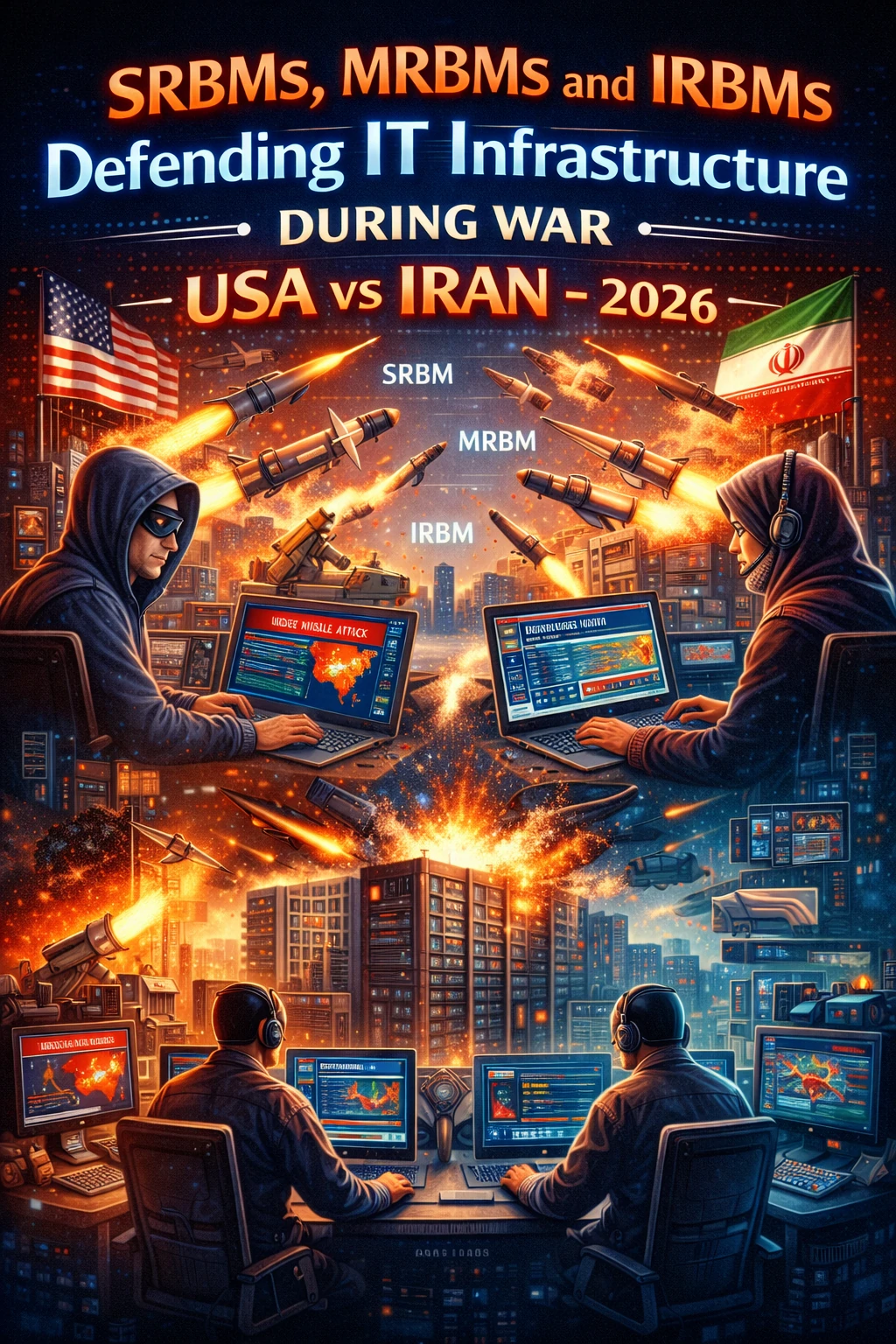
SRBM, MRBM, and IRBM are range categories for ballistic missiles. Definitions vary slightly by organization, but the industry-common framing is: short-range ballistic missiles (SRBMs) measured in the hundreds to roughly one thousand kilometers of maximum range, medium-range ballistic missiles (MRBMs) in the one-thousand to three-thousand kilometer class, and intermediate-range ballistic missiles (IRBMs) in the three-thousand to roughly fifty-five-hundred kilometer class. The details matter less than the operational implication: these ranges define which facilities can be threatened from which launch areas, and how quickly disruption can propagate across regions.
From an IT lens, the key takeaway is not the physics lesson. It’s the planning horizon. Different ranges imply different warning windows, different geographies at risk, and different “blast radius” for downstream dependencies such as power grids, fiber routes, landing stations, satellite uplinks, airports, ports, and logistics corridors that your organization quietly depends on.
Why missile taxonomy matters to IT continuity planning
Many enterprises plan for cyber incidents as if the environment stays stable: power is available, carriers route around issues, and staff can travel. Wartime conditions break those assumptions. Even limited regional strikes can trigger broader effects: rolling blackouts, telecom congestion, partial internet filtering, damaged last-mile facilities, and “just-in-time” parts delays. Your services can fail without being directly targeted.
Missile range categories are a proxy for geographic exposure. If your business continuity design assumes a single “safe” neighboring region, an IRBM-class reach changes the calculus. If your recovery plan assumes staff can physically reach a site, SRBM-class regional volatility can invalidate that. The more your organization depends on a tight cluster of facilities, the more you need to design for geographic independence rather than geographic proximity.
The wartime threat model for IT teams
In a USA–Iran escalation scenario, IT risk typically arrives through multiple channels at once. You should model them as a combined stress test rather than separate incidents:
- Physical disruption to utilities and transit that affects data centers, offices, carrier hotels, and cloud connectivity.
- Cyber operations targeting availability and trust such as DDoS, wiper-like destructive activity, ransomware-as-chaos, and opportunistic exploitation of exposed systems.
- Influence and deception including deepfake voice/video, fake “emergency” change requests, and spoofed vendor communications.
- Supply chain and compliance constraints including sanctions, export controls, payment friction, and abrupt vendor policy changes.
- Human and operational strain including staffing shortages, fatigue, disrupted comms, and leadership pressure for rapid decisions.
The objective is resilience under compound failure: keep “minimum viable operations” alive while preventing a crisis response from becoming the breach vector.
Build for degraded conditions, not perfect recovery
Many recovery strategies assume you can rebuild fast if you have backups. In wartime, rebuilding can be slow because the environment is unstable. You want architectures that continue operating safely in a reduced mode. That means explicitly defining what “essential” looks like: which user groups, which transactions, which APIs, which integrations, and which data freshness requirements you can relax without breaking legal or safety obligations.
A strong pattern is a tiered service model: core identity, core communications, and core transaction systems receive the highest redundancy and the simplest dependencies. Everything else becomes optional or deferred. If you cannot describe your minimum viable operations in one page that a non-technical executive can understand, your organization will improvise under pressure, and improvisation is where security controls are bypassed.
Resilient architecture: geographic independence and dependency pruning
Wartime continuity is less about “multi-region” marketing diagrams and more about dependency realism. Ask two blunt questions: can one region operate without the other, and can you survive if a critical vendor is unreachable?
- Geodiversity that actually isolates failure means separating power grids, carrier routes, DNS providers, and management planes where practical. If your “secondary” rides the same upstream dependencies as your primary, you have a false sense of resilience.
- Multi-path connectivity means at least two carriers, tested failover, and a plan for congestion. Include private connectivity options where possible, but also assume that private links can degrade.
- Local survivability means sites can run safely if WAN is impaired: cached auth where appropriate, local DNS resolvers, local software repos, and offline break-glass procedures that don’t require cloud console access.
- Dependency pruning means removing non-essential third-party scripts, analytics tags, and fragile integrations from critical user flows. In a crisis, fewer moving parts is a security feature.
Backups that survive both ransomware and chaos
In conflict-driven incident waves, ransomware and destructive malware often aim at the same thing: deny recovery. Your backup strategy must assume attackers will try to delete snapshots, steal credentials, and corrupt recovery confidence. Treat backups as a separate product with its own security architecture.
- Immutability and isolation using write-once controls where available, separate admin domains, and minimal standing privileges for backup operators.
- Recovery rehearsals that restore into a clean environment and validate applications end-to-end, not just that files exist. A restore you haven’t tested is a hope, not a control.
- Tiered recovery data including offline copies for crown jewels and “fast restore” copies for essential services. If bandwidth becomes constrained, you need choices.
- Key management continuity ensuring encryption keys and HSM access remain available during outages, with tightly governed emergency access paths.
Identity becomes the frontline: make takeover hard under pressure
Wartime conditions amplify social engineering. Attackers exploit urgency: “emergency access,” “urgent vendor fix,” “security team needs your token,” “CEO approved,” “military situation requires immediate action.” Your best defense is to make the secure path faster than the insecure path.
- Phishing-resistant MFA for privileged roles, with strict device posture requirements where feasible. Reduce reliance on push approvals that can be fatigued.
- Privileged access management that time-bounds admin rights, logs all elevation, and makes “just give me admin” an auditable exception.
- Break-glass accounts that are truly isolated, tested, and governed with crisis procedures that do not depend on a single person or a single communication channel.
- Change control under crisis using pre-approved emergency runbooks, dual control for sensitive actions, and a strict policy on “instructions via chat.”
Network and application resilience: assume hostile traffic and brittle transit
In an escalation, you may see both sophisticated intrusion attempts and loud opportunistic scanning. You also may see “friendly fire” problems: legitimate user traffic spikes, carrier reroutes, and upstream packet loss that looks like an attack. Engineer for clarity and graceful degradation.
- DDoS readiness with tested runbooks, upstream scrubbing where available, and the ability to switch traffic profiles to protect core endpoints.
- Rate limiting and load shedding at the edge and in services, so your systems fail predictable rather than collapse.
- Segmentation so that compromise of a public-facing app does not become lateral movement into backups, identity, or OT networks.
- Patch and exposure discipline focused on internet-facing assets, remote management interfaces, and high-impact vulnerabilities. If it is reachable, assume it will be tested.
OT, facilities, and “invisible IT” that suddenly matters
During conflict, the systems that keep your compute alive become prime failure points: building management systems, generators, fuel logistics, HVAC controls, access systems, cameras, badge services, and even printer fleets that quietly run embedded software. These are often under-inventoried and over-trusted.
The goal is not to turn IT into an industrial control expert overnight. The goal is to make sure facilities can run safely if networks are impaired, and to prevent OT systems from becoming a bridge into enterprise identity and backups. Establish clear boundaries, document manual fallbacks, and ensure that vendor remote access is strictly controlled and monitored.
Incident response that still works when communications are unreliable
A conflict environment forces a shift from “incident response” to “incident response plus crisis management.” You need technical containment, but also executive decision paths, legal review, customer communications, and workforce safety decisions happening in parallel. Adopt a recognized lifecycle model, then harden it for disruption.
Prepare out-of-band communications that do not rely on your primary email and chat platforms. Pre-stage contact trees, vendor escalation paths, and internal authentication for “who is really on the other end.” Decide in advance what you will do if your primary identity provider is down, if your ticketing system is unavailable, or if your cloud console access is impaired.
Tabletop exercises should include uncomfortable constraints: partial power loss, no Slack/Teams, leadership traveling, conflicting information, and a simultaneous legal/compliance requirement. This is where you discover whether your plan is a document or a capability.
Defending trust: deepfakes, spoofed vendors, and “helpdesk theater”
In wartime narratives, attackers target trust as much as they target servers. A spoofed “carrier outage notice” can trick staff into reconfiguring DNS. A deepfake voice can push a rushed payment or credential reset. A fake “emergency patch” can deliver malware through your own change process.
Countermeasures are procedural and technical: verified call-backs using known numbers, signed change requests, strict policies against accepting secrets over phone, and a “two-channel verification” rule for high-impact actions. Make it culturally acceptable for engineers to slow down a risky request, even when executives are stressed.
Sanctions and supply chain reality: security controls can be blocked by policy
In a USA–Iran context, sanctions and compliance measures can affect how you buy services, renew subscriptions, pay vendors, and ship hardware. Even if your organization is far from the region, you can be impacted through third parties, payment processors, and cloud policy enforcement. Your continuity plan should include legal and procurement partners, because “we can’t renew that security service right now” is an operational risk, not just a finance issue.
Keep an updated inventory of critical vendors, contract renewal dates, and regional dependencies. Maintain alternate suppliers for essentials where feasible, and ensure you have access to installation media, license keys, and configuration backups that do not depend on a single portal.
A practical wartime readiness posture for IT teams
The best wartime posture is boring, disciplined, and repeatable. It favors simple architectures, minimized privileges, rehearsed recovery, and clear lines of authority. It assumes that you may need to operate safely while partially disconnected and under sustained pressure.
- Align leadership on “minimum viable operations” and document what gets degraded first.
- Validate that backups are immutable, isolated, and restorable into a clean environment.
- Reduce privileged standing access and enforce phishing-resistant authentication for admins.
- Stress-test your dependency chain: DNS, IdP, cloud console access, carriers, and SaaS control planes.
- Prepare out-of-band comms and verified call-back procedures for high-risk requests.
- Segment networks so public-facing compromise cannot reach backups, identity, or OT systems.
- Run crisis-oriented tabletop exercises with realistic constraints and decision pressure.
Closing perspective: resilience is a security outcome
SRBMs, MRBMs, and IRBMs are military terms, but their practical meaning for IT is about geography, timing, and cascading failure. In a 2026 USA–Iran wartime scenario, infrastructure disruption and cyber activity can arrive together, and the organizations that cope best are the ones that already engineered for uncertainty. When you can keep core services stable under stress, you reduce the payoff of attacks, limit operational panic, and protect decision-making when clarity is hardest to find.

 13003
13003  IT Pro