Wi-Fi 7 is the industry name commonly used for IEEE 802.11be (often described as “Extremely High Throughput”). For IT professionals, Wi-Fi 7 is less about a single headline speed number and more about how the new PHY/MAC features change capacity planning, latency behavior, roaming stability, and what “goodput” looks like in real buildings. If you manage enterprise WLANs, campuses, healthcare networks, warehouses, or high-density offices, Wi-Fi 7 introduces design choices that are genuinely new, not just incremental.
Wi-Fi 7 deployments succeed when you treat it as a full stack change: RF design, wired uplinks, switching capacity, PoE budgets, client support, and operations tooling all matter. “Buying Wi-Fi 7 APs” is rarely the whole project.
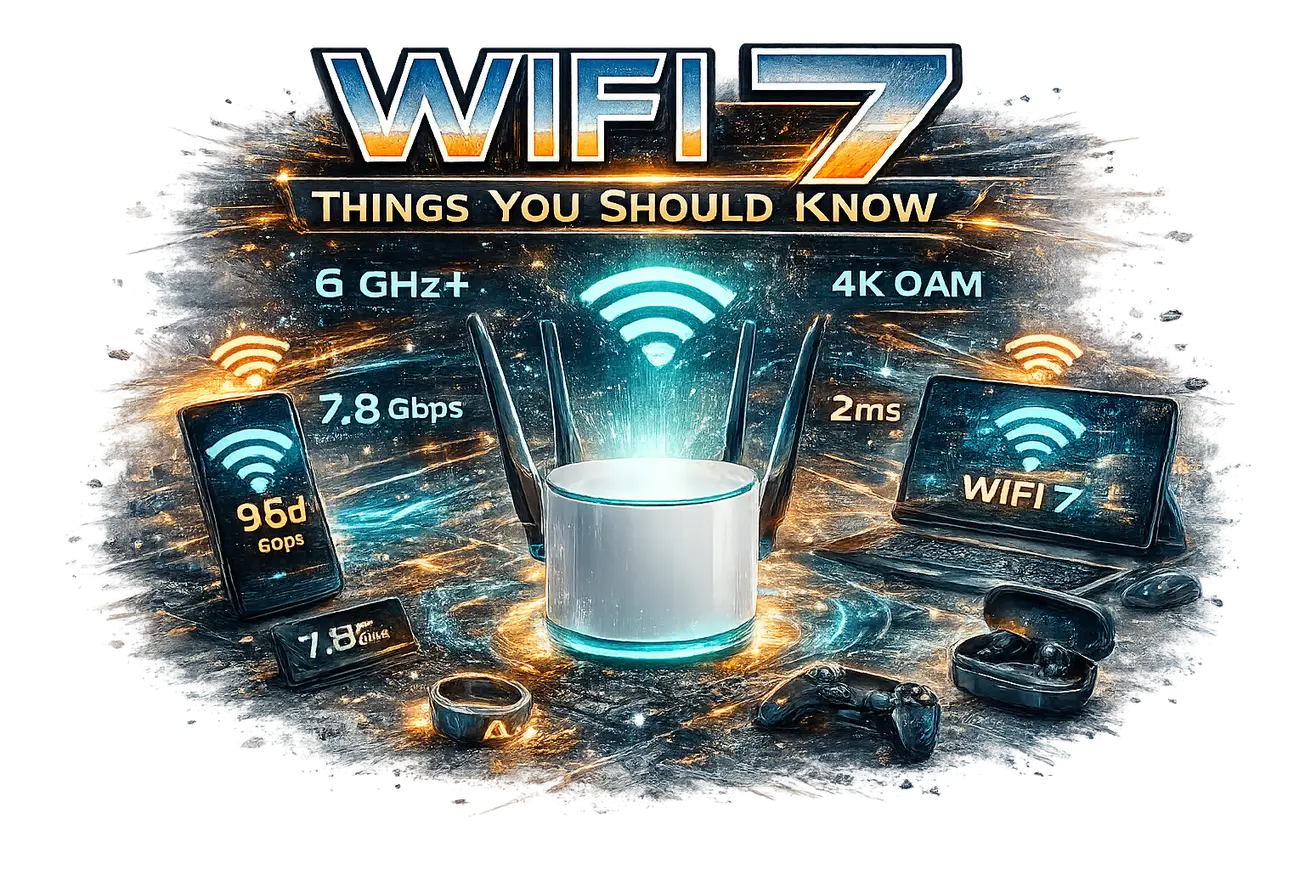
What Wi-Fi 7 Actually Changes for Enterprise WLANs
Wi-Fi 7 builds on Wi-Fi 6/6E concepts like OFDMA and MU-MIMO, but extends them with capabilities that can change how traffic behaves under contention. In practical terms, the big shifts are:
- Better spectrum utilization through wider channels where available, plus smarter handling of interference.
- Multi-link operation that can reduce latency spikes and improve resilience when one band is noisy.
- Higher peak modulation under ideal RF conditions, which helps short bursts, high-rate clients, and uplinks.
- More flexible resource scheduling that can improve efficiency in mixed client populations.
The result is not a guarantee of “multi-gig everywhere,” but a toolkit that can raise the ceiling and, more importantly, make the floor less painful when environments get busy.
Wi-Fi 7 Bands and the Reality of 2.4 GHz, 5 GHz, and 6 GHz
You still operate in the same three band families as modern enterprise Wi-Fi: 2.4 GHz for legacy and reach, 5 GHz as the workhorse, and 6 GHz (introduced broadly with Wi-Fi 6E) as the cleanest spectrum where regulations allow. Wi-Fi 7 is designed to take advantage of all of them, but your outcome depends on your RF environment and regulatory domain.
- 2.4 GHz remains congestion-prone and narrow. It can still be useful for IoT, but is typically not where you “feel” Wi-Fi 7.
- 5 GHz is widely supported and can deliver strong results with proper channel planning, DFS awareness, and clean RF.
- 6 GHz is where the biggest benefits show up, especially for wide channels and lower interference—assuming clients support it.
In many enterprises, Wi-Fi 7’s success is proportional to 6 GHz adoption. If your client fleet is mostly 5 GHz-only, you can still gain from Wi-Fi 7 features, but you’ll typically see more “capacity and consistency” than “headline speed.”
Multi-Link Operation: The Feature IT Teams Will Actually Notice
Multi-Link Operation (often shortened to MLO) is a flagship Wi-Fi 7 capability. Conceptually, it allows a compatible client and AP to use multiple links (often across different bands) in a coordinated way. That coordination can be used for different goals, depending on vendor implementation and client behavior:
- Lower latency and fewer spikes by steering time-sensitive frames over the cleaner link in the moment.
- More resilient connectivity when a single channel experiences interference or DFS events.
- Higher throughput in scenarios where traffic can be distributed efficiently.
For operations teams, the most valuable effect can be the reduction of “mystery lag” complaints, where a client is technically connected but experiences periodic stalls due to contention, interference, or band transitions. MLO can help smooth those edges, but only when both sides (AP and client) support it well.
320 MHz Channels: Powerful, Situational, and Often Misunderstood
You will hear a lot about Wi-Fi 7 supporting 320 MHz channels, which is essentially “twice the width” of the 160 MHz channels used in high-end Wi-Fi 6/6E designs. Wider channels can increase peak throughput, but they also change your RF planning math:
- Wider channels reduce the number of non-overlapping channels, which can hurt reuse in dense deployments.
- Wider channels can be more sensitive to interference because there’s more spectrum that could be impacted.
- Wider channels can be great in low-density or targeted high-capacity zones, like auditoriums, labs, and media production areas.
In enterprise networks, 320 MHz is often best treated as a design option for specific areas rather than a global default. In many offices and campuses, well-planned 80 MHz (and sometimes 160 MHz) can deliver more consistent results through better channel reuse.
4096-QAM: What It Means and Why It Doesn’t Magically Fix Bad RF
Wi-Fi 7 increases the maximum modulation scheme commonly discussed in marketing to 4096-QAM (often written as 4K-QAM). Higher modulation can increase data rate in the same channel width, but it requires very clean RF conditions: strong signal, low noise, low interference, and stable multipath handling.
The practical translation for IT teams is straightforward: if your environment is already engineered well, Wi-Fi 7 can reward you with more performance headroom. If your environment is noisy, oversubscribed, or poorly planned, higher modulation won’t be reachable consistently, and your users will experience “normal Wi-Fi” behavior regardless of the AP label.
Puncturing and Smarter Use of Imperfect Spectrum
Real RF is messy. A channel may be mostly clean but impacted by a narrower interference source. Wi-Fi 7 improves the ability to “work around” parts of spectrum that are temporarily unusable, rather than abandoning the entire channel width. This can improve throughput stability, especially in environments where occasional interference is unavoidable.
For IT pros, the operational benefit is subtle but important: better sustained performance under imperfect conditions, and fewer scenarios where capacity collapses because one sub-region of a wide channel is contaminated.
Capacity vs Speed: How to Set the Right Expectations Internally
Stakeholders love peak numbers, but your job is usually to deliver predictable application performance. Wi-Fi 7 can raise peak throughput substantially in ideal cases, but enterprise success is measured by: client concurrency, roaming reliability, VoIP/video stability, and median throughput at the edge of the cell.
A useful way to frame Wi-Fi 7 in internal planning discussions is:
- Speed is what a single high-end client gets near an AP under light load.
- Capacity is what hundreds of clients get across a floor under heavy load.
- Consistency is whether critical apps behave the same at 9 AM as they do at 3 PM.
Wi-Fi 7’s strongest story in many enterprises is improved consistency under load, especially when combined with 6 GHz and a modern client fleet.
Wired Network Impacts: Uplinks, Switching, and PoE Considerations
Wi-Fi 7 can expose weak spots in the wired layer faster than earlier generations. If your access layer and uplinks are designed around older AP throughput profiles, you may see bottlenecks. Common wired considerations include:
- Multi-gig Ethernet ports on APs (2.5G/5G, sometimes higher) to avoid a 1G uplink ceiling.
- Switch backplane and uplink capacity to ensure aggregation doesn’t become the choke point.
- PoE budgets because higher-end APs can draw more power, especially with multiple radios and advanced features enabled.
- Cabling quality to reliably support multi-gig over existing copper runs.
A common enterprise pitfall is purchasing Wi-Fi 7 APs and connecting them to 1G ports with limited PoE headroom, then blaming “Wi-Fi 7” when performance does not match expectations. Validate the wired design early.
Client Reality: Your WLAN Is Defined by the Slowest Common Denominator
Wi-Fi is a shared medium. Even with advanced scheduling, client diversity matters. In many environments, older clients still represent a meaningful fraction of the fleet, and they can influence airtime usage. For planning, focus on:
- Which client OS versions and chipsets your organization actually runs.
- Support for 6 GHz across corporate devices, BYOD, and specialized equipment.
- Driver maturity, especially early in new Wi-Fi generations where vendor tuning continues.
- Application sensitivity to latency, jitter, and packet loss, not just throughput.
If you are building a refresh plan, consider pairing Wi-Fi 7 upgrades with a client lifecycle strategy so the network can actually use the features you’re paying for.
Security and Policy: WPA3, Enterprise Auth, and Segmentation Still Matter
Wi-Fi 7 does not replace your security architecture. The fundamentals remain: strong authentication, segmentation, least privilege, and continuous monitoring. Most modern enterprise Wi-Fi 7 platforms continue to support WPA3-Enterprise, 802.1X/EAP methods, and policy enforcement models you already use.
Areas where many organizations can improve during a Wi-Fi 7 refresh include:
- Revisiting SSID sprawl and consolidating where possible for operational clarity.
- Strengthening NAC posture for unmanaged devices and IoT.
- Ensuring management plane security for controllers, cloud dashboards, and API integrations.
- Auditing legacy encryption and fallback modes that linger for “compatibility” longer than they should.
Roaming and Real-Time Apps: Voice, Video, VDI, and Collaboration Platforms
Many WLAN teams are judged by how collaboration apps behave while users move. Wi-Fi 7 can help, but roaming remains a multi-variable outcome: RF design, cell sizing, minimum data rates, client roaming aggressiveness, and authentication overhead all play roles.
If voice and real-time collaboration are critical in your environment, validate:
- AP density and transmit power strategy to avoid oversized cells that cause sticky clients.
- Minimum supported rates to reduce legacy airtime drag, balanced against coverage requirements.
- QoS configuration end-to-end, including WMM mappings, wired QoS, and WAN behavior.
- Roaming optimizations supported by your infrastructure and client OS, especially where fast transitions are used.
Treat Wi-Fi 7 as an opportunity to re-baseline your “real-time readiness” posture rather than assuming the new standard alone fixes roaming pain.
Design Strategy: Where Wi-Fi 7 Shines and Where It’s Overkill
Wi-Fi 7 can be a strong fit when your constraints are capacity, latency spikes, high-density concurrency, or next-gen application demands. It may be less impactful when constraints are coverage in challenging buildings, old client fleets, or heavily congested spectrum with no room to improve.
Environments where Wi-Fi 7 tends to deliver obvious value include:
- High-density offices with heavy collaboration traffic and high client concurrency.
- Education and campus networks where roaming and density are constant challenges.
- Warehouses and logistics where interference and device diversity are common.
- Healthcare where real-time apps and predictable performance matter.
- Media production and engineering where large file transfers and low latency workflows coexist.
Conversely, if your biggest pain is “coverage holes behind concrete” or “RF is polluted by neighboring tenants,” your investment may be better spent first on RF remediation, additional AP placement, directional antennas, or spectrum management.
Operational Readiness: Monitoring, Troubleshooting, and Visibility
As Wi-Fi gets faster and more complex, troubleshooting becomes more about visibility than guesswork. For Wi-Fi 7 rollouts, it’s worth planning operational tooling and baselines as part of the project:
- Client telemetry for RSSI/SNR, retransmits, MCS distribution, roaming events, and band selection behavior.
- RF visibility via spectrum analysis, interference classification, and channel utilization trends.
- Application-aware monitoring for real-time platforms and business-critical SaaS.
- Firmware and driver management processes that allow safe, staged updates and rollback plans.
Early Wi-Fi 7 ecosystems may show wider variability between client drivers and AP firmware revisions than mature Wi-Fi 6 ecosystems. Operational success often depends on disciplined update practices and clear baselines.
Procurement Checklist: What to Validate Before You Buy
Wi-Fi 7 purchasing is easiest when you tie requirements to measurable outcomes. Consider validating these areas in a lab or pilot:
- Client mix compatibility with your real device fleet, not a vendor demo laptop only.
- 6 GHz behavior in your regulatory domain and typical building materials.
- Multi-gig uplink needs and whether switching upgrades are required.
- PoE requirements with your feature set enabled, including USB ports or additional radios if present.
- Management model that fits your security posture: cloud-managed, controller-based, or hybrid.
- Observability features that help your team troubleshoot quickly.
- Lifecycle and support commitments that align with enterprise refresh schedules.
Migration Approach: How to Roll Out Wi-Fi 7 Without Chaos
A controlled migration typically beats a rushed “big bang,” especially in environments that include IoT, scanners, medical devices, or embedded clients with slower refresh cycles.
A practical rollout approach often looks like:
- Pilot in a representative area that includes typical client density and interference patterns.
- Validate critical apps during peak usage windows, not just during a quiet test.
- Measure wired bottlenecks under load to avoid hidden uplink constraints.
- Stage firmware and policy changes with clear rollback options.
- Expand in rings while monitoring support tickets, roaming behavior, and performance metrics.
The goal is to make Wi-Fi 7 a reliability project as much as a performance project.
Common Myths That Cause Bad Wi-Fi 7 Decisions
Wi-Fi marketing tends to compress complexity into one number. In enterprise practice, that’s risky. Here are misconceptions that frequently lead to disappointment:
- “Wi-Fi 7 means everyone gets multi-gig speeds.” Real outcomes depend on RF conditions, client capabilities, and channel reuse.
- “Wider channels are always better.” In dense deployments, reuse and stability can outperform maximum channel width.
- “New APs fix legacy clients.” Older clients still consume airtime and may not benefit from advanced features.
- “The wireless is slow.” Many “Wi-Fi” complaints are actually DNS, WAN, identity, or application-layer issues.
What to Document for Change Control and Long-Term Success
Enterprise Wi-Fi is easier to run when decisions are documented. During a Wi-Fi 7 project, capture the “why” behind design choices so future teams can maintain consistency:
- Band strategy per site and device class, including any restrictions for IoT or legacy.
- Channel width policy and where wider channels are allowed or avoided.
- Power and cell sizing rationale to prevent accidental drift over time.
- QoS mappings and app assumptions.
- Security posture including authentication methods, segmentation, and guest access controls.
- Baseline KPIs such as roaming success rate, median throughput, packet loss, and helpdesk ticket trends.
Bottom Line for IT Professionals
Wi-Fi 7 is a meaningful evolution, especially when paired with 6 GHz and a modern client fleet. Its strongest enterprise value typically shows up in better efficiency, fewer performance cliffs under load, and improved behavior for latency-sensitive work. But it also raises the bar for design discipline and makes it easier for wired bottlenecks, PoE limitations, and client diversity to show up as “wireless problems.”
If you treat Wi-Fi 7 as an end-to-end upgrade—RF, wired, clients, and operations—you can build a WLAN that feels less fragile, scales more cleanly, and supports the next wave of enterprise applications with fewer compromises.

 12977
12977  IT Pro