- Details
- Written by: IT Pro
- Category: Blog
- Hits: 5431
Introduction
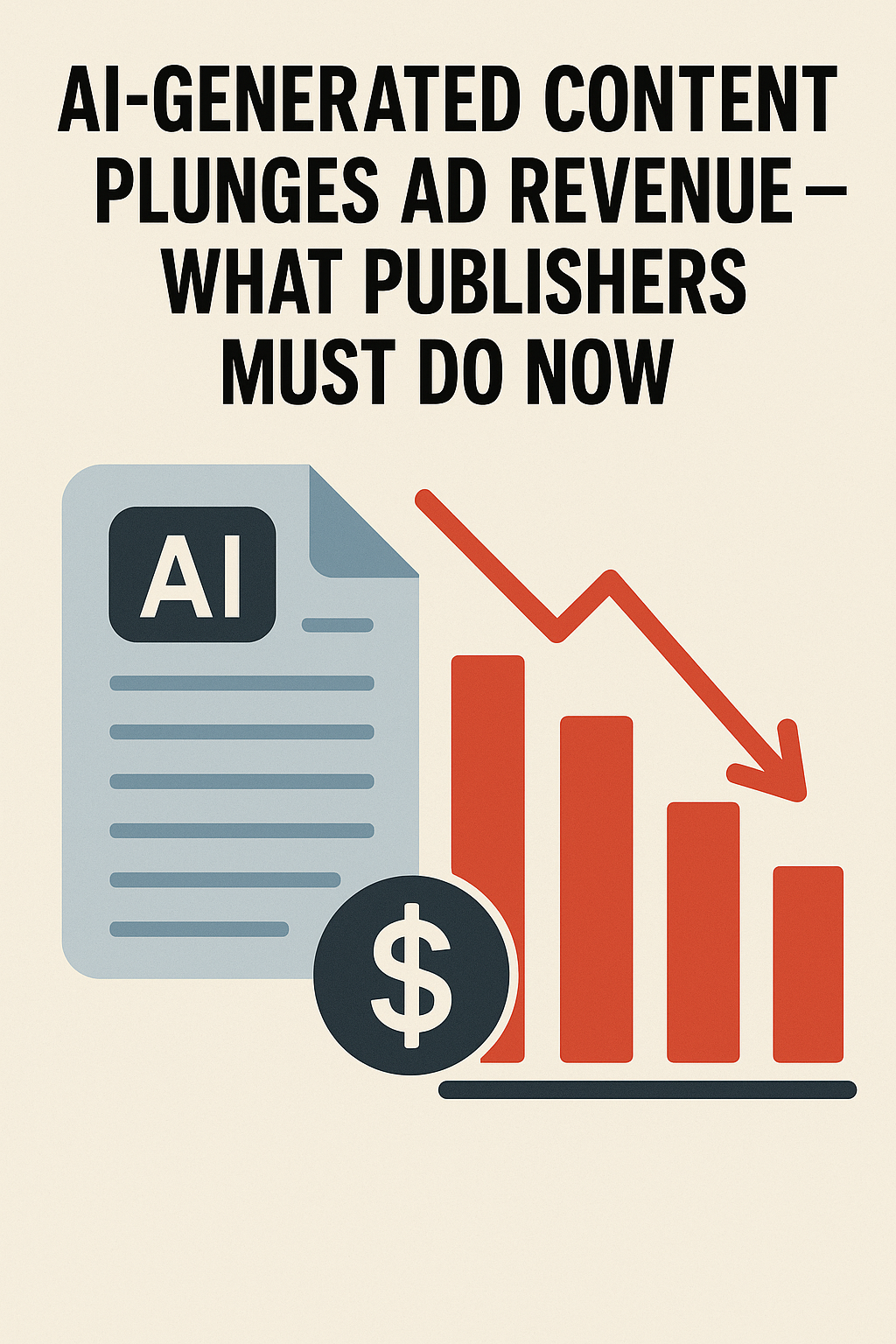
For the past decade, the digital publishing economy has operated on a straightforward principle: traffic fuels ad revenue, and content fuels traffic. But that model is rapidly being disrupted. Generative AI tools, search-engine summaries, and chatbot-driven information delivery are increasingly giving users the answers they want without sending them to publisher websites.
The downstream effect: declining pageviews, shrinking impressions, lower CPMs, and widespread revenue pressure. While this shift has happened quickly, its impact will likely endure. Publishers must adapt — aggressively and strategically — to preserve audience reach and revenue in the years ahead.
Why ad revenue is plunging
AI summaries reduce click-throughs
Search engines and AI assistants are now presenting answers directly — often summarizing publisher content. When users get information without clicking, pageviews drop. Fewer visits means fewer impressions and weaker ad yield.
Massive growth in low-quality content supply
AI makes content production drastically faster and cheaper. This causes:
-
Oversupply
-
Lower content differentiation
-
Fierce competition for visibility
-
Lower CPM and eCPM averages across the market
Advertisers have more inventory to choose from — which pushes prices down.
Platforms becoming the gatekeepers
Publishers no longer control the channel between content and audience.
Search engines, AI chatbots, aggregation feeds, social platforms — increasingly control:
-
Discovery
-
Reach
-
Attention duration
This weakens publishers’ leverage and negotiating power.
Advertiser trust declines when quality declines
The rise of low-effort AI-generated articles has created:
-
More misinformation
-
Lower user engagement
-
Brand-safety concerns
All of which suppress ad demand and ad pricing.
What publishers must do now
Below is a strategic roadmap designed for any digital publisher looking to survive the current disruption.
1. Shift to differentiated, high-value content
The generic, shallow, mass-produced article era is collapsing.
Publishers must focus on:
-
Expertise
-
Insights
-
Original research
-
Interviews
-
Long-term reporting
-
Investigations
-
Commentary
-
Data-driven analysis
Content must provide depth AI summaries cannot fully replace.
2. Diversify revenue streams beyond programmatic ads
Over-reliance on display ads is dangerous.
Publishers should explore:
-
Memberships / subscriptions
-
Paid newsletters
-
Exclusive content tiers
-
Licensing models
-
Sponsored content (transparently labeled)
-
Events / webinars / online courses
-
Digital products
-
Affiliate partnerships
The goal: revenue resilience.
3. Strengthen direct audience relationships
Dependence on external platforms is risky.
Publishers should aggressively build:
-
Direct visits
-
Email lists
-
Push-notification opt-ins
-
Social community presence
-
Repeat readership
-
Loyal audience habits
Direct access is the antidote to losing platform referral traffic.
4. Optimize for the new search + AI environment
Publishers should adjust strategies to the reality that AI summaries will coexist beside their links.
Actions include:
-
Auditing traffic drops by content type
-
Improving structured data & schema markup
-
Increasing unique value per article
-
Creating deeper connected content hubs
-
Designing content where summaries trigger curiosity instead of satisfying it
AI will scrape the surface — publishers must own the depth.
5. Protect and monetize intellectual property
Publishers need to treat their content as valuable property — not disposable fuel.
Critical steps include:
-
Clear licensing language
-
Enforcement of usage terms
-
Tracking unauthorized scraping
-
Negotiating licensing opportunities where possible
-
Watermarking premium data/reports
-
Paywalling exclusive material
-
Negotiating compensation deals when platforms use or summarize content
Protect first — monetize second.
A 6-month action roadmap
Month 1–2
Audit & Strategize
-
Identify traffic declines
-
Evaluate monetization weak points
-
Define premium content opportunities
Month 3–4
Diversify Revenue
-
Add subscription or paid features
-
Launch or expand a newsletter strategy
-
Secure sponsorship or brand collaborations
Month 5–6
Optimize & Scale
-
Improve SEO fundamentals
-
Rework evergreen articles for depth
-
Expand long-form content formats
-
Track improvements and refine strategy
The Opportunity Hidden in the Crisis
AI disruption is not purely destructive.
It forces publishers to:
-
Move upmarket
-
Build loyalty
-
Professionalize monetization
-
Innovate formats
-
Depend less on platforms
-
Produce higher-value journalism
The next generation of publishing will be built not on volume — but on value.
Conclusion
AI-driven disruption is reshaping digital publishing at every level — traffic, audiences, ad economics, content discovery, and business models. Publishers that continue to rely solely on traditional ad-driven strategies risk steep revenue decline.
The solution is to transform:
-
What gets published
-
How content earns money
-
How audiences are retained
-
How ownership is protected
Those who evolve early will stabilize.
Those who don’t will struggle to survive at all.
- Details
- Written by: IT Pro
- Category: Blog
- Hits: 5195
Introduction
In the race to build the world’s most advanced AI infrastructure, one name is suddenly dominating headlines: Supermicro. Once known primarily for its modular server platforms, the company has taken a dramatic strategic leap with the introduction of turnkey AI factories — pre-integrated, ready-to-deploy AI compute facilities designed to accelerate enterprise adoption.
These are not simple server bundles. They are complete AI infrastructure systems — integrated racks, networking, cooling, software layers, orchestration platforms, security tooling, and scaling architectures, all engineered to support modern AI workloads out of the box.
Supermicro is betting on a fundamental market shift: that enterprises want powerful AI hardware, but do not want to build their own AI datacenters from scratch.
Could “AI factories” become the next dominant infrastructure model? And if so, what does it mean for the global AI market?
Let’s break it down.

What Is a Turnkey AI Factory?
Supermicro defines an AI Factory as:
a fully validated, preconfigured AI computing environment designed for rapid deployment, scalable training, and high-performance inference.
In simpler terms:
It’s an AI datacenter you can buy in a box.
An AI factory includes:
-
AI-optimized GPU clusters
-
rack-scale integration
-
high-density cooling systems
-
high-bandwidth networking
-
scalable storage architecture
-
orchestration software
-
monitoring tools
-
security layers
The goal is speed:
From purchase → deployment → usable AI compute in weeks.
Not months. Not years.
2. Why Supermicro Is Doing This Now
Two forces are colliding:
1. Compute demand is exploding
Training models requires thousands of GPUs.
2. Enterprises want ownership
No renting forever.
No waiting six months for cloud slots.
3. The global GPU shortage has forced alternatives
You can’t rent what doesn’t exist.
4. Companies want private, secure, sovereign AI compute
especially finance, healthcare & government.
Supermicro sees the gap.
And is filling it.
3. What Makes Supermicro’s AI Factories Different
There are three differentiators:
A. Full Stack Integration
GPU racks, storage, cooling, software — all validated together.
B. Rapid Deployment Model
In some cases, installation is measured in weeks, not quarters.
C. Modular Scaling
Start with one factory module → scale outward.
This reduces:
-
integration risk
-
configuration errors
-
compatibility headaches
This matters enormously for enterprises who lack HPC expertise.
NVIDIA Is at the Core
Supermicro’s AI factory offerings are anchored around NVIDIA hardware:
-
NVIDIA H100
-
NVIDIA H200
-
NVIDIA HGX systems
-
NVIDIA NVL series
-
networking optimized for NVLink and Infiniband
Supermicro is leveraging:
-
NVIDIA reference architectures
-
NVIDIA validation
-
NVIDIA ecosystem compatibility
-
NVIDIA AI software stack
This ensures demand — because NVIDIA GPUs are the global standard for AI training.
Market Timing Is Perfect
Supermicro is launching these AI factories at the perfect inflection point.
The market is hungry for:
-
private AI clusters
-
on-prem AI infrastructure
-
sovereign compute strategies
-
enterprise AI deployments
-
turnkey HPC systems
Large organizations are shifting from experimentation → production.
They do not want:
-
to design systems
-
to integrate components
-
to hire HPC engineering teams
-
to troubleshoot firmware-level problems
They want ready infrastructure.
Enterprise Use Cases Are Expanding Rapidly
AI factories enable:
Industry
-
autonomous vehicle training
-
demand forecasting
-
predictive maintenance
-
industrial robotics
Healthcare
-
medical imaging models
-
drug discovery simulations
-
clinical data processing
Finance
-
algorithmic risk analysis
-
trading model training
-
large-scale fraud detection
Government
-
sovereign LLM development
-
defense AI research
-
national cloud platforms
Tech & Research
-
LLM pre-training
-
RAG deployments
-
high-volume inference
AI factories serve the full spectrum.
Why This Is Potentially a Game Changer
In the past 50 years of computing, there have only been a few major shifts:
-
mainframes
-
on-prem servers
-
cloud computing
-
hyperscale cloud
AI factories could represent the next structural shift:
Datacenters optimized entirely around AI workloads.
Not generic computing.
If Supermicro succeeds:
-
enterprises deploy faster
-
capital flows accelerate
-
AI compute decentralizes
-
infrastructure complexity decreases
-
smaller economies access AI capability
-
reliance on hyperscalers weakens
This is disruptive.
Very disruptive.
Why Competitors Should Be Worried
Major names cannot ignore this:
-
Dell
-
HPE
-
Lenovo
-
Huawei
-
IBM
-
Oracle
-
Cisco
Because:
Supermicro’s modularity and speed could eat market share quickly.
Especially where incumbents move slowly.
Challenges Ahead
However, there are risks.
Global GPU supply constraints
Even if you have racks…
You need chips.
Cooling density requirements
AI clusters require extreme cooling.
Integration complexity in legacy environments
Old infrastructure & new AI clusters collide.
Competition from hyperscalers
AWS, Azure, and Google will respond.
Capital barriers
AI factories are expensive.
The Road Ahead
Expect three major trends:
1. National AI factories
Governments will buy them.
2. Corporate sovereign cloud strategies
private internal clouds
3. Layered AI expansion
1 factory → 5 → 20
This will scale fast.
Conclusion
Supermicro’s introduction of turnkey AI factories signals a major transformation in how enterprises acquire and deploy AI compute infrastructure.
Instead of:
-
designing systems
-
integrating hardware
-
sourcing cooling
-
building networks
-
orchestrating software
-
tuning performance
Enterprises will simply plug in.
This represents the beginning of a new era — where AI compute becomes a standardized, modular, rapidly deployable industrial resource.
So, is it a game changer?
Very likely.
Because the future of AI infrastructure will not be built system by system.
It will be delivered as a factory.
- Details
- Written by: IT Pro
- Category: Blog
- Hits: 5655
Introduction
Over the last decade, the global center of gravity for artificial intelligence infrastructure has shifted in unexpected ways. Once dominated by Silicon Valley, Shenzhen, and European tech centers, the strategic focus of AI investment has rapidly expanded into the Middle East — particularly the Gulf region.
Today, countries such as the United Arab Emirates (UAE), Saudi Arabia, Qatar, Bahrain, and Oman are aggressively investing in massive AI compute clusters, sovereign data centers, hyperscale cloud campuses, and nation-scale digital transformation strategies. Their goal is clear:
To become the world’s premier hub for AI training, cloud capacity, and computational infrastructure—and they have the capital, urgency, and strategy to achieve it.
This article examines how and why the Middle East became the fastest-growing global center for AI infrastructure—and what it means for the future of global technology.
Why the Middle East Targeted AI Infrastructure
The region recognized a critical shift early:
AI is the new oil.
The value is not just in the models…
…but in the compute, data, and capability needed to create and operate them.
Governments across the Middle East identified AI as:
-
a key economic growth engine
-
a post-oil diversification pathway
-
a geopolitical differentiator
-
a national security imperative
-
a competitive technological frontier
Where other regions debated AI policy, the Middle East funded AI infrastructure aggressively.
Massive Capital Investment Is the Core Driver
Unlike most regions, the Middle East can deploy enormous capital very fast.
Key advantages:
-
sovereign wealth funds
-
national development banks
-
national infrastructure funds
-
government-backed research spending
-
public-private mega-partnerships
Saudi Arabia’s Public Investment Fund (PIF), UAE’s Mubadala, and Qatar Investment Authority collectively control trillions of dollars in deployable resources.
AI infrastructure requires capital density.
The region has it.
Government-Led AI Transformation Strategies
These are not private company efforts — they are national strategies.
Examples include:
-
UAE National AI Strategy
-
Saudi Vision 2030
-
Qatar Vision 2030
-
Bahrain Digital Economy Plan
-
Oman Vision 2040
These strategies prioritize:
-
digital transformation
-
automation investment
-
sovereign compute capability
-
national AI ecosystems
-
talent pipelines
-
advanced research clusters
In the Middle East, AI is policy — at the highest levels of leadership.
Rapid Growth of Hyperscale Data Centers
In the last five years, the region has seen:
-
Google Cloud regions launch
-
AWS data centers expand
-
Microsoft Azure campuses built
-
Oracle Cloud scale rapidly
-
Alibaba Cloud footprint increase
The region now hosts:
dozens of hyperscale facilities
and hundreds of megawatts of AI/compute power.
Capacity continues to rise aggressively.
Strategic Geographic Advantage
The Middle East sits geographically at the intersection of:
-
Europe
-
Asia
-
Africa
This unlocks:
-
cable interconnect routes
-
cross-continent low-latency zones
-
trade corridor connectivity
-
data exchange advantage
-
service reach expansion
The region can service 3.5+ billion people with sub-150ms latency.
This is not possible from North America, South America, or Europe alone.
Energy Is the Biggest AI Infrastructure Bottleneck — And the Gulf Owns It
AI training clusters require:
-
gigantic power consumption
-
stable grids
-
predictable cost
-
cooling infrastructure
The Middle East has key advantages:
-
abundant power supply
-
gas reserves
-
renewable expansion (solar especially)
-
cheap energy compared to global markets
-
large physical land availability
Saudi Arabia and UAE are uniquely positioned to power AI at scale.
AI Sovereignty Is a Strategic Priority
Unlike many Western governments, Gulf regions want:
-
sovereign datasets
-
sovereign compute
-
sovereign models
That means:
No dependency on foreign cloud control.
No risk of external policy restrictions.
No reliance on imported compute access.
Owning infrastructure = owning the future.
Global Tech Giants Are Following the Investment Trail
The region is attracting:
-
NVIDIA partnerships
-
OpenAI partnerships
-
Microsoft cloud expansion
-
Oracle AI data centers
-
Huawei cloud deployments
-
Google AI research hubs
-
AI venture fund expansions
Private capital follows sovereign direction.
And the region has momentum.
Education & Talent Pipelines Are Accelerating
The Middle East is developing talent locally through:
-
AI university programs
-
dedicated AI institutes
-
government training initiatives
-
STEM scholarship pipelines
-
tech-focused visa programs
The UAE alone has announced major national-level AI education initiatives.
Saudi Arabia is building multiple tech megacampus institutions.
Talent import + local development = scalability.
Why This Shift Matters for the World
The result is a dramatic structural change in global compute power distribution.
Historically the seats of compute were:
-
United States
-
China
Now the new emerging axis is:
Middle East + Asia Pacific
This will impact:
-
global AI leadership
-
chip supply chains
-
training location densities
-
startup ecosystems
-
cross-border cloud development
-
economic advantage
The world is watching.
Predictions for the Next 5 Years
Expect:
1. More sovereign AI clouds
National clouds, not shared clouds
2. Mega GPU clusters
tens of thousands → hundreds of thousands
3. National AI model development
Arabic + bilingual foundation models
4. Accelerating foreign investment
US, EU, China—all competing for influence
5. Middle East AI hubs becoming export engines
technology, compute, and talent
6. Multiregional data corridor development
Gulf → Africa → India → Europe
The region is just getting started.
Conclusion
The Middle East’s emergence as the world’s new AI infrastructure hub is not a coincidence—it is the result of strategic foresight, aggressive investment, geographic advantage, energy capacity, and national ambition.
While the U.S. and China dominate model development, the Middle East is becoming the center of global AI infrastructure scale.
This is not a short-term trend.
It is the beginning of a new global AI era, where compute, data, and innovation no longer have a single center of gravity — but multiple.
The Middle East is not following the AI revolution.
It is helping lead it.
- Details
- Written by: IT Pro
- Category: Blog
- Hits: 5807
Introduction
As artificial intelligence adoption accelerates across industries, a new infrastructure paradigm is rapidly gaining popularity: the Private AI Cloud. Unlike traditional public cloud deployments where enterprises rely on shared compute resources, private AI clouds give organizations full control over the hardware, data, models, and security layers powering their AI initiatives.
Driven by escalating demand for GPU capacity, strict data compliance requirements, and the strategic importance of generative AI, private AI clouds are emerging as a mission-critical cornerstone in enterprise digital transformation strategies.
This article explains what private AI clouds are, why companies are rushing to build them, and how this shift will transform global IT infrastructure in the next decade.
What Exactly Is a Private AI Cloud?
A Private AI Cloud is a dedicated, isolated AI compute environment built specifically for:
-
training large AI models
-
running inference workloads
-
deploying enterprise AI applications
-
integrating data pipelines securely
-
processing sensitive data at scale
It typically includes:
-
dedicated GPU clusters
-
on-premise or co-located server infrastructure
-
private high-speed networking
-
internally controlled storage and data layers
-
strict access and identity controls
-
AI software and orchestration tools
It is essentially an enterprise built cloud, optimized specifically for AI workloads — not general applications.
Why Traditional Cloud Isn’t Enough
Public clouds were designed for:
-
web apps
-
storage
-
databases
-
hosting
-
transactional compute
But AI workloads require fundamentally different infrastructure dynamics, including:
1. Massive GPU density
training + inference demand
2. Low-latency data pipelines
especially for real-time use cases
3. Deterministic performance
no noisy neighbors
4. Direct hardware control
for tuning and optimization
5. Data sovereignty
full lifecycle accountability
6. Predictable long-term cost
AI compute in public cloud can scale uncontrollably
The public cloud is powerful—but not optimized for enterprise AI at scale.
Why Private AI Clouds Are Exploding in Popularity
There are several major drivers behind this rapid trend:
A. GPU Scarcity
Hyperscale cloud platforms cannot meet demand.
Private AI clouds bypass waiting queues.
B. Cost Efficiency
Long-term private GPU clusters can be far cheaper than cloud rental.
Owning becomes cheaper than leasing.
C. Data Security
Sensitive data never leaves the organization.
No third-party access risks.
D. Regulatory Compliance
Governments are tightening data restrictions.
Private AI clouds enable full compliance control.
E. Competitive Advantage
AI innovation becomes proprietary.
Infrastructure becomes strategic IP.
This shift is multi-dimensional—not technical only, but economic, regulatory, and competitive.
Who Is Building Private AI Clouds Today?
Large Enterprises
-
banks
-
insurance providers
-
telecoms
-
healthcare systems
-
energy firms
Government Agencies
military, strategic research, intelligence, public sector analytics
Medical & Pharmaceutical
drug discovery, genomics, clinical data mining
Manufacturing
automation, simulation, robotics
Automotive
autonomous driving models + simulation
Tech Giants
Meta, OpenAI, Tesla, ByteDance, Tencent — all run private AI infrastructure at staggering scale
This is becoming the default model for AI leadership.
5. The Hardware Stack Behind Private AI Clouds
A typical setup may include:
GPU Infrastructure
-
NVIDIA H100 / H200 / GH200
-
Or next-gen Blackwell systems
High-Bandwidth Memory (HBM)
Infiniband or CXL networking
Distributed storage
petabyte-level
AI Orchestration Software
-
Kubernetes
-
SLURM
-
Ray
-
proprietary schedulers
Model Ops Pipelines
continuous training
continuous inference
Security stack
zero trust
hardware isolation
encryption
This is significantly more complex than legacy data centers.
Financial Logic Behind Building Private AI Clouds
This is key.
Many organizations are reaching an inflection point: renting GPUs is too expensive
owning GPUs is now cheaper over 36 months
Because:
Cloud GPU hourly costs are extreme.
If an enterprise knows they will train and serve AI workloads continuously — long-term ownership becomes financially strategic.
This is equivalent to shifting from renting servers → owning servers in the early 2000s cloud era.
History is repeating.
Why This Signals a Broader Industry Shift
Private AI clouds indicate that:
AI is becoming core infrastructure, not optional experimentation.
Enterprises are no longer:
-
testing AI
-
dabbling in POCs
-
piloting limited models
They are transitioning into:
-
sustained training cycles
-
multi-model lifecycles
-
enterprise-grade inference
-
AI-integrated operations
-
internal AI platforms
Infrastructure investment mirrors this shift.
Challenges Companies Face
Private AI clouds are powerful — but difficult.
Challenges include:
-
procurement delays
-
global GPU scarcity
-
complex integration
-
limited talent
-
orchestration difficulty
-
unpredictable scaling patterns
-
energy consumption
-
cooling density requirements
-
multi-site data replication
-
lifecycle maintenance
Many fail the first build attempt.
This is normal.
The learning curve is steep.
9. The Future of Private AI Clouds
Expect several trends to accelerate in 2025–2030:
1. Verticalized AI cloud stacks
finance-specific AI clouds
healthcare-specific AI clouds
defense-specific AI clouds
2. Regional sovereign AI clouds
built by governments
3. Hybrid + federated AI systems
multi-site orchestration
4. Shared industry GPU pools
consortium-based
5. On-prem + colocation hybrids
major trend
6. AI cloud standardization layers
market consolidation approaching
AI infrastructure is becoming the new industrial backbone.
Conclusion
The rise of private AI clouds represents a profound shift in how large organizations acquire, build, secure, and scale artificial intelligence platforms. As AI workloads expand, data protection regulations tighten, and competition intensifies, enterprises are realizing that public cloud infrastructure alone is no longer sufficient.
Private AI clouds provide:
-
control
-
privacy
-
predictable cost
-
competitive advantage
-
regulatory compliance
-
guaranteed compute access
Over the next several years, this infrastructure model will redefine enterprise computing — and may ultimately become the standard for any organization deploying AI at scale.
Private AI clouds are not the future of enterprise AI.
They are the present.
- Details
- Written by: IT Pro
- Category: Blog
- Hits: 5147
Introduction
Google has officially started deploying AI-powered features across its Workspace suite globally, signaling one of the largest productivity transformations in the service’s history. After months of limited regional pilots and controlled enterprise testing, the company is now expanding access to its new AI tools across Gmail, Docs, Sheets, Slides, Meet, and Drive.
This rollout represents a major shift in how individuals and organizations collaborate, create content, and communicate—and positions Google as a central player in the rapidly growing market of AI-enhanced office productivity platforms.

What Exactly Is Google Rolling Out?
Google is integrating advanced generative AI technology directly into core Workspace apps. These new capabilities include:
AI in Gmail
-
automatic email drafting
-
context-aware reply suggestions
-
tone transformation (formal, casual, concise, etc.)
-
rewriting assistance
AI in Docs
-
long-form writing assistance
-
summarization
-
rewrite and style transformation
-
idea generation prompts
-
grammar + structure analysis
AI in Sheets
-
automated data classification
-
smart table generation
-
predictive formulas
-
project outline creation
-
analytics summaries
AI in Slides
-
AI-generated images using natural language prompts
-
layout suggestions
-
automatic slide deck builds
AI in Meet
-
live meeting summarization
-
automatic action items
-
noise filtering
-
speech enhancement
AI in Drive
-
document summaries
-
content recommendations
-
contextual file suggestions
This is not a minor feature update—this is a system-wide AI assistance layer.
Why the Rollout Matters Now
The expansion is happening at a pivotal time:
1. Enterprises are investing heavily in AI tools
Companies need productivity gains, automation, and time savings.
2. Competitors are escalating
Microsoft is pushing Copilot deeply into Office 365.
3. Remote work remains widespread
AI can dramatically reduce communication overload.
4. AI literacy is rising globally
Users are ready for more than simple autocomplete.
Google must scale, or risk losing its productivity leadership.
How AI Is Changing Workplace Productivity
Google’s AI rollout isn’t just about convenience—it represents a radical shift in work structure.
From manual work → assisted work
AI drafts, formats, and organizes.
From scratch creation → guided generation
Start with an outline, not a blank page.
From multiple tools → unified platform
No switching between apps, models, or web services.
From reactive to proactive productivity
Google’s AI predicts needs before users ask.
We are transitioning from “apps” to “work automation ecosystems.”
Global Availability Strategy
The worldwide rollout is occurring in phases:
-
Enterprise customers first
-
Education customers later
-
Consumers after stability validation
-
Regional releases governed by compliance rules
-
Language availability expanded gradually
English is prioritized initially, followed by top-tier language expansions.
This phased strategy mirrors Google’s approach with previous global innovations such as Gmail Smart Compose and Drive AI recommendations.
How This Affects the Competitive Landscape
Google’s AI rollout dramatically shifts the office software battlefield.
Google vs Microsoft
Microsoft Copilot is Google’s most direct rival.
Both are racing toward:
-
AI-integrated email
-
AI-driven productivity automation
-
AI-powered document generation
-
enterprise AI support systems
Google vs OpenAI Ecosystem
OpenAI is pushing ChatGPT + new “ChatGPT for Work” tools.
Google is responding pre-emptively across 3 billion Workspace users.
Google vs startups
Dozens of AI productivity startups will be disrupted.
Some will adapt.
Others will disappear.
What Benefits Users Should Expect
Faster output
routine writing takes minutes, not hours.
Fewer repetitive tasks
emails, summaries, reports, outlines, all automated.
Improved consistency
tone, clarity, and structure improve across organization.
Better communication
meetings become summarized automatically.
More creativity
Slides can be generated in seconds.
This is productivity acceleration at scale.
Challenges & Concerns
No rollout of this magnitude is without obstacles.
Accuracy reliability
AI can:
-
misinterpret context
-
hallucinate information
-
make confidence errors
Privacy
corporate data handling must be airtight.
Regulatory compliance
varies by region, especially:
-
EU
-
UK
-
Japan
-
Middle East
Skill adaptation
users must learn how to prompt effectively.
Job displacement fears
automation pressure is real.
The AI-First Future of Workspace
Google is positioning Workspace as:
Not a suite of apps…
…but an integrated AI co-worker.
Expect:
-
autonomous agenda creation
-
proactive workflow automation
-
workload prediction
-
automated reporting
-
real-time analytical insight
-
cross-app task orchestration
Workspace is becoming the center of enterprise automation.
Conclusion
Google’s global rollout of AI-powered Workspace capabilities marks a transformational moment in the evolution of office productivity software. By embedding advanced generative AI throughout Gmail, Docs, Sheets, and other core services, Google is redefining how work is created, structured, and managed.
This expansion has enormous implications for corporate workflows, competitive positioning against Microsoft and OpenAI, and the future of digital collaboration itself.
The next phase of workplace productivity is here—and it is intelligent, automated, and AI-driven.


 11915
11915  IT Pro