For consumer tech headlines, “new iPhone” is usually enough. For IT professionals, the question is more specific: what has actually changed in a way that matters for deployment, security, support, and long-term TCO? With the iPhone 17 now positioned as Apple’s mainstream flagship and the iPhone 16 line moving into the previous-generation slot, it is time to look past marketing slogans and examine the concrete differences.
This article compares iPhone 17 and iPhone 16 from an IT and engineering perspective: silicon, thermal envelope, radios, display technology, camera stack, Apple Intelligence capabilities, manageability, and lifecycle planning. The focus is not on whether the 17 is “cooler”, but whether it is a materially better choice for your users and your fleet.
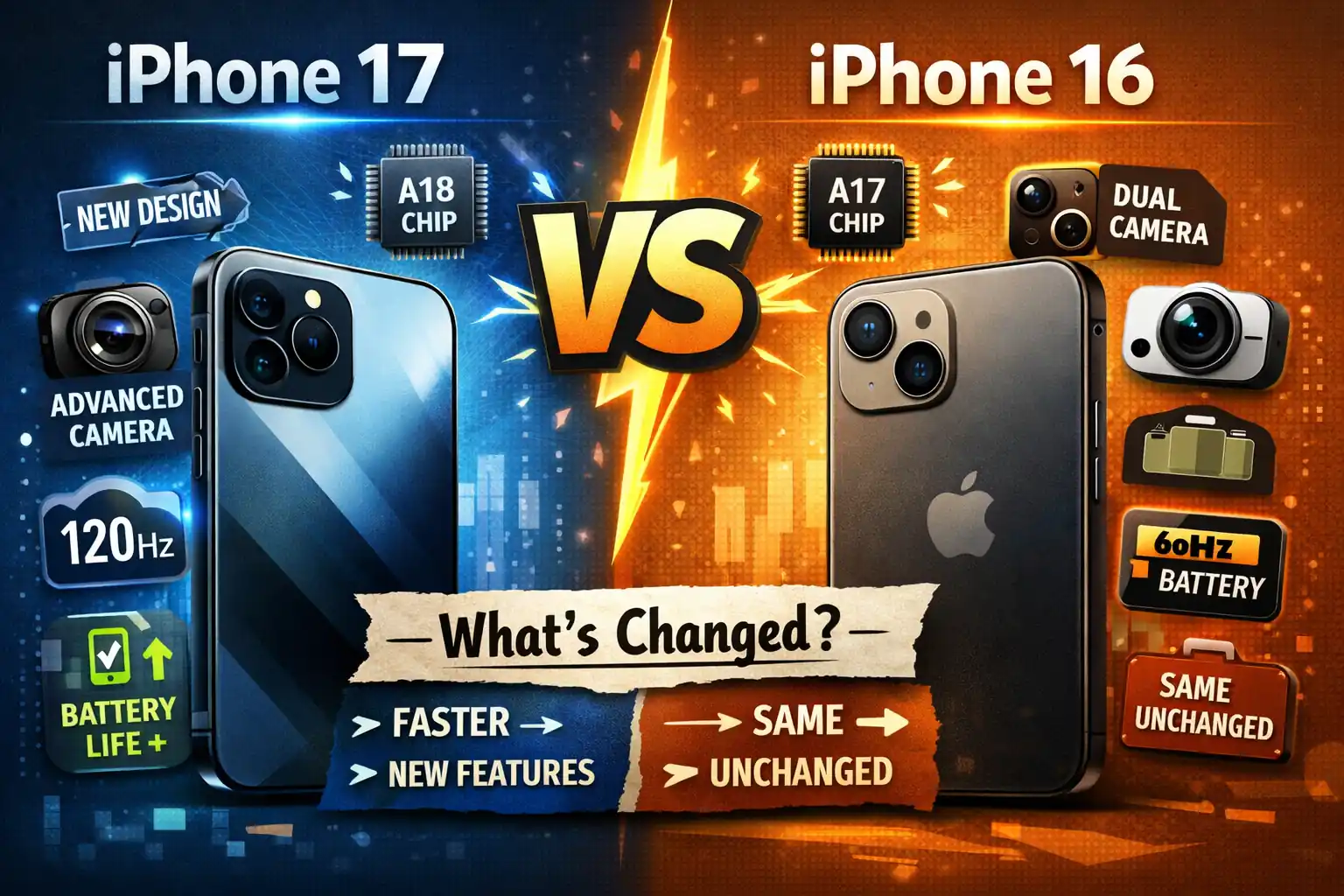
Lineup Positioning and Form Factors
iPhone 16 and 16 Plus launched in 2024 as Apple’s mainstream pair, with 6.1-inch and 6.7-inch OLED displays, A18 silicon, Wi-Fi 7, a dedicated Camera Control button, and the configurable Action button, all shipped initially with iOS 18 and built to support Apple Intelligence over time.:contentReference[oaicite:0]{index=0}
The 2025 cycle reshuffled that lineup. iPhone 17 now occupies the same “default flagship” slot that iPhone 16 previously held, but with a slightly larger 6.3-inch display and ProMotion, and it is sold alongside a thin iPhone Air and the higher-end iPhone 17 Pro and 17 Pro Max models.:contentReference[oaicite:1]{index=1} For IT, the key takeaway is simple: iPhone 17 is the new baseline for users who do not explicitly need Pro-class hardware, while iPhone 16 becomes the price-optimized option for fleets and cost-sensitive deployments.
Display: From 60 Hz to Full-Line ProMotion
One of the biggest technical deltas between iPhone 17 and iPhone 16 is the display subsystem. iPhone 16 and 16 Plus use 6.1-inch and 6.7-inch Super Retina XDR OLED panels at 60 Hz.:contentReference[oaicite:2]{index=2} They are perfectly adequate for office and field work, but they lag behind high-refresh competitors and Apple’s own Pro models when it comes to UI smoothness.
iPhone 17 moves to a 6.3-inch OLED with ProMotion, offering an adaptive refresh rate up to 120 Hz, along with always-on display support.:contentReference[oaicite:3]{index=3} For IT, this is more than cosmetic. Higher refresh improves perceived responsiveness, especially in graphics-heavy enterprise apps, complex dashboards, and remote-desktop clients. Always-on can also change how users triage notifications and glanceable information, which may affect battery usage profiles in the field.
Silicon and Performance: A18 vs A19
The iPhone 16 line is powered by the A18 SoC, designed to run Apple Intelligence workloads with a significantly faster Neural Engine than its predecessor.:contentReference[oaicite:4]{index=4} In practice, A18 already delivers more than enough performance for typical enterprise mobile workloads and most on-device AI features introduced with iOS 18 and later iOS 26 releases.:contentReference[oaicite:5]{index=5}
iPhone 17 steps up to the A19 chip, and the Pro line uses A19 Pro for even more GPU and Neural Engine headroom.:contentReference[oaicite:6]{index=6} For IT professionals, this matters if you:
• Plan to deploy heavy on-device AI workloads (for example, complex document summarization, local vision models, or offline transcription at scale).
• Run 3D-accelerated applications (CAD viewers, AR field-service tools, or GPU-optimized dashboards).
• Want the longest possible OS and feature runway for a 4–5 year replacement cycle.
For pure line-of-business apps and standard collaboration tools, A18 is far from obsolete. A19 is effectively about future-proofing and higher performance ceilings, not fixing any show-stopping bottlenecks in iPhone 16.
Camera System Changes That Matter for IT
iPhone 16 already brought a strong dual-camera setup with a 48 MP main sensor and an improved ultrawide, plus the new Camera Control hardware button for fast capture.:contentReference[oaicite:7]{index=7} For general enterprise use (documentation photos, whiteboard capture, on-site evidence, inventory), it is more than sufficient.
iPhone 17 significantly escalates the camera system for the non-Pro tier. The main camera remains 48 MP but gains an optical-quality 2× telephoto mode, and the ultrawide camera is also 48 MP, producing 24 MP photos by default with four times the resolution of iPhone 16’s ultrawide module.:contentReference[oaicite:8]{index=8} For IT, the impact is clearest in use-cases that lean on imaging quality:
• Field engineers documenting fine details (serial numbers, PCB traces, wiring runs).
• Insurance, construction, or facilities teams capturing wide-angle scenes with enough resolution for later zooming.
• Computer-vision workflows where higher-resolution source images improve model accuracy.
If your fleet primarily uses cameras for basic capture, iPhone 16’s system remains adequate. If imaging fidelity is a business requirement, iPhone 17 creates a strong technical argument for standardizing on the newer generation.
Connectivity, Buttons, and Physical Interface
Both generations include USB-C, 5G with Qualcomm modems, Wi-Fi 7, and support for dual eSIM in most markets.:contentReference[oaicite:9]{index=9} From a network policy and roaming perspective, there is no dramatic generational divide: both are modern radios with similar band coverage and throughput.
The most visible physical UI change actually arrived with iPhone 16 and is carried forward to iPhone 17: the Action button and the touch-sensitive Camera Control button on the side of the device.:contentReference[oaicite:10]{index=10} For IT, these can be standardized as workflow shortcuts:
• Launching a zero-trust VPN client.
• Triggering a line-of-business app for barcode/QR scanning.
• Starting a secure camera capture mode that auto-uploads to a managed backend.
Because both iPhone 16 and iPhone 17 share this hardware layer, you can design one button-driven workflow and deploy it across mixed fleets without special-casing by generation.
Apple Intelligence and Software Lifespan
iPhone 16 shipped with iOS 18 and is fully supported by later releases like iOS 26, which introduce a redesigned interface and expanded Apple Intelligence capabilities.:contentReference[oaicite:11]{index=11} iPhone 17 ships directly into that ecosystem, also targeting Apple Intelligence as a first-class workload with its A19 chip and upgraded Neural Engine.:contentReference[oaicite:12]{index=12}
For IT, the critical questions are:
• How long do you plan to keep each device in service?
• Are you planning to rely on Apple’s on-device intelligence for summarization, natural-language queries, or privacy-sensitive data processing?
Given Apple’s historical support window, iPhone 16 should remain OS-current for many years, but iPhone 17 will almost certainly be supported at least one major release longer. If you are aligning hardware refresh with a long-term AI strategy, that extra OS generation can be important.
Thermal Design, Battery Life, and Sustained Performance
iPhone 16 already improved thermal design with a re-worked internal layout and better heat dissipation, allowing higher sustained performance for workloads like gaming or intensive productivity apps.:contentReference[oaicite:13]{index=13}
iPhone 17 and especially the 17 Pro line refine this further with a new thermal design targeted at keeping A19 and A19 Pro under control during prolonged high-load scenarios, including camera use and AI workloads.:contentReference[oaicite:14]{index=14} For IT, this means fewer throttling-induced slowdowns during long remote sessions, AR usage, or continuous background processing.
In everyday mixed usage, both generations deliver “all-day” battery life. iPhone 17 adds incremental gains rather than a step change, but ProMotion can offset some of the extra efficiency by lowering refresh in static scenarios. From a fleet-management perspective, you should treat battery longevity as comparable and focus more on workload profiles than on headline milliamp-hour numbers.
Manageability, Security, and Fleet Integration
Because both iPhone 16 and iPhone 17 target the same current iOS baselines, their manageability story is nearly identical from an MDM and security-policy standpoint. Both support:
• Modern supervised-mode enrollment (including Automated Device Enrollment).
• eSIM-centric provisioning for mobile operators in many markets.
• The latest passkey, Secure Enclave, and hardware-backed keychain capabilities.
• The same App Store, VPP, and internal app distribution mechanisms.
Security posture is likewise comparable, assuming both generations are kept on the same iOS patch level. There are no major generation-specific security features that exist only on iPhone 17 at this stage; Apple tends to ship such changes at the platform level. The one practical difference is lifecycle: iPhone 17 will get security and feature updates longer than iPhone 16, so if you plan on running devices for five years or more, the newer hardware gives you more breathing room.
Cost, Lifecycle, and Deployment Strategy
With the arrival of iPhone 17, Apple has repositioned iPhone 16 as the “previous-gen value” option. That typically translates into lower street pricing from resellers and carriers, especially on volume contracts, while iPhone 17 sits at the mainstream flagship price point around USD 799 at launch.:contentReference[oaicite:15]{index=15}
A pragmatic strategy for many organizations will be tiered deployment:
• Knowledge workers, general office staff, and low-intensity field roles: iPhone 16 is usually sufficient and may significantly reduce per-seat hardware cost.
• Power users, creators, camera-heavy roles, and teams piloting on-device AI workflows: iPhone 17 brings tangible benefits in display smoothness, camera quality, and compute headroom.
• Executives or specialist roles: iPhone 17 Pro or Pro Max may be justified where camera, storage, or maximum performance are core to the job.
Should You Standardize on iPhone 17 or Keep Buying iPhone 16?
From an IT professional’s standpoint, the move from iPhone 16 to iPhone 17 is evolutionary but not trivial. The biggest real-world changes are:
• ProMotion and always-on display for better UX and data density.
• A19 silicon and improved thermals for long-term AI and performance headroom.
• A much more capable camera system on the non-Pro tier, with 48 MP ultrawide and better telephoto options.
• A slightly longer OS and security support horizon simply by virtue of being one generation newer.
If your current or planned workloads do not stress cameras, GPUs, or on-device AI, iPhone 16 remains a highly viable, modern platform that integrates cleanly with existing MDM and security controls. For organizations that want to lean into Apple Intelligence, extended lifecycle, and higher-fidelity imaging, iPhone 17 is the more future-proof standardization point.
In short: iPhone 17 is not a mandatory upgrade for every user, but it is a meaningful technical evolution over iPhone 16. The right decision for your environment will depend less on annual hype and more on your workload mix, lifecycle expectations, and budget envelope.

 12977
12977  IT Pro