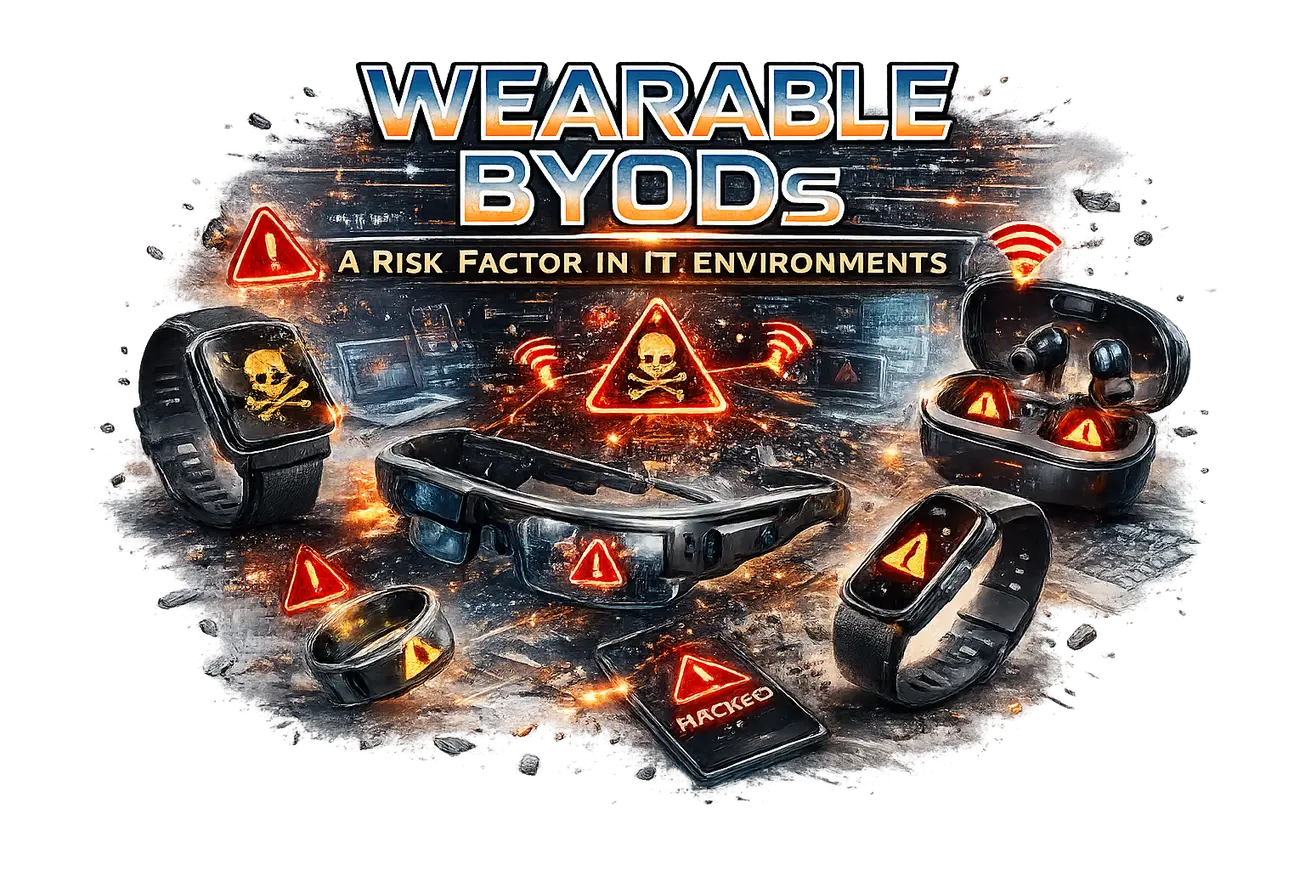
“Bring Your Own Device” used to mean phones and laptops. In most environments today, it also means smartwatches, fitness trackers, hearables (smart earbuds), smart rings, augmented reality glasses, medical wearables, and a growing list of sensor-rich devices that quietly connect to corporate identities, networks, and data flows. For IT teams, wearable BYOD is a security problem because it expands the attack surface without expanding your control surface. These devices are easy to miss in asset inventories, hard to manage with traditional endpoint tooling, and often tethered to a personal phone that becomes a bridge between corporate systems and consumer cloud ecosystems.
Wearables also change the nature of “data exposure.” It’s no longer only about files leaving the network. It’s about notification content visible on a wrist, microphones activated in a conference room, passive Bluetooth radios that can be probed in a hallway, and health or location data that is extremely sensitive under privacy regulations. The result is a risk category that sits at the intersection of endpoint security, identity, physical security, privacy, and governance.
Why wearables are different from classic BYOD
Wearables are typically designed around convenience, always-on connectivity, and deep integration with consumer ecosystems. Even when a wearable has enterprise-friendly features, many deployments still rely on a companion phone and vendor cloud services. That architecture creates several security characteristics IT should treat as “default assumptions”:
- Wearables are often invisible to asset management and discovery because they do not join the domain, do not run conventional agents, and may never authenticate directly to corporate services.
- The companion device matters as much as the wearable. If the phone is compromised, the wearable becomes an extension of that compromise through notifications, app tokens, and paired communications.
- The user interface is constrained. Users approve prompts quickly, glance at alerts, and accept pairings or permissions with minimal context.
- The security model is frequently vendor-specific and updated on a consumer cadence, which may not align with enterprise change control.
- Sensors and radios are the “feature,” meaning the device is purpose-built to capture, transmit, and sync information continuously.
For IT professionals, the key takeaway is that wearables should not be evaluated as “small phones.” They are ambient computing devices. Their risks are distributed across identity, data visibility, physical space, and supply chain.
Common wearable types entering enterprise spaces
The wearable category is broader than a smartwatch. In many organizations, the following device classes appear in offices, labs, and production areas:
- Smartwatches and fitness trackers that mirror notifications, support voice assistants, and sometimes provide cellular connectivity.
- Hearables that integrate microphones, voice assistants, call handling, and audio passthrough modes that can be used in sensitive spaces.
- Smart rings used for convenience features, notifications, health metrics, or in some cases proximity-based access.
- AR/VR glasses used for remote assistance, training, field service, or personal media capture.
- Medical wearables used for monitoring that can introduce regulated personal data into corporate networks and logs.
Even when a wearable never touches Wi-Fi, the device can still be relevant to corporate risk through Bluetooth, NFC, or tethering via a phone with access to corporate email, messaging, and identity providers.
The attack surface: radios, apps, identities, and ambient data
Wearable risk is best understood as a set of overlapping surfaces. A single smartwatch can simultaneously be a Bluetooth endpoint, an identity convenience tool, a notification mirror, a microphone, and a cloud-synced sensor pack. When you map threats, treat each of these as its own control domain.
Wireless exposure: Bluetooth Low Energy pairing, discoverability modes, and protocol quirks can create opportunities for probing, tracking, or exploitation in proximity. NFC can enable quick interactions that are hard to audit. If the device supports Wi-Fi or cellular, it may bypass some corporate network controls entirely.
Companion apps and cloud sync: The companion phone app often holds tokens, permissions, and sync rules. Data can flow from corporate notifications into personal cloud backups or cross-device sync features. The wearable vendor’s cloud becomes part of your effective data boundary.
Identity shortcuts: Wearables frequently enable “approve with a tap,” proximity unlock, or quick responses. Convenience features can reduce friction for users and also reduce friction for attackers who gain physical proximity or partial control of a device.
Ambient leakage: Notifications displayed on a wrist can disclose sensitive subjects, customer names, ticket identifiers, incident details, or one-time links. Microphones and cameras create an additional risk layer in meeting rooms, SOC areas, labs, and facilities with protected IP.
Real-world risk scenarios IT teams should plan for
Wearable BYOD risk becomes clearer when translated into scenarios that security operations, governance, and IT support can recognize and respond to. The point is not to assume every wearable is hostile. The point is to avoid being surprised by predictable failure modes.
Sensitive notification exposure: An employee receives an incident bridge invite, a customer escalation, or a password reset email. The subject line is visible on a smartwatch during a meeting, on public transport, or in a shared workspace. Even without message content, metadata can be damaging.
Conference room capture: A wearable with a microphone, voice assistant, or audio recording feature is present during discussions about pricing, M&A, security incidents, or unreleased product details. The risk is not only malicious recording; it includes accidental activation and cloud sync.
Identity approval fatigue: Quick approvals are useful for MFA and SSO, but they also enable a form of “tap-to-approve” behavior. If an attacker triggers repeated prompts, a distracted user may approve the wrong request, especially on a small wearable UI.
Proximity and physical access complications: Some environments use proximity-based unlocking on laptops, doors, or applications. If a wearable is used as a trust signal and it is lost, stolen, or borrowed, the organization can inherit a physical security risk disguised as a convenience feature.
Shadow connectivity: A wearable with cellular capability can move data without joining corporate Wi-Fi. A compromised phone can use the wearable ecosystem for notification mirroring and data exfiltration pathways that bypass traditional proxies or network segmentation controls.
Regulated data mixing: Medical wearables can introduce health data into IT systems indirectly via support tickets, screenshots, logs, or troubleshooting conversations. That can create compliance obligations you didn’t intend to take on.
Governance: define what “acceptable” means in your environment
Technical controls work best when the organization has clear, enforceable expectations. Many BYOD policies were written before wearables became mainstream and focus on phones, laptops, and removable media. Updating governance is not about banning devices universally. It’s about aligning wearables with risk tiers and space tiers.
Mature programs typically define “device presence rules” for different zones:
- High-sensitivity zones where microphones, cameras, and recording-capable wearables are restricted, with clear signage and secure storage options.
- Standard office zones where wearables are allowed but notification handling and pairing rules are enforced through identity and endpoint posture controls.
- Visitor and contractor rules that address wearables explicitly, not implicitly.
Policies should also clarify the organization’s stance on content visibility and data handling, such as whether corporate email notifications are permitted on wearables, whether message previews must be disabled, and how wearable loss should be reported. When rules are vague, enforcement becomes inconsistent and incident response becomes slower.
Technical controls that reduce wearable BYOD risk
Wearables rarely support the same management hooks as laptops or phones, so the best control strategy focuses on the systems you can control: identity, the companion phone posture, network access, and data protection. The goal is to reduce impact, reduce likelihood, and improve detection without turning daily work into friction overload.
Identity-first enforcement: Use conditional access to require strong authentication and device posture for corporate apps. Where possible, bind access to managed devices and restrict high-risk actions when a session is initiated from unknown or unmanaged endpoints. This helps even if the wearable is only indirectly involved.
Managed phone posture as a proxy control: If wearables sync through a phone, treat the phone as the enforcement point. Mobile device management or unified endpoint management can enforce encryption, screen lock, OS version baselines, and app governance for the companion ecosystem.
Notification hygiene: Reduce the value of wearable notification exposure by limiting what appears in notifications for corporate apps. Consider disabling message previews, enforcing “sensitive content hidden,” and restricting actionable notifications that allow approvals or replies from a locked wearable.
Network segmentation and access policy: Ensure that unknown wireless endpoints cannot reach sensitive internal services. NAC, guest network isolation, and strict firewalling reduce the damage if a wearable or its companion attempts lateral movement or discovery.
Data loss prevention and cloud controls: Treat consumer cloud sync as a potential egress channel. DLP policies, CASB controls, and tenant restrictions can reduce accidental syncing of corporate data into personal accounts, especially through the phone that pairs with the wearable.
Logging and detection with realistic expectations: You may not see the wearable directly, but you can detect patterns such as unusual approval behavior, anomalous sign-ins, sudden token refresh spikes, or access from unexpected device types. Align SIEM detections to identity events, not only endpoint agents.
Physical security and “secure spaces” matter more than ever
Wearables blur the line between cybersecurity and physical security. If your organization has spaces where microphones/cameras are a problem, then treating wearables as “just personal accessories” is a gap. The most practical approach is to operationalize secure spaces rather than try to police people informally.
Consider controls that are respectful and workable:
- Clear zone signage that explicitly mentions wearables and capture-capable devices.
- Lockers or secure pouches for employees and visitors entering sensitive areas.
- Meeting practices for sensitive topics that include device expectations up front.
- Exceptions and approvals that are documented for legitimate use cases such as accessibility needs.
The IT security program should partner with facilities and HR to avoid creating “security theater” rules that are not enforceable. A small set of well-defined zones with consistent enforcement usually performs better than broad rules no one follows.
Privacy, compliance, and the hidden cost of wearable data
Wearables generate and store sensitive personal information, including location patterns, heart rate, sleep data, and sometimes medical indicators. Even if the organization does not intend to process this data, it can enter the corporate environment indirectly through support channels, collaboration tools, screenshots, or incident investigations.
IT professionals should work with legal and privacy stakeholders to clarify:
- Whether any wearable-related data is considered within the scope of corporate monitoring.
- How incident response should handle devices that contain personal health data.
- What retention and access rules apply if wearable data becomes part of a ticket or investigation record.
This is not only a legal concern. It affects trust. Overly aggressive monitoring can create employee pushback and shadow workarounds. The healthiest programs are transparent about what is monitored, why, and how it is protected.
Operational readiness: handling lost wearables and suspected misuse
Wearable incidents are often “small” until they are not. A lost smartwatch might contain recent notifications, calendar details, and a map of the user’s day. A compromised companion phone can turn wearables into an always-present signal. Incident response playbooks should explicitly include wearables so service desks and SOC teams are not improvising.
Useful preparation includes:
- A clear reporting path for lost or stolen wearables, similar to lost phones and badges.
- Guidance for revoking sessions, rotating credentials, and invalidating tokens when wearable-linked accounts are at risk.
- A standard checklist for assessing whether sensitive notifications or approvals may have been exposed.
- Documentation of which corporate apps permit wearable notifications and what those notifications include.
Make sure the process is simple enough that employees will actually use it. If reporting feels punitive or complicated, people wait, and waiting is what turns manageable incidents into major exposures.
A practical “wearable BYOD” security baseline for IT teams
If your organization is starting from scratch, you can still make meaningful progress quickly by focusing on a baseline that reduces the most common risks. The following practices are widely applicable and do not require invasive device control:
- Enforce conditional access and strong authentication, with user-friendly safeguards against accidental approvals.
- Require managed posture for the companion phone when it is used to access corporate email, chat, or identity flows.
- Minimize notification data exposure by limiting previews and sensitive content in lock-screen style alerts.
- Define secure zones where capture-capable wearables are restricted and provide practical storage options.
- Segment networks and limit what unknown wireless endpoints can reach, even if they appear briefly.
- Update BYOD policy language to explicitly include wearables, with clear expectations and respectful enforcement.
- Add wearable scenarios to incident response playbooks, focusing on session revocation, credential hygiene, and rapid reporting.
The baseline is not the finish line. It is a starting point that reduces likelihood and impact while your organization matures its approach based on actual wearable use cases and risk tolerance.
Conclusion: treat wearables as a security domain, not a footnote
Wearable BYOD is not a temporary trend. It is part of the broader shift toward ambient computing, where identity follows the user across devices, sensors, and spaces. For IT professionals, the right approach is neither panic nor denial. It is disciplined risk management: define where wearables are acceptable, reduce data exposure by design, enforce access through identity controls, and operationalize secure spaces and incident response.
When organizations treat wearables as a first-class part of BYOD—alongside phones and laptops—they gain clearer visibility, fewer surprises, and a security posture that matches the reality of modern work.


 12977
12977  IT Pro