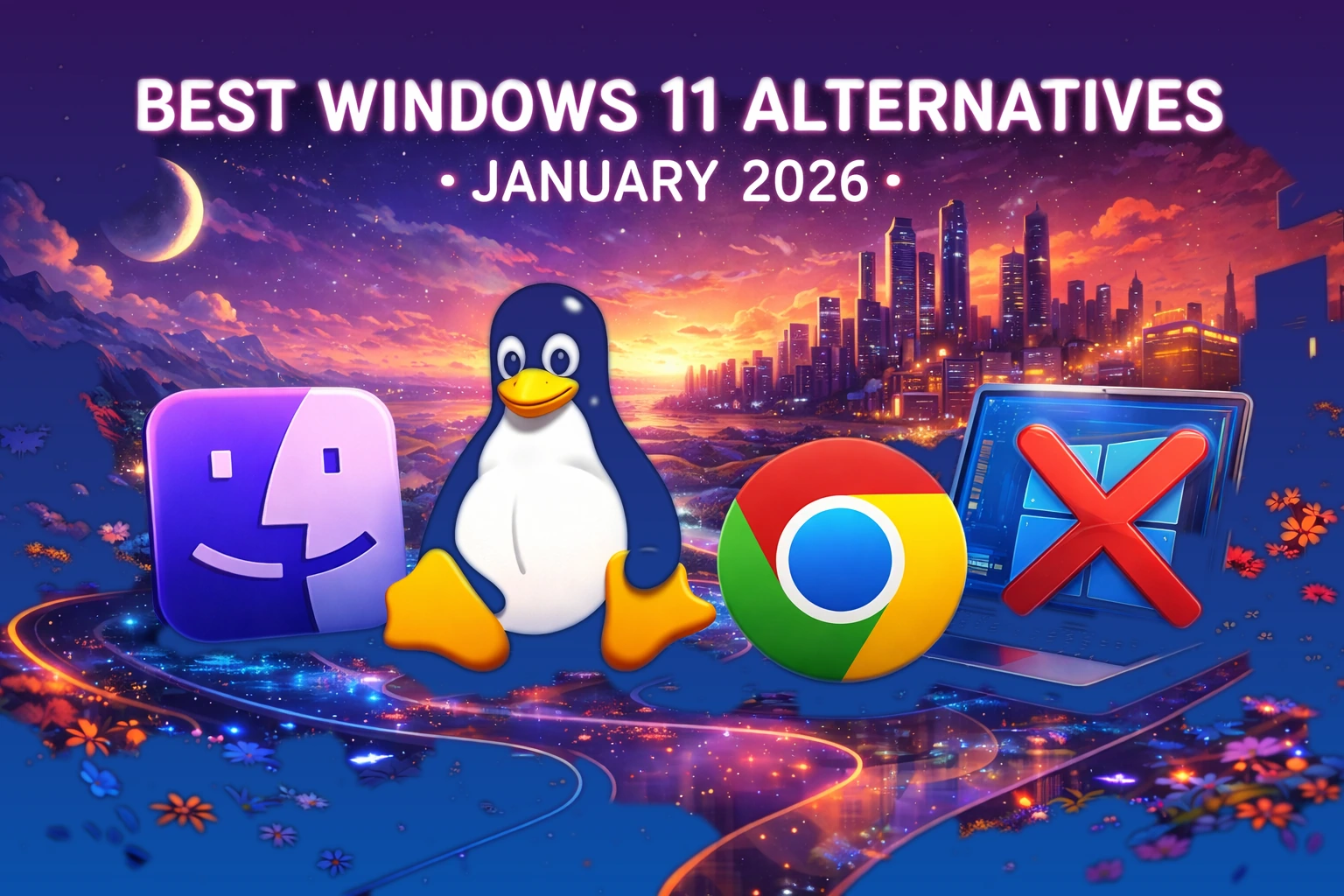
In January 2026, “Windows 11 alternative” usually isn’t a single operating system choice. It’s an endpoint strategy: how you keep devices secure, manageable, and cost-effective while meeting application compatibility and compliance requirements. For IT professionals, the practical question is less about UI preference and more about lifecycle risk, fleet management, identity integration, patch cadence, incident response, and the long tail of peripherals and line-of-business applications.
The market now offers multiple credible paths: stable Windows servicing channels for specialty endpoints, Linux desktops for technical and web-first roles, ChromeOS-style endpoints for simplified management, thin-client operating systems for virtual desktop environments, and “Windows as a service” options that decouple the desktop from the physical device. The strongest programs treat these as building blocks rather than mutually exclusive choices.
The fastest way to succeed is to classify users by persona (task worker, knowledge worker, developer, creative, privileged admin, kiosk) and map each persona to an endpoint model that you can secure and support without exception sprawl.
What to Evaluate First: The IT-Centric Checklist
If you’re replacing or reducing Windows 11 adoption, your “best alternative” is the one that survives contact with operational reality. Before you pilot anything, align stakeholders on what must work on day one and what can be phased in over time.
- Application truth: inventory Windows-only apps, kernel drivers, VPN clients, smart card middleware, and legacy browser dependencies.
- Identity and access: SSO, MFA, conditional access, device posture, local admin policy, and privileged access workflows.
- Management plane: provisioning, configuration drift control, patch enforcement, compliance evidence, remote support tooling.
- Security stack: disk encryption, secure boot equivalents, EDR availability, logging/telemetry controls, IR playbooks.
- Peripheral and AV reality: docking stations, printers, scanners, conferencing gear, GPU needs, specialized USB devices.
- Lifecycle guarantees: support horizon, cadence stability, and what “end of support” implies for your risk acceptance.
Fast Decision Map by Common Scenarios
| Scenario | Alternatives that often fit | Why IT teams pick them |
|---|---|---|
| Hardware can’t move to Windows 11 yet | Windows 10 LTSC / IoT LTSC, ESU bridge, ChromeOS Flex, Linux, Cloud PC / VDI | Extends usable life while keeping patching and governance possible |
| Web-first knowledge workers | ChromeOS Flex, Ubuntu LTS, Linux Mint, macOS, Cloud PC | Most workflows are browser + identity + MDM policy |
| Developers and ops roles | Ubuntu LTS, Fedora, Debian, openSUSE, RHEL, macOS | Strong terminal/container toolchains and package management |
| High-risk / high-privilege roles | Qubes OS, hardened Linux deployments, VDI-based admin workstations | Isolation and reduced blast radius are the priority |
| Windows-only apps remain non-negotiable | Windows 365, Azure Virtual Desktop, Citrix, VMware Horizon | Compatibility stays, endpoint OS becomes less important |
Microsoft-Centric Alternatives (Avoid a Full Windows 11 Endpoint)
If your environment is heavily Windows-dependent, the most realistic alternatives are often still Microsoft-based: stable servicing models for specific fleets, time-boxed security update bridges, and cloud desktops that shift complexity away from endpoint hardware constraints.
Windows 10 Enterprise LTSC 2021
LTSC is designed for stability-focused environments where feature churn is a liability. In real IT deployments, LTSC is most valuable for dedicated-purpose endpoints, lab systems, and devices tied to specialized hardware or certified workflows. It is not a universal “everyone’s desktop” answer, but it can remove pressure where predictable behavior matters more than new features.
- Best for: fixed-purpose systems, specialized peripherals, stable images
- Why it helps: fewer disruptive changes; easier standardization for locked-down builds
- Operational note: treat it as a scoped policy decision with defined device classes
Windows 10 IoT Enterprise LTSC 2021
For kiosks, signage, POS, and embedded-style endpoints, IoT Enterprise LTSC exists for a reason: long-term stability and extended lifecycle options. If you have fleets that cannot tolerate UI shifts or platform changes, IoT LTSC is often the cleanest way to keep those devices in a controlled support window while the broader organization modernizes.
- Best for: kiosks, shared devices, dedicated-purpose endpoints
- Why it helps: extended lifecycle reduces forced refresh pressure on specialized fleets
- Operational note: validate licensing intent and deployment boundaries up front
Windows 10 Extended Security Updates (ESU)
ESU is not an OS replacement, but it is a practical alternative to a rushed Windows 11 migration when hardware, budgets, or application readiness are not aligned. Used correctly, ESU is a time-boxed bridge: you buy security updates while you execute a controlled transition plan.
- Best for: incompatible hardware, phased refresh programs, migration bridges
- Why it helps: reduces exposure during transition instead of forcing a chaotic upgrade
- Operational note: define an off-ramp date and enforce it in asset lifecycle governance
Cloud Desktops and VDI (Keep Windows Apps, Change the Endpoint)
If app compatibility is the blocker, you can keep Windows where it matters while simplifying the endpoint OS. This approach is particularly effective when you want locked-down devices, faster replacements, and reduced local data exposure. The IT win is centralizing control: patching, baseline hardening, and logging become more uniform.
Windows 365
Windows 365 delivers a Cloud PC that behaves like a consistent Windows desktop regardless of endpoint hardware. It fits well for contractors, BYOD programs, high-turnover roles, and mixed fleets where standardizing the physical device is difficult.
- Best for: contractors, remote-first work, standardized user experience across devices
- Why it helps: decouples desktop from hardware; simplifies endpoint support
- Operational note: model bandwidth/latency, offline requirements, and cost per persona
Azure Virtual Desktop
Azure Virtual Desktop is often the strongest “compatibility anchor” during transitions. You can deploy Linux or ChromeOS endpoints for everyday work and provide Windows desktops only for the applications that require it.
- Best for: legacy Windows apps, regulated workflows, centralized control
- Why it helps: reduces endpoint OS dependency; concentrates governance and monitoring
- Operational note: user experience depends on profile strategy and network reality
Citrix
Citrix remains common where enterprises need mature application delivery controls, granular policy enforcement, and a well-understood operational model. It can be the bridge that makes endpoint OS diversity safe.
VMware Horizon
Horizon is frequently used to deliver virtual desktops and applications with consistent user experience across heterogeneous endpoints. It can help you separate “what users need” from “what hardware runs locally.”
Web-First and Lightweight Endpoints (Reduce Local Complexity)
ChromeOS Flex
ChromeOS Flex is one of the most practical ways to repurpose aging Windows hardware into a managed, web-first endpoint. For task workers, shared devices, kiosks, and environments that live in the browser, it can significantly reduce the patching and configuration burden compared to a full traditional desktop stack.
- Best for: web-first roles, shared devices, kiosk-like workloads
- Why it helps: policy-driven model reduces local drift and minimizes support overhead
- Operational note: plan exceptions for Windows-only apps via VDI/Cloud PC
IGEL OS
IGEL OS is a thin-client operating system designed to connect endpoints to virtual desktops and cloud workspaces. It’s useful when you want locked-down devices, minimal local attack surface, and centralized control over what the device is allowed to do.
HP ThinPro
ThinPro targets thin-client and VDI-first deployments. If your goal is to standardize endpoints around remote sessions, a thin-client OS can simplify hardening, reduce local storage risk, and accelerate device replacement.
Linux Desktop Alternatives That Work for Enterprise IT
Linux desktops are a mainstream option in 2026 for developers, engineering teams, security roles, and many knowledge-worker workflows where the browser is the center of gravity. The success pattern is consistent: standardize on a small set of distributions, define golden images, enforce encryption, and use configuration management to keep endpoints consistent over time.
Ubuntu Desktop (LTS)
Ubuntu LTS is commonly selected for enterprise pilots because the cadence is predictable and the ecosystem is large. It’s a strong baseline for standardized builds, developer workstations, and browser-centric productivity roles.
Fedora Workstation
Fedora is popular in engineering organizations that want modern toolchains and fast-moving developer ecosystems. It’s a strong fit when containers and cloud-native workflows are central to daily work.
Debian
Debian is a stability-first choice well suited to controlled enterprise environments where predictability matters more than the newest UI or freshest package versions.
Linux Mint
Linux Mint is often chosen for user comfort and reduced training friction during Windows-to-Linux transitions, especially for productivity roles.
Pop!_OS
Pop!_OS is a developer-friendly desktop with practical defaults and strong ergonomics. It can be a good fit for technical teams, including those with GPU-capable workstations.
openSUSE (Leap / Tumbleweed)
openSUSE offers flexibility across stability needs. Leap generally fits conservative environments, while Tumbleweed appeals to teams comfortable with rolling updates and newer packages.
Red Hat Enterprise Linux (RHEL)
RHEL is attractive where vendor support, lifecycle clarity, and compliance narratives matter. It’s often used for standardized engineering desktops and regulated environments.
SUSE Linux Enterprise Desktop
SUSE’s enterprise desktop is useful for organizations that want commercially supported Linux endpoints—especially if SUSE is already part of the server or infrastructure footprint.
Zorin OS
Zorin OS focuses on approachability for Windows migrants. It’s often used for pilots where the goal is fast adoption with minimal UI shock.
Platform Shifts: When the Alternative Is a Different Hardware + OS Stack
macOS
macOS is a credible Windows 11 alternative when the organization values a tightly integrated platform, strong security defaults, and consistent hardware. Many IT teams standardize macOS for engineering, creative, or executive fleets where the long-term support story is clearer with fewer hardware permutations.
- Best for: engineering, creative roles, standard-hardware fleets
- Why it helps: consistent device lineup reduces driver variability and support complexity
- Operational note: treat macOS as a managed first-class platform, not an exception
High-Security Alternatives for “Assume Breach” Workflows
Qubes OS
For a small subset of users, the best Windows 11 alternative is a different security model rather than a different vendor. Qubes OS is designed around compartmentalization—separating activities into isolated domains to limit blast radius. This can be valuable for threat research, high-risk roles, or workflows that routinely handle sensitive data.
- Best for: security research, high-risk roles, compartmentalized workflows
- Why it helps: isolation-first design reduces impact of a single compromise
- Operational note: narrow role targeting and training are essential
A Practical Migration Playbook (Without Creating Endpoint Chaos)
Most “Windows 11 alternative” programs fail when they become a grab bag of exceptions. The winning approach is to define a few supported lanes, pilot them with real users, and formalize what “supported” means—imaging, patching, encryption, monitoring, and remote support.
- Create a persona matrix: map users to app needs, peripherals, security requirements, and support expectations.
- Standardize choices: keep the approved OS list small and enforce it to avoid distro sprawl.
- Decide the app strategy: native where possible, web where practical, VDI/Cloud PC for Windows-only holdouts.
- Automate provisioning: treat endpoint configuration as code to reduce drift and ticket volume.
- Measure outcomes: compliance rates, patch latency, ticket categories, and user productivity signals.
- Document the off-ramps: bridges like ESU and legacy VDI lanes must have defined end dates.
A common, resilient reference architecture in 2026 is blended: Linux or ChromeOS Flex for web-first roles, a small stable Windows lane (LTSC/IoT LTSC) for specialty endpoints, and Cloud PC/VDI for the remaining Windows-only applications. This reduces forced hardware refresh pressure while keeping governance centralized.
Closing Thoughts
The best Windows 11 alternative in January 2026 is the one your team can secure and operate at scale without living in exception hell. For many organizations, that means moving from a single-OS mindset to a role-based endpoint model: simplify where possible, isolate and virtualize where necessary, and keep lifecycle and governance explicit. If you design around personas and operational reality, “alternative” stops meaning compromise and starts meaning control.

 12993
12993  IT Pro