For more than a decade, cloud computing dominated the IT strategy of enterprises and startups alike. Migrating everything to AWS, Azure, or Google Cloud became the “default”. Local infrastructure was often dismissed as outdated, expensive, and rigid.
But 2025 marks a pivotal turning point.
A new trend is emerging: a return toward hybrid and even local infrastructure–not instead of cloud, but alongside it, driven by cost pressures, data locality concerns, performance needs, and a wave of new AI workloads.
This shift is reshaping how organizations think about architecture, risk, compliance, and long-term scaling. It is no longer a question of whether cloud is right, but how much cloud is optimal.
In other words: Cloud-Only is ending. Cloud-Smart is beginning.
Let’s break down the landscape.
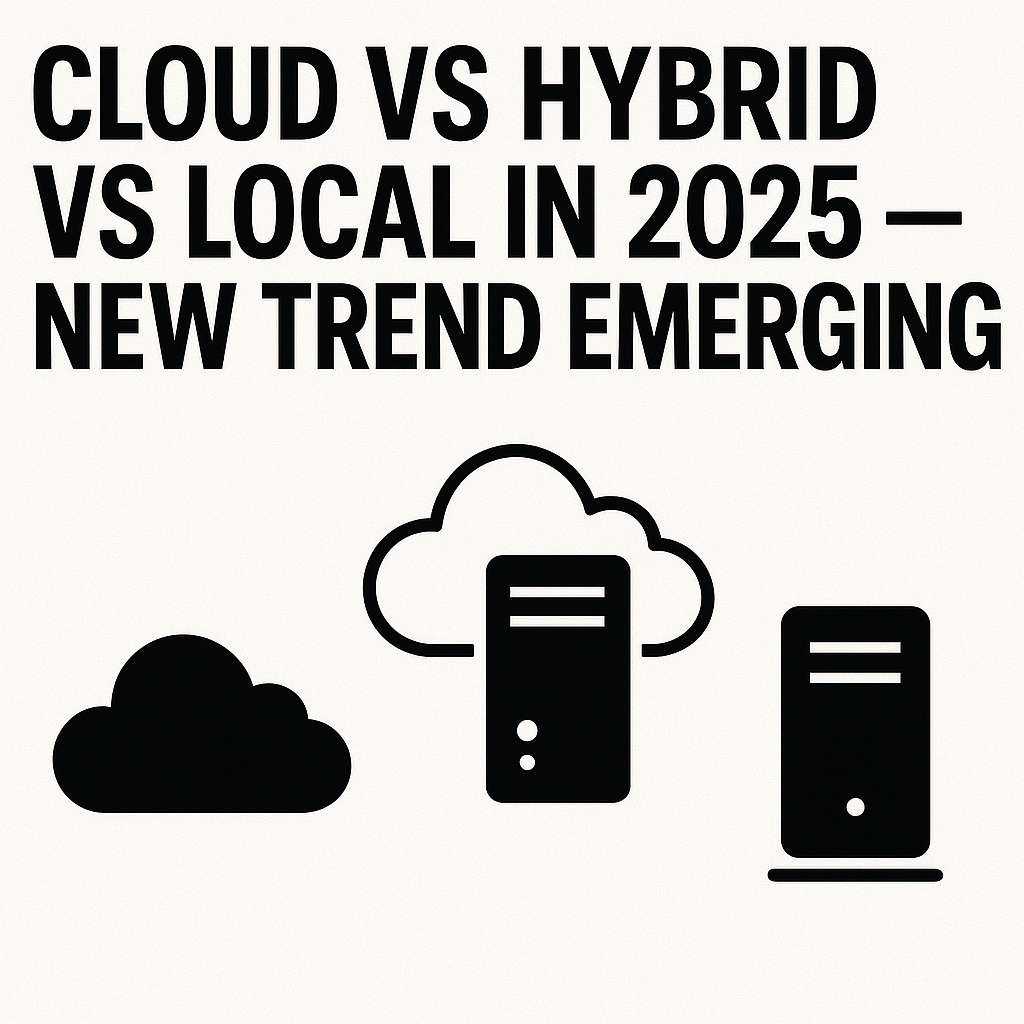
Cloud in 2025 — Still Powerful, but Changing
Cloud continues to grow, but the momentum is shifting.
Strengths of Cloud in 2025
-
Instant scalability
-
Global distribution
-
High resiliency
-
No upfront capital expense
-
Great ecosystem integrations
-
Perfect for rapid product launches
Cloud platforms also continue to lead in:
-
Managed databases
-
Developer tooling
-
Security automation
-
Kubernetes orchestration
-
Serverless platforms
-
Distributed storage
-
Edge computing
But The Cloud Has New Weaknesses
By 2025 the industry acknowledges disadvantages that were ignored for a long time:
① Cost escalation
Runaway cloud bills became one of the biggest problems of 2023–2025.
Companies discovered:
-
Scaling up is easy
-
Scaling down is not
-
Outbound data fees (egress) are painful
-
Compute prices are sticky
-
GPU availability costs exploded
② Vendor lock-in concerns:
Leaving AWS?
Almost impossible once deep into the ecosystem.
③ Unpredictable performance
Especially for:
-
AI workloads
-
real-time analytics
-
financial transaction systems
-
in-house LLM inference
④ Regulatory constraints
New privacy laws in 2024/2025 force data sovereignty in certain industries.
Cloud can comply—but not always easily.
Local Infrastructure in 2025 — Not Dead. Rising Again.
Local infrastructure was supposed to be obsolete.
But something surprising happened in 2023-2025:
Companies started buying servers again.
Why?
New Motives Driving On-Premise Adoption
-
Mature 2nd-hand server market
-
Affordable used GPUs
-
Powerful compact rack systems
-
Open-source AI stacks
-
Private AI initiatives
-
Better virtualization
-
Cheaper long-term TCO for stable workloads
Cost is the primary driver
If workloads are:
-
stable
-
predictable
-
permanent
running them locally becomes dramatically cheaper after 2–3 years.
AI infrastructure changed everything
Training?
Inference?
Vector search?
These are hardware water-eaters.
Owning GPUs is cheaper than renting them at scale.
Advantages of Local in 2025
-
Zero egress fees
-
Full control
-
Higher raw performance
-
Predictable capex
-
Stronger privacy posture
-
Long-term cost efficiency
Disadvantages
-
Maintenance overhead
-
Cooling + energy demands
-
Requires staff skill
-
Slower scaling
-
Capital expense upfront
Yet—the trend is rising again.
The Real Winner in 2025: Hybrid Models
Hybrid is no longer a compromise—it's a strategy.
In 2025, hybrid means:
-
critical workloads locally
-
scalable workloads in the cloud
-
AI in specialized clusters
-
data storage mixed based on compliance
-
distributed compute
Examples
Run inference locally
Scale inference bursts on cloud GPUs
Keep internal databases local
But use cloud CDN for global caching
Store archives cheap on-prem
But analytics in a cloud data lake
Local training + cloud deployment pipelines
Hybrid solves the majority of issues that cloud OR local alone cannot.
Why Hybrid Wins
-
Lower cost ceiling
-
Lower latency
-
Better compliance
-
Flexible scaling
-
Partial independence from vendors
-
Redundancy
Hybrid is also boosted by new technologies:
-
on-prem Kubernetes
-
edge clusters
-
colocation services
-
S3-compatible local storage systems
-
internal GPU racks
-
cloud bursting infrastructures
2025 marks the maturity of hybrid as a model, not an exception.
Why The Trend Is Changing Now.
Four major driving forces in 2025:
1. Cost Re-Evaluation
Boards are asking:
“Why is cloud costing us more every quarter?”
2. AI Hardware Reality
GPU demand broke cloud assumptions.
3. Regulations
Data sovereignty laws + AI compliance laws changed strategy globally.
4. Maturity of On-Prem Tech
Kubernetes + automation made operations easier than ever.
What Companies Are Doing in 2025
This is the new architecture trend:
Cloud for:
-
SaaS platforms
-
global scale distribution
-
dynamic workloads
-
edge presence
-
serverless functions
-
prototypes
-
rapid deployment
Local for:
-
AI computation
-
secure data operations
-
high-performance workloads
-
legacy systems
-
predictable workloads
-
long-term storage
Hybrid for:
-
enterprise modernization
-
cost optimization
-
scale + compliance at once
Which Strategy Fits Which Organization?
Cloud-Only
Best for:
-
startups
-
small companies
-
fast prototypes
-
non-technical teams
-
global products with unpredictable scaling
Local-Heavy
Best for:
-
banks
-
telecoms
-
government
-
defense
-
medical institutions
-
private AI companies
Hybrid
Best for:
-
mid-market enterprises
-
large corporations
-
AI research labs
-
SaaS platforms reaching maturity
-
media / VFX companies
-
universities
The Real New Trend of 2025: Cloud-Smart Architecture
Forget Cloud-First.
Forget Cloud-Only.
The new trend forming:
Cloud-Smart
Use cloud where it makes sense.
Use local where it is better.
Use hybrid where optimal.
Rational economics win.
Not ideology.
Conclusion: The Future Is Multi-Dimensional
2025 marks the end of the binary thinking era.
Not cloud OR local.
But cloud AND local—balanced intelligently.
Cloud is no longer a revolution.
Local is no longer outdated.
Hybrid is no longer transitional.
All three now coexist strategically.
The companies that thrive in 2025 and beyond will be those that design infrastructure based on:
-
workload behavior
-
compliance needs
-
economic logic
-
performance requirements
-
long-term sustainability
This is the new trend emerging.
And it is only the beginning.


 12985
12985  IT Pro