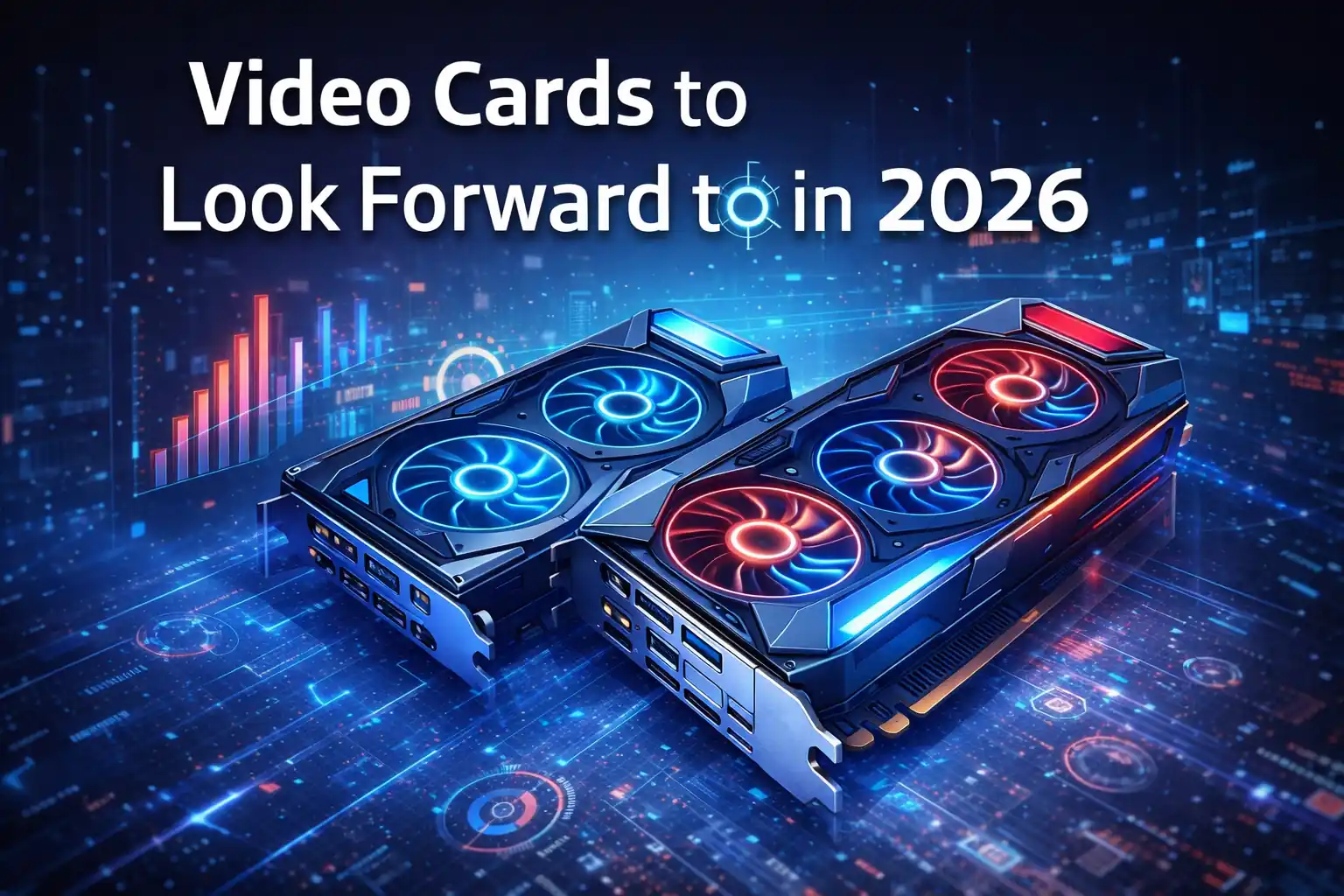
For IT professionals, “video cards” in 2026 are no longer a single buying category. A modern GPU purchase can be about VDI density, AI-assisted creative workflows, real-time rendering, encoding pipelines, multi-monitor trading floors, digital signage, or “just” gaming performance as a proxy for interactive 3D workloads. The GPU has become a shared acceleration layer for everything from desktop experiences to data center strategy—and 2026 is where a lot of the industry’s decisions finally show up in deployable hardware.
This article is written to help you think like an operator, not a spec-sheet tourist. We’ll look at what’s actually moving in the GPU market in 2026, what’s likely to matter most across the year, and how to translate “new cards” into stable, supportable fleet choices.
What “2026 GPUs” really means for planning
A helpful way to frame 2026 is to split GPUs into two timelines that now influence each other: the client lane (consumer/workstation/laptop) and the rack lane (data center accelerators). The rack lane is pulling supply, packaging capacity, and advanced memory allocation in ways that can show up as pricing volatility or spotty availability in the client lane. In other words, your “gaming GPU refresh” and your “AI initiative” can collide—whether you want them to or not.
In 2026, you should expect the most meaningful GPU improvements to cluster around five practical themes: higher effective performance per watt, faster memory and better bandwidth utilization, stronger AI-assisted rendering/upscaling stacks, more capable media engines for modern codecs, and updated display + power standards that reduce friction in real-world deployments.
NVIDIA in 2026: Blackwell maturity on the desk, Rubin pressure in the rack
On the client side, the GeForce RTX 50-series (Blackwell) is the most visible “2026 GPU” story for many organizations—especially anywhere you’re standardizing on CUDA-enabled applications, leaning on RTX features for visualization, or supporting teams that depend on NVIDIA’s creator and AI ecosystem. Blackwell client cards also bring the kind of platform updates that IT ends up caring about more than raw FPS: PCIe Gen5, modern display output capabilities, and next-generation memory configurations in the upper tiers.
On the software side, the “AI frame generation” era keeps expanding. Whether you love it or hate it, the practical outcome for IT is that user-perceived performance is increasingly gated by the quality of the vendor’s temporal reconstruction and frame generation stack—not just shader throughput. When evaluating Blackwell-era cards for end users, treat the driver + feature cadence as part of the platform lifecycle, not as “nice to have.”
In the rack lane, NVIDIA’s Vera Rubin platform being shown as a second-half-of-2026 rollout reinforces the big strategic pressure point: cutting-edge memory (and packaging capacity) is increasingly claimed by data center accelerators first. Even if you never buy a rack-scale GPU, you may still feel the ripple effects in lead times, pricing, and “which SKUs actually exist in volume.”
What to look forward to with NVIDIA this year is less about a surprise new family and more about the ecosystem maturing: broader feature support across applications, improved stability and compatibility for AI-assisted workflows, and partner designs that reduce operational risk (cooling, acoustics, power delivery, and physical integration).
IT reality check: In 2026, supply constraints are not just a “gamers complaining on forums” problem. Advanced DRAM allocation and component prioritization can shape corporate procurement outcomes—especially when you’re trying to standardize a model across a fleet.
If your org depends on a specific GPU configuration, treat availability as a requirement and validate it like you would validate a NIC or SSD SKU.
AMD in 2026: RDNA 4 for desktops, “Helios” ambition for AI infrastructure
AMD’s Radeon RX 9000 series, based on RDNA 4, is one of the most relevant “look forward to” stories in 2026 for organizations that want strong raster performance, competitive price/performance, and a growing AI + media feature set—without making NVIDIA the default choice for every workstation. RDNA 4’s positioning puts a spotlight on pragmatic improvements IT actually feels: ray tracing efficiency improvements, stronger AI acceleration blocks, and platform-level maturity in AMD’s software stack.
One of the most operationally important dynamics in 2026 is the VRAM conversation. In mainstream tiers, configurations can still diverge sharply, and that divergence tends to surface in professional workloads long before it becomes obvious in games. If you support creators, analysts, engineers, or developers running local models, pay close attention to memory capacity tiers and avoid “bare minimum VRAM” buys that look fine in a benchmark chart but fail under real multitasking.
In the rack lane, AMD is also loudly signaling that it intends to compete system-to-system, not just chip-to-chip. The Helios rack-scale platform and the Instinct MI455X story are worth watching even for client-focused IT teams, because they shape where AMD’s software and ecosystem investments go next (tooling, libraries, partnerships, and enterprise support expectations). If your organization is considering AMD for AI infrastructure, 2026 is a year where the messaging is turning into hardware you can evaluate in real deployments.
Intel in 2026: iGPU leaps, and the possibility of a midrange shake-up
Intel’s GPU story in 2026 matters in two ways. First, integrated graphics gains are becoming meaningful in “thin client with acceleration” scenarios: office laptops that can handle light creative work, hardware-accelerated conferencing pipelines, and smoother multi-monitor experiences without a discrete GPU tax. If you’re refreshing laptop fleets, iGPU performance improvements can reduce the number of “needs a dGPU” exceptions.
Second, Intel’s discrete Arc roadmap remains one of the best “if this lands well, it changes buying behavior” narratives—particularly in the midrange. A credible midrange dGPU with strong media capabilities and competitive pricing can become an IT-friendly choice for specific roles: streaming/recording stations, low-cost creator machines, lab boxes, and general-purpose GPU compute experiments that don’t justify premium-tier pricing.
The biggest thing to look forward to here is not a single feature; it’s the potential for genuine three-vendor competition in the segments where IT actually buys volume. If Intel’s drivers and platform support continue to mature, it can create leverage in procurement negotiations and reduce single-vendor risk.
Memory and bandwidth in 2026: GDDR7 momentum and why VRAM tiers matter
2026 is a year where memory bandwidth and memory behavior increasingly define “is this GPU good” outcomes. Faster memory helps, but what IT teams feel is more specific: fewer stutters under mixed workloads, better responsiveness at high resolution, and a larger “safe zone” for multi-app use without unexpected performance cliffs.
There’s also a supply-side angle: advanced memory is valuable and in demand. When memory becomes the constraint, vendors respond with SKU segmentation, reduced availability, or price shifts. That can affect your standardization strategy. If you need predictable builds, favor SKUs that appear consistently in OEM and SI channels, and avoid “headline” variants that exist in theory but not in purchasing reality.
Practical guidance: For professional endpoints, VRAM is often a stability feature, not a performance feature.
If your users live in browsers with heavy GPU compositing, multiple 4K displays, Teams/Zoom, creative tools, and occasional AI workloads, “extra” VRAM can be the difference between a smooth day and a steady stream of “my system feels weird” tickets.
Display and I/O in 2026: DisplayPort 2.1b, cable realities, and planning multi-monitor setups
In 2026, display standards are not just a gamer talking point. They’re an endpoint management concern. Higher refresh 4K panels, ultrawide productivity displays, and advanced HDR workflows all depend on bandwidth, cable quality, and stable link training. DisplayPort 2.1-class capabilities and the ecosystem around certified cables are becoming more relevant—especially when you deploy the same desk kit at scale.
What to look forward to here is less “8K at absurd refresh rates” and more “fewer weird problems.” Better standards support can mean fewer intermittent blank screens, fewer docking station edge cases, and fewer support calls where the fix is “swap the cable.” The catch is that higher bandwidth raises the importance of cable certification and appropriate length choices, particularly in office environments with longer runs.
If you manage multi-monitor setups, refresh your deployment playbook for 2026: standardize on certified cables, document known-good dock/monitor combinations, and validate your GPU choice against your display inventory—not just against “supports DP/HDMI.”
Power delivery in 2026: ATX 3.1, 12V-2x6, and why this is now an ops concern
The high-power GPU era forced a simple truth into IT operations: power delivery is part of reliability. In 2026, ATX 3.1-era thinking and the 12V-2x6 connector ecosystem are no longer “enthusiast trivia.” If your org deploys high-end GPUs (or even midrange cards in small form factor cases), you should treat power delivery as a managed dependency: PSU quality, correct cable routing, connector seating practices, and thermal conditions.
The good news is that the industry has responded with incremental safety improvements and protective approaches. You’ll see more emphasis on better connector designs, better PSU-side controls, and accessories that monitor temperature or detect improper seating conditions. The bad news is that the failure modes are still very real when a build is rushed, the connector is strained, or the case airflow is marginal.
What to look forward to in 2026 is a “boring” win: fewer preventable incidents. But you only get that win if you operationalize it. Document the build standards, enforce cable practices, and standardize PSUs for GPU tiers. Treat “high-watt GPU” builds like you treat “high-write SSD” builds: validated components, known-good combinations, and clear handling procedures.
Media engines and modern codecs: why creators and comms teams care
A lot of organizations discover the GPU’s value through video, not rendering. Hardware encoders and decoders matter for livestreaming, internal training content, remote production, social clips, and even “Teams plus screen recording” workflows. AV1 support and quality improvements have become a real differentiator in endpoints that create or transform video at scale.
The “look forward to” theme in 2026 is consistency: better quality at a given bitrate, more stable real-time encoding, fewer dropped frames under multitasking, and broader software support across popular creator tools. If you have in-house media workflows, include encoder quality testing in your GPU evaluation process rather than assuming “any modern card is fine.”
What IT professionals should watch throughout 2026
If you want to stay ahead of the GPU curve this year without turning it into a hobby, track the market through an IT lens: stability, availability, supportability, and measurable user impact.
- Driver cadence and enterprise stability signals: watch for fixed-issue velocity, known-problem transparency, and whether regressions are handled quickly.
- VRAM tier normalization: note which capacity levels become common in the tier you buy most, and avoid configurations that will age badly.
- Power and connector ecosystem maturity: favor builds and vendors that reduce connector strain and improve monitoring/protection.
- Display interoperability: validate high-bandwidth display modes with the exact monitors/docks/cables you deploy.
- AI workload creep: even “non-AI” teams will start running local inference features inside mainstream apps. Plan for GPU acceleration as a general capability, not as a special project.
A practical “look forward to” shortlist for 2026 procurement
Rather than chasing a single “best GPU,” build shortlists by role. Here are common profiles that show up in IT environments in 2026, and what to target.
High-end creator / visualization workstation
Look forward to stable, high-VRAM configurations with strong rendering + AI acceleration, modern display support, and reliable thermals. Prioritize vendor-certified drivers where applicable, validated PSU/connector choices, and chassis airflow that keeps sustained loads boring. If your users do 3D, heavy video, or local model experimentation, capacity and stability are usually worth more than peak benchmark wins.
Mainstream 1440p-class performance for power users
This is the sweet spot for many IT teams: enough performance for accelerated productivity, multiple displays, light content creation, and occasional serious 3D work, without the operational headaches of ultra-high power draw. In 2026, you should look forward to more sensible VRAM tiers and more mature upscaling/frame generation stacks that boost perceived responsiveness.
Media/communications endpoints
Choose GPUs like you choose cameras: test the output. In 2026, media engines and encoder quality can be the deciding factor. Prioritize AV1 support, consistent real-time behavior under multitasking, and the specific toolchain your org actually uses (not what benchmarks assume).
Fleet laptops with discrete GPUs
For mobile teams, look forward to improved performance per watt and better “on battery” behavior in modern laptop GPUs. Validate thermals, fan behavior, and sustained performance—because the best paper spec is useless if the chassis can’t hold it under real work. Standardize models when possible, because laptop GPU performance is heavily coupled to cooling and power limits.
Experimentation boxes and dev stations
If you need a “good enough GPU compute sandbox,” 2026 is an interesting year to look forward to increased competition and better midrange options. The goal is often not peak speed; it’s affordable capacity, stable drivers, and predictable behavior in the frameworks you support.
Concrete models worth tracking in 2026
The safest way to name models in an IT context is to treat them as “watch items” rather than “promises.” Availability varies by region and channel, and partner designs can differ materially. With that said, these are practical cards and families to keep on your radar this year:
- NVIDIA GeForce RTX 5090 (high-end): notable for very high VRAM capacity in the flagship tier and as a reference point for Blackwell-era capabilities.
- NVIDIA GeForce RTX 5050 (entry tier watch): worth tracking if your org buys a lot of “good-enough dGPU” systems and you want modern feature support at lower cost.
- AMD Radeon RX 9000 series (RDNA 4): watch for balanced 1440p-class performance, VRAM tiering, and whether AMD’s software stack aligns with your org’s needs.
- Intel Arc “Battlemage” midrange (watch item): worth tracking if you want more vendor diversity and strong media capabilities in cost-sensitive builds.
A simple 2026 GPU selection checklist for IT
When you remove the hype and focus on what causes tickets, downtime, and user frustration, GPU selection becomes pleasantly methodical. Use a checklist that reflects operational reality.
- Role fit: map the GPU to actual workloads (apps, monitors, codecs, AI features) instead of generic “performance.”
- VRAM headroom: choose capacity that stays stable under multitasking and will not age out quickly.
- Display compatibility: validate your exact monitor + dock + cable combinations, including length and certification.
- Power and thermals: standardize PSU tiers, connector practices, and airflow requirements for each GPU class.
- Driver and support posture: test the vendor stack in your environment, on your OS image, with your security tooling.
- Availability risk: confirm real procurement volume and lead times before you commit to a “standard model.”
The bottom line for 2026
The video cards to look forward to in 2026 are less about a single “winner” and more about the market becoming operationally legible again: better standards support, better efficiency, and more credible competition across tiers. NVIDIA’s client ecosystem continues to mature while the data center roadmap pulls attention and supply. AMD’s RDNA 4 desktops and Helios/Instinct messaging reinforce a broader platform push. Intel’s iGPU gains and midrange dGPU potential keep pressure on the segments where most organizations actually buy.
If you approach 2026 GPUs as a platform decision—power, display, drivers, availability, and role fit—you’ll make purchases that stay boring in production. And in IT, boring is the goal.


 12977
12977  IT Pro