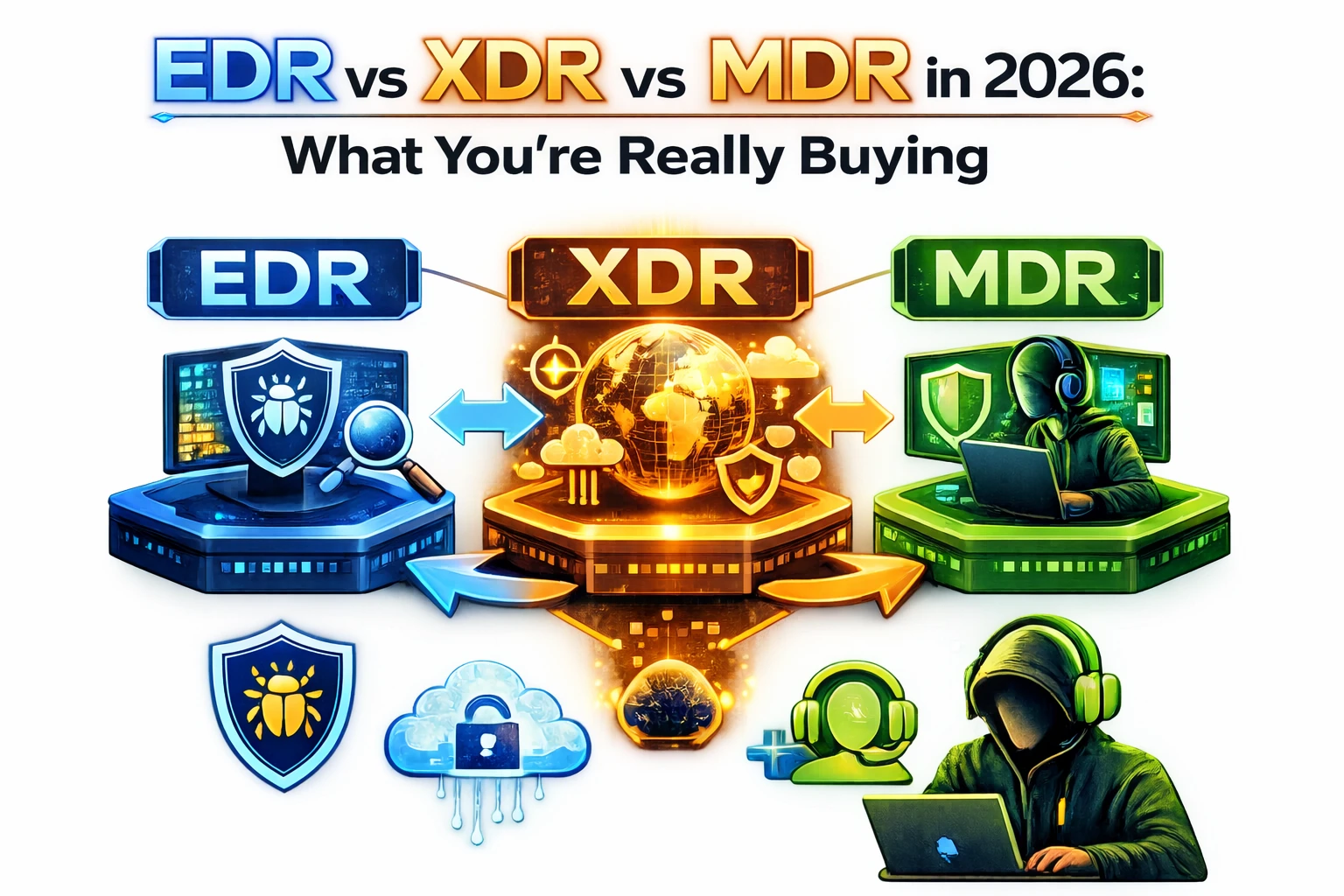
In 2026, “EDR”, “XDR”, and “MDR” are still used as if they’re product categories with clean borders. In reality, they’re packaging styles around three things that matter far more than the acronym: telemetry coverage, detection + response capability, and who is responsible at 03:00 when something breaks.
For IT professionals, the difference between a great purchase and an expensive regret usually has nothing to do with the marketing page. It comes down to operational outcomes: time-to-detect, time-to-contain, blast-radius control, alert fatigue, and how confidently you can answer, “Are we actually safer this quarter than last quarter?”
This article breaks down what EDR, XDR, and MDR really mean in 2026, how vendors blur the lines, what you’re paying for under the hood, and how to evaluate these options like an operator instead of a brochure reader.
The 2026 Reality: Acronyms Don’t Define Outcomes, Operating Models Do
You can buy an “XDR” platform and still miss identity-based lateral movement. You can deploy “EDR” everywhere and still drown in noise. You can sign an “MDR” contract and still be the one doing containment at midnight.
In 2026, most mature security programs treat these solutions as parts of an operating model: a technology layer, a process layer, and a human layer. The acronym is just the label on the box.
The cleanest way to think about it:
- EDR is primarily endpoint depth (visibility + response on devices).
- XDR is primarily cross-domain correlation (endpoint + identity + email + network + cloud + SaaS).
- MDR is primarily outsourced detection + response operations (people + process + tooling, delivered as a service).
The confusion starts because vendors sell combinations of these. In practice, you’re buying one or more of the following: a sensor footprint, a data pipeline, analytics/detections, response controls, and a staffed team with SLAs.
EDR in 2026: Still the Foundation, But Not the Whole House
Endpoint Detection and Response remains the baseline for modern incident response. If you can’t see what’s executing on endpoints, what spawned what, what touched LSASS-like credential targets, what created persistence, and what reached out to suspicious infrastructure, you’re operating in the dark.
In 2026, EDR is less “an agent with alerts” and more a continuous endpoint security fabric: prevention, detection, investigation context, and response actions tied together.
What Strong EDR Looks Like in 2026
EDR capabilities vary wildly across vendors, even when the feature checklist looks similar. A strong EDR implementation in 2026 usually includes:
- High-fidelity telemetry (process lineage, command line, module loads, script engines, registry/file/network events).
- Modern behavioral detections (not just signatures, but technique-level analytics).
- Fast remote response (isolation, kill process, quarantine, block hashes, revoke tokens where supported).
- Threat hunting workflow (pivoting across device history with low friction).
- Tamper resistance (hard to disable, hard to uninstall without authorization).
- Scalable performance (agent overhead matters on VDI, dev endpoints, and older hardware).
For IT operations, the response controls are where EDR earns its cost. Being able to isolate a host in seconds, pull triage data remotely, and push containment actions at scale is often the difference between “contained in 30 minutes” and “clean-up project for two weeks.”
Where EDR Stops Being Enough
In 2026, most serious incidents are not purely endpoint problems. The kill chain commonly spans:
- Identity compromise (password spraying, token theft, consent grants, MFA fatigue, session hijacking)
- Email and collaboration abuse (phishing, BEC, malicious file sharing, OAuth tricks)
- Cloud control plane activity (suspicious IAM changes, new keys, anomalous API calls)
- SaaS data access (mass downloads, unusual sharing, data exfiltration patterns)
- Network-level discovery and lateral movement (especially in hybrid environments)
EDR is critical, but it cannot be your only source of truth. When leadership asks, “Was this just one laptop, or did they touch cloud resources too?” EDR alone won’t answer that reliably.
XDR in 2026: Correlation Across Domains (When It’s Real)
Extended Detection and Response is supposed to unify detection and response across multiple layers: endpoints, identity, email, network, cloud, and SaaS. In 2026, the promise is compelling: fewer blind spots, faster investigations, and lower dwell time.
The problem is that “XDR” is used for two very different products: a true cross-domain platform, or an “EDR-plus” solution with a couple of connectors. Both are marketed as XDR. Only one behaves like it.
The Two Types of XDR You’ll See in 2026
Most XDR offerings in 2026 fall into one of these operating patterns:
Native-suite XDR
This is XDR where one vendor provides most of the sensors and controls (endpoint + email + identity + cloud), and the correlation is deep because data formats, enrichment, and response actions are standardized.
Open/hybrid XDR
This is XDR that focuses on ingesting third-party telemetry (SIEM-like behaviors), normalizing it, and correlating events with detection logic across many sources.
Both models can work. Native-suite XDR tends to be easier to operationalize quickly. Open/hybrid XDR tends to be more flexible if you’re deeply invested in best-of-breed tools. Your environment and staffing model decide which is more realistic.
What You’re Really Buying With XDR
If you strip the branding away, XDR is usually a bundle of:
- Data ingestion from multiple security and IT sources
- Normalization and enrichment (users, hosts, geo, reputation, asset criticality)
- Correlation logic (linking related events into a single investigation thread)
- Detections that span domains (endpoint + identity + email + cloud)
- Response orchestration (semi-automated actions with approvals and guardrails)
- Case management (assignments, evidence, audit trail, post-incident reporting)
The key value isn’t that it “collects more logs.” The key value is that it lets you answer questions faster: which user is compromised, which devices were touched, what data was accessed, and what to isolate first.
The XDR Trap: Paying for Ingestion Without Getting Response
Many teams buy XDR expecting faster containment, then discover they mostly purchased “nice dashboards” and expensive ingestion, while the organization still struggles with:
- ambiguous detections that require manual triage
- missing response actions outside endpoints
- slow identity lockouts due to process friction
- lack of change control integration (response breaks production)
- poor asset context (critical servers treated like laptops)
If your XDR cannot confidently execute response across identity, email, and cloud controls, it becomes a correlation engine that still depends on humans to do the hard part under pressure.
MDR in 2026: You’re Buying a Team, Not Just a Tool
Managed Detection and Response is fundamentally different from EDR and XDR because it changes who does the work. MDR is an operational service that typically includes: monitoring, investigation, triage, threat hunting, and guided or hands-on response.
MDR exists because even excellent tools don’t run themselves. In 2026, alert volume is still high, attacks are still fast, and most organizations do not have enough experienced analysts to cover all shifts without burnout.
MDR is appealing when you want security outcomes but do not want to build a full internal SOC.
What MDR Usually Includes (And What It Often Doesn’t)
Typical MDR deliverables include:
- 24/7 monitoring (or defined coverage hours with escalation)
- Triage + investigation (confirming malicious activity vs noise)
- Threat hunting (proactive searches based on new techniques)
- Guidance (clear steps for containment and remediation)
- Incident reporting (what happened, what was affected, how to prevent recurrence)
MDR gaps often show up here:
- Limited response authority (they can advise, but you must execute the action)
- Slow escalation paths (high confidence takes time when context is missing)
- Tool lock-in (service only supports their preferred platform)
- Shallow environment knowledge (MDR sees alerts, not business nuance)
- Scope exclusions (OT/IoT, niche SaaS apps, legacy endpoints)
MDR can be extremely effective, but only if expectations match the contract. The difference between “outsourced triage” and “outsourced response ownership” is massive, and it needs to be explicit.
Side-by-Side: EDR vs XDR vs MDR (Operator View)
| Category | EDR | XDR | MDR |
|---|---|---|---|
| Main goal | Detect + respond on endpoints | Correlate + respond across domains | Outsource detection + response operations |
| Primary value | Visibility and containment on devices | Faster investigations, fewer blind spots | Coverage + expertise without full internal SOC |
| Best when | You need solid endpoint IR capability | You’re hybrid/cloud and need unified context | You need 24/7 outcomes with limited staffing |
| Common failure mode | Noise + narrow visibility beyond endpoints | Ingests data but can’t drive response | Ambiguous SLAs, limited containment authority |
| Hidden costs | Tuning, exclusions, exception handling | Connector maintenance, data volume licensing | Escalation effort, scope gaps, integration time |
Detection Quality: The Part Nobody Measures Well
Most teams evaluate platforms based on feature lists. Mature teams evaluate them based on signal quality. In 2026, “AI-powered” detection marketing is everywhere, but daily operational reality still depends on:
- precision (how often alerts are truly malicious)
- context (how quickly an analyst can confirm impact)
- coverage (which techniques are reliably detected)
- response latency (how fast actions can be executed safely)
A platform that generates fewer alerts but provides clear, actionable investigations often delivers better outcomes than one that generates “more detections” without clarity.
For procurement and PoCs, don’t ask vendors to “show dashboards.” Ask them to run realistic scenarios and show: process tree reconstruction, lateral movement evidence, identity pivots, and response steps.
The 2026 Baseline Telemetry You Should Expect From XDR (Not Optional)
If you are seriously evaluating XDR in 2026, treat these telemetry domains as baseline expectations:
- Endpoints (Windows, macOS, Linux; servers and VDI included)
- Identity (directory events, suspicious sign-in behavior, token activity)
- Email + collaboration (phish delivery, mailbox rules, malicious sharing)
- Cloud control plane (IAM changes, API activity anomalies, key creation)
- SaaS audit logs (file access patterns, admin actions, risky behavior)
- Network signals (at least enough to confirm C2, beaconing, data movement)
If a vendor calls it XDR but can’t correlate endpoint execution to a suspicious identity session, then to an email lure, then to a cloud resource access event, you are not getting the full XDR value.
Response: The Real Differentiator in 2026
Detection wins you awareness. Response wins you survival. In 2026, the most valuable platforms are those that reduce the time between “confirmed malicious” and “contained with minimal blast radius.”
The strongest response stories look like this:
- Disable or reset a compromised identity quickly, including session revocation when possible
- Quarantine or isolate endpoints automatically based on high-confidence detections
- Block known bad infrastructure across web gateways/DNS where integrated
- Remove persistence and prevent re-entry (scheduled tasks, autoruns, malicious configs)
- Collect evidence for post-incident actions without destroying artifacts
The weakest response stories look like this: an analyst identifies a compromise, writes a ticket, waits for approvals, and the attacker keeps moving.
XDR can improve response speed, but only when response actions exist across the domains you actually use. MDR can improve response speed, but only when authority and escalation workflows are clear.
MDR Variants in 2026: “Co-Managed” vs “We Own It”
MDR in 2026 ranges from “we triage and notify you” to “we take containment actions immediately.” These models feel similar during sales calls but behave very differently during incidents.
Common MDR delivery styles:
Alert triage MDR
The provider confirms suspicion and escalates with recommended steps. You do most response actions.
Guided response MDR
The provider investigates deeply and guides your team through containment and remediation.
Hands-on MDR
The provider executes response actions (within agreed permissions), often with pre-approved playbooks.
The right model depends on your risk tolerance and staffing reality. If your business cannot wait for manual approvals during ransomware-like events, you need a contract that supports rapid containment under defined guardrails.
Pricing in 2026: What Drives the Bill (Beyond “Per Endpoint”)
Security buyers often assume costs are simple. They rarely are. In 2026, these are common cost drivers across EDR, XDR, and MDR:
- Endpoint count (workstations, servers, VDI, BYOD coverage decisions)
- Data volume (cloud logs, SaaS audit logs, network flow, identity telemetry)
- Retention (how far back you can investigate reliably)
- Advanced modules (email security, identity protection, cloud workload protection)
- Response automation (orchestration features, SOAR-like capabilities)
- Service coverage (business hours vs 24/7 MDR, response authority level)
The biggest surprise cost tends to be ingestion and retention when “XDR” behaves like a log platform. The second biggest surprise cost tends to be MDR add-ons that expand response authority or scope.
Procurement Mistakes That Still Happen in 2026
These mistakes are extremely common even in well-run IT organizations:
- Buying for features instead of outcomes (the tool looks great; the workflow is painful)
- Ignoring identity telemetry (modern attacks pivot through identity first)
- Skipping response drills (containment fails when approvals and playbooks aren’t tested)
- Overtrusting automation (auto-remediation without guardrails can break production)
- Underestimating tuning (noise reduction is an operational project, not a checkbox)
- Assuming MDR means “we’re covered” (coverage depends on scope and permissions)
The most expensive failures are rarely the ones where a tool didn’t detect something. They are the ones where the organization detected the compromise but couldn’t respond quickly enough.
How to Decide: A Practical Decision Framework for IT Pros
Instead of starting with “Which acronym do we want?”, start with your operating reality. These questions typically reveal the right direction quickly.
If you already have a capable internal SOC
You may prioritize EDR depth and expand into XDR only where correlation improves speed and precision. In this model, XDR is an acceleration layer, not a replacement for your workflows.
If your SOC is small, or coverage is limited to business hours
MDR may deliver the fastest risk reduction because it brings human coverage immediately. Pair it with strong EDR as the execution layer for containment.
If you’re heavily hybrid/cloud and incidents span identity and SaaS
XDR becomes more compelling because endpoint-only visibility won’t tell the full story. Prioritize identity and cloud response actions, not just ingestion.
If you’re under strict compliance and audit pressure
Focus on evidence quality, retention, chain-of-custody, reporting, and consistent processes. Tools that produce clean incident narratives and support audit requirements can be worth more than those that simply generate more detections.
PoC Testing: What to Validate Before You Sign Anything
A proof-of-concept should simulate real operational work, not a vendor demo. In 2026, strong PoC validation typically covers:
- Signal-to-noise in your environment (not in a lab)
- Investigation speed (how many clicks to confirm scope and impact)
- Identity pivots (can you connect endpoint actions to user sessions and sign-ins)
- Containment safety (isolation controls and rollback options)
- Operational fit (permissions, helpdesk workflows, change management)
- Data quality (missing fields and blind spots in logs are deal-breakers)
During the PoC, involve both security and IT operations. The best platform is the one you can actually run during high stress without breaking production.
Vendor Questions That Expose the Truth (Without the Sales Gloss)
These questions cut through marketing quickly:
- Which response actions can be automated across identity, email, and cloud?
- What does containment look like when the endpoint is offline or unmanaged?
- How do you handle token theft and session persistence?
- What is your average analyst workflow to confirm an incident?
- How do you reduce false positives in a noisy enterprise network?
- What is included in the base license vs add-on modules?
- How do you support multi-tenant MSP/MSSP environments (if relevant)?
- What happens if we leave your platform? (data export, portability, retention access)
If the answers are vague or the vendor avoids operational detail, you are likely buying a product name rather than a working security capability.
The “What You’re Really Buying” Summary
In 2026, the cleanest truth is this:
EDR is a capability you operate.
It gives you endpoint visibility and response power, but it depends on your team’s processes and tuning.
XDR is a capability multiplier when it truly correlates across identity, email, cloud, and endpoints, and when it supports response actions beyond the endpoint.
MDR is an operating model purchase.
You’re paying for coverage, expertise, and investigation work—sometimes with response execution, sometimes without.
The best 2026 security outcomes come from aligning tooling with reality: your infrastructure, your staffing, your business risk tolerance, and your incident response maturity. Buy the model you can run reliably, not the acronym that sounds most advanced.
If you want a simple rule that holds up in real environments: prioritize response speed and clarity over feature count. A platform that helps you contain incidents confidently will outperform a platform that only tells you “something suspicious happened” while you scramble to figure out what to do next.


 12966
12966  IT Pro