For years, IPv6 in the enterprise lived in a strange place: universally acknowledged as “the future,” but treated like an optional project that could be delayed indefinitely. Meanwhile, consumer networks, mobile carriers, and major content platforms moved ahead, quietly making IPv6 the default path for huge portions of internet traffic. Enterprises often stayed behind for practical reasons: legacy tooling, uneven security visibility, vendor gaps, and the reality that IPv4 still “worked” through NAT, RFC1918 space, and creative address management.
Now something has changed—without dramatic headlines. Many enterprises aren’t “migrating to IPv6” in a single big-bang event. They’re enabling it in specific places where it solves real problems, reduces operational friction, or aligns with cloud-native and security architectures. The result is a kind of quiet progress: IPv6 becomes normal in more segments each quarter, not as a disruptive cutover but as a steady expansion of dual-stack networks, IPv6-ready tooling, and IPv6-first thinking.
Why IPv6 is suddenly feeling less optional
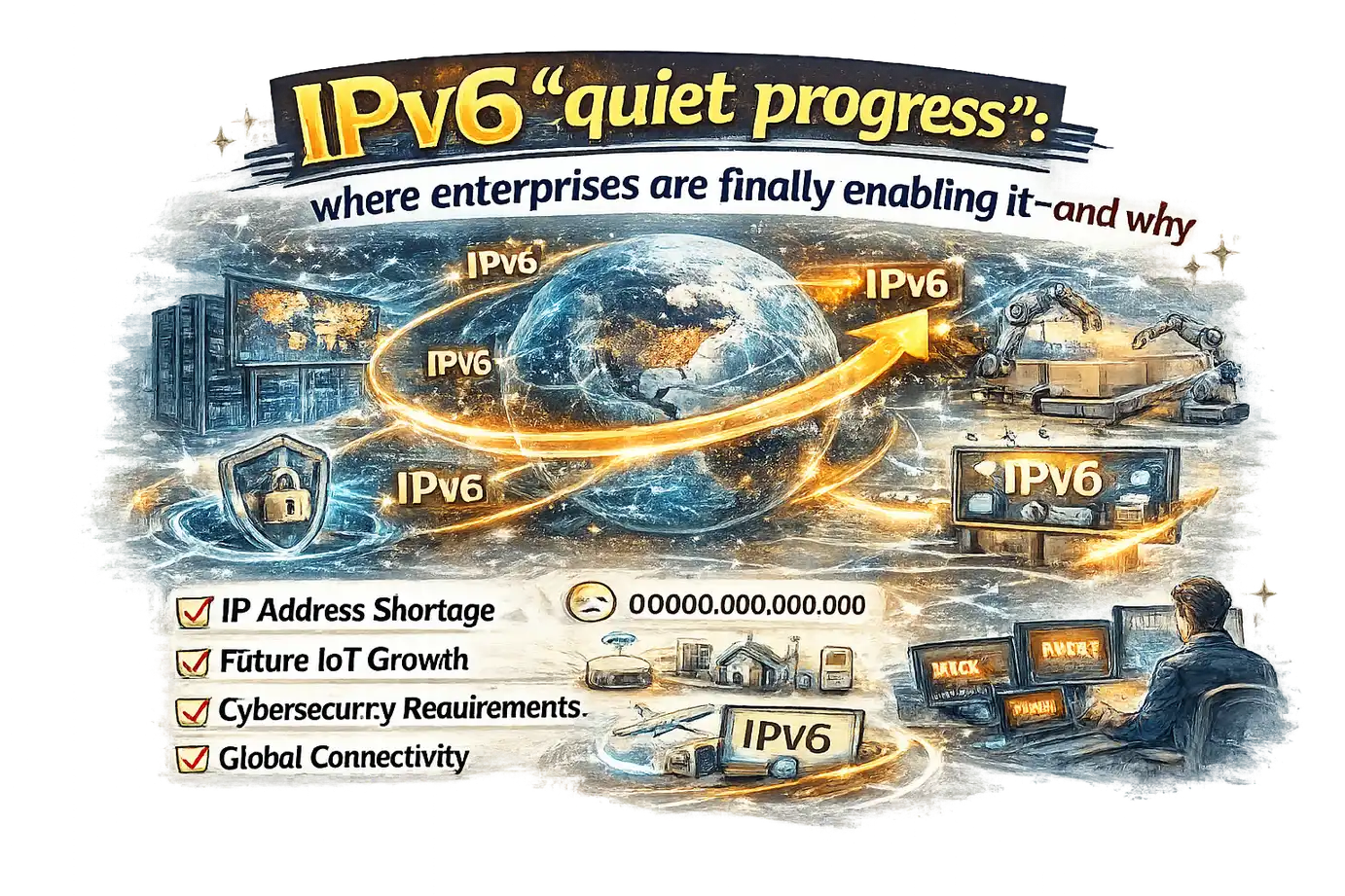
The most important driver is not ideology—it’s gravity. IPv4 address scarcity keeps pushing complexity outward: carrier-grade NAT for remote sites, awkward overlapping RFC1918 ranges during mergers, brittle NAT policies in multi-cloud, and constant exceptions in security rules and troubleshooting. IPv6 doesn’t magically simplify every network, but it removes an entire class of constraints that stem from trying to make too many endpoints fit into too few public addresses.
A second driver is architecture. Modern enterprise networks look less like a single campus with a data center and more like a mesh of branch edges, cloud VPCs/VNETs, SaaS dependencies, remote users, and identity-driven security controls. In that world, address management and reachability become policy problems as much as routing problems. IPv6—paired with mature DDI (DNS, DHCP, IPAM) and modern security controls—fits naturally into segmented designs where clarity and scale matter more than clever NAT gymnastics.
A third driver is “platform readiness.” The ecosystem is more IPv6-capable than it was even a few years ago: operating systems, browsers, CDNs, cloud providers, and many security vendors have hardened their IPv6 support. That doesn’t eliminate edge cases, but it reduces the fear of stepping into unknown territory. For many IT teams, the decision has shifted from “can we?” to “where do we get value first?”
Where enterprises are enabling IPv6 first
Enterprise enablement tends to cluster around areas where IPv6 directly reduces operational pain or aligns with technology refresh cycles. The common pattern is selective adoption: specific domains go dual-stack, certain services become IPv6-reachable, and monitoring/security become IPv6-aware as a requirement rather than a nice-to-have.
Internet-facing services and CDN front doors
The simplest “wins” often appear at the edge. Enterprises can enable IPv6 on public-facing properties—web apps, APIs, customer portals—without redesigning internal networks. When a CDN or edge platform terminates client traffic, IPv6 can be offered to clients even if origin services remain IPv4 behind the scenes. This is a low-risk way to reduce dependency on IPv4 scarcity and improve reachability for networks where IPv6 is preferred.
For IT professionals, this is also a forcing function for operational maturity. The moment you expose IPv6 externally, you must ensure WAF policies, rate limits, geo rules, bot management, and logging work identically across both protocol families. “Same policy, same visibility” becomes the standard. Enterprises that do this well often treat IPv6 enablement as a validation exercise for their edge security posture.
Cloud networking and multi-cloud segmentation
Public cloud environments are a major accelerant. Even when enterprises keep workloads dual-stack, the act of designing VPC/VNET layouts, routing, and security groups with IPv6 in mind changes how teams think about address space and segmentation. IPv6 addressing is plentiful, which makes it easier to allocate clean prefixes per environment, per region, per tenant, or per application domain—without constantly negotiating overlapping ranges.
In multi-cloud scenarios, IPv6 can reduce the “address collision tax” that appears when different teams independently pick private IPv4 ranges and later need connectivity. IPv6 won’t remove every integration challenge, but it can reduce the number of cases where a merger, acquisition, or new business unit forces a painful readdressing project just to establish predictable connectivity.
Campus Wi-Fi and modern access networks
Campus refresh cycles—new wireless controllers, Wi-Fi 6/6E/7 upgrades, NAC improvements, and segmented SSIDs—are a frequent entry point for IPv6. Many organizations enable IPv6 on client networks while keeping backend services dual-stack. The reasons are practical: modern client devices often prefer IPv6 when available, and IPv6 can reduce awkward NAT behaviors that complicate peer-to-service paths, telemetry, and performance troubleshooting.
This is also where policy and hygiene matter. When IPv6 appears on access networks, IT teams need consistent RA (Router Advertisement) behavior, appropriate protections against rogue RAs, and a clear stance on SLAAC versus DHCPv6 in different segments. The best outcomes come when IPv6 is treated as part of baseline access design, not an add-on to be patched later.
Branch offices, SD-WAN, and SASE edges
Branch connectivity increasingly relies on SD-WAN overlays and SASE policies, where the edge device becomes the enforcement point for segmentation, threat filtering, and application steering. In these architectures, IPv6 enablement often arrives as part of “edge modernization.” Some organizations run dual-stack at the branch WAN edge while keeping internal VLANs IPv4; others go dual-stack end-to-end for specific user segments.
The hidden benefit is operational: consistent addressing and fewer NAT layers can make it easier to correlate events across logs, trace flows end-to-end, and apply policy in a predictable way. The biggest blocker is typically tooling alignment—ensuring the SD-WAN/SASE platform offers parity in visibility, policy, and reporting for IPv6.
Kubernetes, container platforms, and service meshes
Cloud-native platforms push networking teams toward standardization and automation. In Kubernetes-heavy environments, the conversation isn’t only “Do we route IPv6?” but “Do our CNIs, ingress controllers, load balancers, and observability stacks behave correctly with IPv6?” Enterprises that are deep into container platforms often start by enabling IPv6 at the cluster edge, then expand into dual-stack pods and services when the surrounding ecosystem is ready.
IPv6 can be especially appealing where dense multi-tenant designs cause IPv4 planning headaches. With sufficient prefix allocation and clean addressing boundaries, teams can reduce the frequency of emergency re-IP work that arises when environments expand faster than expected.
IoT, device onboarding, and large-scale identity networks
IoT fleets, sensor deployments, smart building tech, and large device onboarding pipelines create address scale and segmentation pressure. Many of these deployments are naturally “greenfield” compared to legacy data center networks, which makes them good candidates for IPv6-first or dual-stack design. Enterprises are cautious here, not because IPv6 is risky, but because operational control must be tight: device inventory, certificate identity, segmentation, and telemetry collection all need to remain predictable.
IPv6 doesn’t replace identity-based control, but it can support it by giving you clean, structured address allocations that map logically to sites, floors, device types, and policy domains—without squeezing everything into overlapping private IPv4 blocks.
The “dual-stack reality” and what it means operationally
In most enterprises, the near-term destination is not “IPv6-only everywhere.” It is dual-stack in the places that matter, with selective IPv6-only segments where it’s safe and beneficial. Dual-stack is often described as a transition phase, but in practice it becomes an operating mode that can last for years. That’s fine—if it’s engineered intentionally.
Dual-stack done well means more than turning on an interface flag. It means your operating model assumes two parallel paths and avoids surprises when clients choose one over the other. DNS behavior, load balancer listeners, firewall rules, endpoint policies, and monitoring all need to treat IPv6 as a first-class citizen. The goal is parity: same outcomes, same enforcement, same visibility.
A common enterprise pattern is “IPv6 at the edge and access layer, IPv4 deeper inside” while internal services mature. Another pattern is “IPv6 enabled for new environments and acquisitions” where IPv6 becomes the cleanest way to integrate without readdressing.
Security teams are increasingly driving IPv6 enablement
It’s easy to assume security teams resist IPv6. Historically, that was sometimes true—because visibility and control lagged. Today, many security organizations are actively pushing for IPv6 readiness, because the alternative is shadow IPv6: endpoints and networks using IPv6 opportunistically without full monitoring, policy parity, or incident response confidence.
When IPv6 is ignored, problems show up in subtle ways: incomplete logs, blind spots in NDR/IDS coverage, confusing firewall policies, or analysts struggling to correlate events because assets appear under multiple address families. The quiet shift is that enterprises increasingly treat “IPv6 parity” as a security requirement.
- Firewall policy must support IPv6 objects, groups, and consistent segmentation logic.
- SIEM pipelines must normalize IPv6 fields and preserve them through parsing and enrichment.
- Threat intel, blocklists, and reputation systems must handle IPv6 addresses and prefixes.
- Vulnerability scanning and asset discovery must reliably identify IPv6-only endpoints.
- Incident response playbooks must include IPv6 flow analysis and log search patterns.
Enterprises that move fastest tend to align network engineering and security operations early. The best IPv6 deployments are not “network-only” initiatives—they’re cross-functional readiness programs where routing, DDI, endpoint engineering, SOC tooling, and governance move together.
Common blockers that are finally shrinking
IPv6 didn’t fail because it was technically inferior. It stalled in many enterprises because the surrounding ecosystem wasn’t consistently ready. That ecosystem has improved, and the remaining blockers are more manageable when approached systematically.
Legacy systems remain a stubborn issue. Some older appliances, embedded systems, and niche management tools still assume IPv4-only behavior. Enterprises are increasingly handling this by isolating those systems in IPv4-only segments while moving modern client and cloud environments forward. In other words, IPv6 progress doesn’t require perfection everywhere—it requires clear boundaries.
Skills and operational confidence are another blocker. IPv6 itself is not “hard,” but the operational details differ: addressing plans based on prefixes, neighbor discovery behaviors, RA guard considerations, and the mental shift away from NAT as a default safety blanket. Enterprises that succeed treat IPv6 as a competency-building effort, not just a configuration task.
Tooling parity is the last major blocker. Even when vendors claim IPv6 support, enterprises need proof in daily operations: dashboards, alerts, packet captures, flow logs, and policy objects all working cleanly. The encouraging trend is that more vendors now support IPv6 deeply enough that enterprises can standardize on a set of “IPv6-validated” tools and avoid fragile one-off workarounds.
Design choices enterprises are converging on
Although every enterprise differs, several practical patterns show up repeatedly in successful IPv6 programs. These patterns reduce ambiguity, simplify operations, and prevent partial deployments that create hidden risk.
Prefix planning is treated like architecture, not arithmetic. Enterprises increasingly allocate prefixes in a way that mirrors organizational boundaries: sites, regions, environments, and security zones. The objective is consistency and delegability. When a site or cloud environment can be assigned a stable prefix block, automation becomes easier and troubleshooting becomes less chaotic.
DNS becomes even more central. In dual-stack networks, DNS answers often determine which protocol path clients take. Enterprises that experience “mysterious” connectivity issues frequently discover that DNS behavior, split-horizon configurations, or inconsistent AAAA records are at the root. Quiet progress usually includes a quiet DNS modernization: clearer ownership, automated record management, and consistent policies for publishing AAAA records.
DDI maturity is a differentiator. IPAM that understands IPv6 prefixes, delegated blocks, and lifecycle management prevents the “spreadsheet of doom” from returning. DHCPv6 and SLAAC decisions are made per segment, based on device type, compliance needs, and operational preferences. The key is documented intent: teams know why a segment uses a particular method and what protections are in place.
Operational observability: the real make-or-break factor
If there is one area where enterprise IPv6 programs either accelerate or stall, it is observability. IT professionals don’t fear IPv6 addresses—they fear not being able to see what’s happening when something breaks at scale.
The “quiet progress” enterprises invest in includes making sure telemetry is boringly reliable: flow logs include IPv6 fields, packet capture workflows work the same way, CMDB and asset inventory link IPv6 to devices, and performance monitoring doesn’t accidentally ignore IPv6 paths. Troubleshooting should not become a special skill reserved for a few network engineers; it should be routine for NOC and SOC teams.
This is also where consistency matters. If IPv6 traffic follows different security or egress paths than IPv4, teams can end up debugging two separate networks. Mature enterprises deliberately avoid “split-brain networking” by ensuring policy, routing intent, and egress design are aligned across both families wherever possible.
Governance: enabling IPv6 without creating chaos
Enterprises that progress steadily treat IPv6 enablement like a platform program with guardrails. They define where IPv6 is supported, what “done” means, and how exceptions are handled. They also define ownership: who manages address plans, who publishes records, who validates security parity, and who signs off on production readiness.
A practical governance approach usually includes a lightweight set of standards that teams can follow without slowing delivery:
- Standard prefix allocation model for sites and cloud environments.
- Documented DNS policies for AAAA records and dual-stack service publication.
- Security parity requirements for firewalling, logging, and monitoring.
- Validated vendor/tool list for IPv6-capable platforms and operational workflows.
- Reference architectures for common patterns (branch, campus, cloud, Kubernetes).
This doesn’t have to be heavy bureaucracy. The goal is to avoid accidental IPv6—where it appears in some places without the supporting controls—and replace it with intentional IPv6 that’s observable, supportable, and secure.
What “quiet progress” looks like in real enterprise metrics
Because many deployments are incremental, progress can be hard to measure if your only yardstick is “percent migrated.” Enterprises often adopt more practical indicators:
- Percentage of internet-facing services reachable over IPv6 at the edge.
- Percentage of managed endpoints receiving IPv6 on primary access networks.
- Count of critical security controls with verified IPv6 parity (policy + logs + alerts).
- Number of cloud environments with standardized IPv6 prefix allocation and routing patterns.
- Reduction in IPv4 collision incidents during integrations and M&A connectivity work.
These metrics match how enterprises actually operate. They acknowledge that IPv4 won’t disappear overnight, while still driving meaningful outcomes: fewer NAT-induced headaches, cleaner segmentation, and better long-term scalability.
Why this matters to IT professionals right now
If you manage networks, infrastructure, security operations, or cloud platforms, IPv6 is increasingly part of your “default competency stack.” Even if your organization is not aiming for a full IPv6-only posture, you will encounter IPv6 in client behavior, vendor services, mobile connectivity, and cloud integrations. The operational question is not whether IPv6 exists—it is whether your environment handles it predictably and safely.
The quiet progress happening across enterprises is a signal that the industry is moving from theoretical IPv6 readiness to practical IPv6 enablement. That shift rewards teams that invest early in parity: consistent policy, consistent visibility, and consistent operational playbooks.
The near future: more IPv6-by-default decisions
Expect IPv6 to appear more frequently as an implicit requirement rather than an optional feature. New campus refreshes, edge security platforms, cloud landing zones, and large device onboarding programs increasingly assume IPv6 will be present. Enterprises that treat IPv6 as “someone else’s problem” risk drifting into partial deployments that create blind spots and brittle exceptions.
Enterprises that embrace the quiet approach—enable it where it creates value, validate parity, expand steadily—tend to avoid drama. IPv6 becomes another normal layer of the network, not a special project with a finish line. And in modern IT, normal is exactly what you want: fewer surprises, clearer policies, and a platform that scales without constantly fighting the limits of the past.


 12975
12975  IT Pro