La infraestructura AI en 2026 está impulsando centros de datos a una nueva realidad operacional: cargas de calor mucho más altas por rack, tolerancias mecánicas y eléctricas más estrictas, y una brecha mayor entre “trabaja en papel” y “se mantiene en producción”. Para los profesionales de TI, el cambio no se trata sólo de comprar aceleradores más rápidos. Se trata de diseñar entornos donde el enfriamiento, la entrega de energía y la resiliencia están diseñados como un sistema único, ya que a niveles de densidad de IA, una pequeña desalineación puede convertirse en trinquete, inestabilidad o tiempo de inactividad.
Este artículo se centra en lo que está cambiando en 2026 y en cómo traducir esos cambios en decisiones prácticas para la arquitectura, las adquisiciones, las operaciones y la planificación de las horas de trabajo, especialmente para los equipos que ejecutan flotas mixtas de cargas de trabajo de las empresas tradicionales y nuevos grupos de IA de peso GPU.
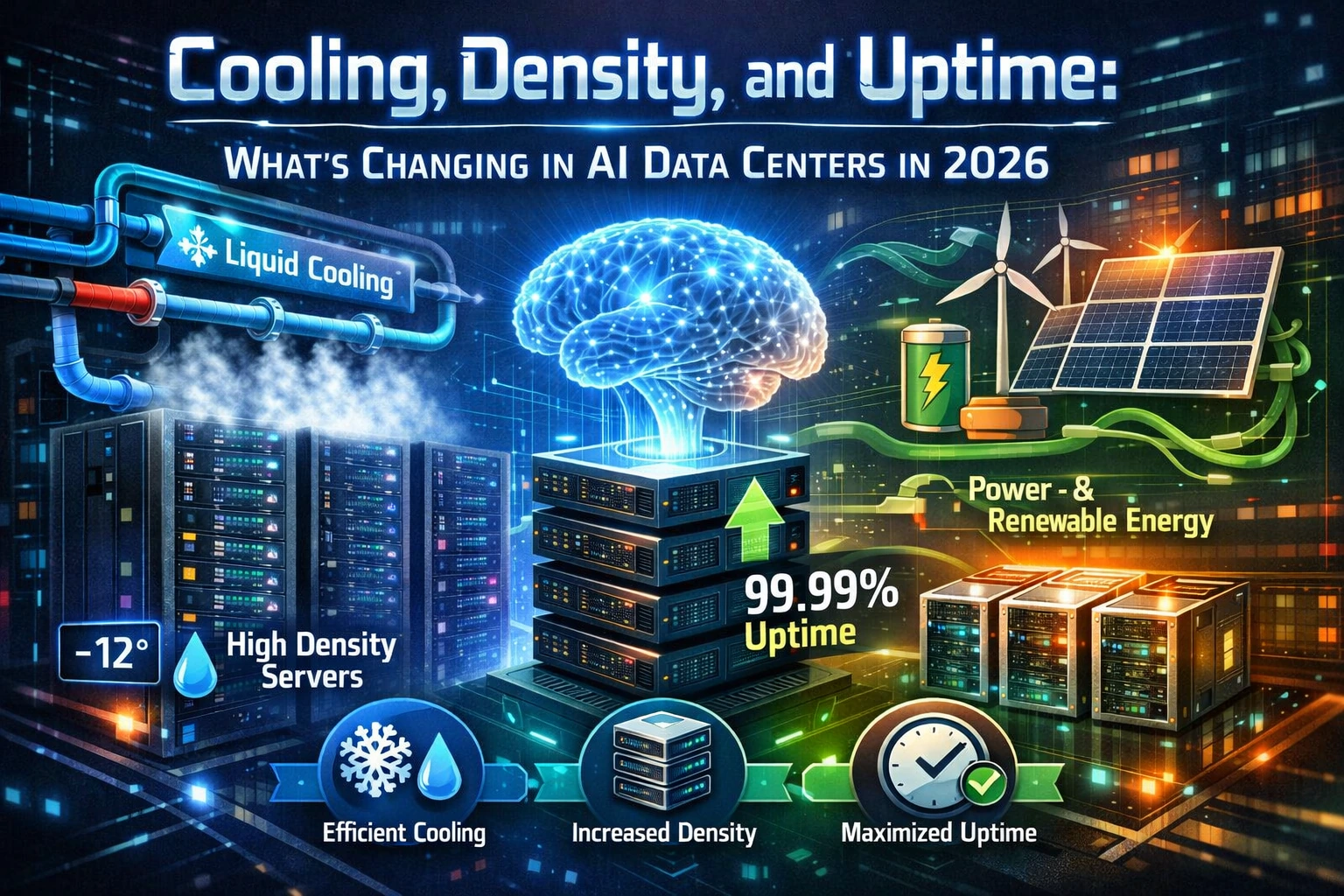
Key takeaway: En los centros de datos de AI, el enfriamiento ya no es un “problema de facilidad”, la densidad ya no es un “problema espacial”, y el tiempo de inactividad ya no es una “registro de rutina”. Estas tres fuerzas ahora interactúan continuamente, y los mejores operadores están construyendo flujos de trabajo y controles que los tratan como una disciplina.
Si tienes rendimiento de aplicaciones, SLAs, respuesta a incidentes o planificación de capacidades, ahora eres parte de la conversación de enfriamiento, ya sea que quieras ser o no.
¿Por qué enfriar es el titular en 2026
Los grupos de capacitación y de inferencia de IA concentran un enorme compute en huellas relativamente pequeñas. Esa concentración impulsa la densidad de calor hacia arriba, y la densidad de calor fuerza una opción: ya sea mantener la energía por rack lo suficientemente baja para que el aire convencional se mantenga cómodo, o adoptar enfoques con ayuda líquida que alejan el calor del silicio más directamente. En 2026, más organizaciones están encontrando que “el aire estándar” ya no coincide con los objetivos de rendimiento que están pagando.
El síntoma operativo que los equipos de TI ven primero no es a menudo un obvio “fallo de choque”. Se presenta como variabilidad de rendimiento intermitente, tropezando con GPU bajo cargas sostenidas, deriva inexplicable de tiempo de funcionamiento de trabajo o aumento de las tasas de error de hardware durante los picos. Son señales de fiabilidad tanto como señales térmicas.
- El comportamiento de carga sostenido importa más que el comportamiento de explosión: Las cargas de trabajo de IA funcionan durante largos períodos, lo que hace hincapié en el rechazo al calor y la gestión del flujo aéreo de forma diferente a la difícil empresa.
- El auricular térmico se convierte en una limitación de programación: Los racimos pueden requerir reglas de colocación de la carga de trabajo ligadas a la temperatura de los racks, temperatura refrigerante o límites de las instalaciones.
- Las opciones de enfriamiento afectan el diseño de las horas de trabajo: nuevas bombas, válvulas, múltiples y puntos de monitoreo añaden componentes que deben ser observados, mantenidos y hechos tolerantes a la falla.
El enfriamiento del aire no es “muerto”, pero su zona de confort está disminuyendo
El enfriamiento de aire sigue siendo viable para muchos despliegues, especialmente donde las densidades son moderadas o donde se distribuyen cargas de inferencia. Lo que está cambiando en 2026 es que el margen de error es más delgado. Contención en caliente, uniformidad de flujo de aire, en blanco, gestión de cables y equilibrio de presión ya no son “nice-a-haves”. Son controles de rendimiento.
En las habitaciones de alta densidad AI, los modos comunes de falla de refrigeración por aire son a menudo autoinfligidos: disciplina deficiente de contención, aire de derivación fugaz, obstrucción de suelos, controles mal ajustados de CRAC/CRAH, y población de rack desigual que causa puntos calientes localizados. Incluso cuando la temperatura total de la habitación se ve bien, un punto caliente obstinado puede convertirse en un problema de disponibilidad si desencadena repetidos problemas o inestabilidad del hardware.
Lo que los equipos de TI deben insistir en zonas de IA refrigeradas por aire
- Instrumentación de temperatura por riesgo, no solo “sensores de habitación”.
- Manejo de contención claro y control de cambio para paneles, puertas y en blanco.
- Los umbrales operacionales vinculados a la programación de empleos, no sólo alarmas de instalaciones.
- A documented airflow commissioning report after any major re-cabling or re-population.
El enfriamiento líquido se convierte en operaciones convencionales, no en un proyecto especial
El enfriamiento líquido no es nuevo, pero en 2026 se trata cada vez más como infraestructura estándar para los clusters densos AI. El gran cambio es cultural y operativo: el enfriamiento líquido no puede vivir sólo con instalaciones o sólo con un equipo de servicios de proveedores. Se convierte en parte de la práctica cotidiana del centro de datos “mantenerlo funcionando”, y IT debe entender sus dominios de falla y observabilidad.
Usted encontrará comúnmente varios patrones, a menudo mezclados dentro del mismo sitio:
- Placas frías directas a chip: flujos de refrigerante a través de placas conectadas a GPUs/CPUs, eliminando el calor cerca de la fuente, mientras que el resto del servidor todavía puede utilizar ventiladores para componentes secundarios.
- Intercambiadores de calor de puerta trasera: Los racks rechazan el calor a través de una puerta trasera refrigerada por líquido, reduciendo las temperaturas de aislamiento caliente y exigiendo el flujo de aire.
- Refrigeración de la inmersión: sistemas enteros están sumergidos en un fluido dieléctrico; fuerte para la densidad extrema, pero cambia los flujos de trabajo de servicio, compatibilidad de componentes y límites de soporte de proveedores.
- Enfoques híbridos: líquido en los chips más calientes, aire para todo lo demás, común como organizaciones transición sin rediseñar todo el edificio.
Para el tiempo de trabajo, la pregunta clave no es “¿es líquido refrigerado?” sino “¿dónde está el límite de transferencia de calor y qué sucede cuando algo en esa cadena se degrada?” Usted está agregando una cadena de suministro térmico: bombas, filtración, desconexión rápida, sensores, detección de fugas, química refrigerante y ciclos de mantenimiento. Esa cadena debe ser monitoreada y diseñada para fracasar con seguridad.
El diseño de refrigeración es ahora un contrato de rendimiento
En entornos empresariales tradicionales, el enfriamiento se trató a menudo como un sobre fijo: mantener la habitación dentro de las directrices y dejar que los servidores manejar el resto. AI cambia esa relación. Las condiciones térmicas ahora influyen directamente en cuánto compute usted realmente recibe para el poder que compra.
Por eso, las discusiones del centro de datos de 2026 incluyen cada vez más términos como “presupuesto térmico”, “deltas de la temperatura”, y “temperaturas de suministro refrigerantes” en las mismas reuniones como “uso de componentes” y “con rendimiento de trabajo”. Es la misma historia: si el enfriamiento no puede mantener condiciones estables bajo carga sostenida, sus aceleradores costosos entregarán menos trabajo por hora.
Cambio práctico de KPI para 2026
Agregue métricas de estabilidad térmica junto con métricas de tiempo libre. Seguimiento de eventos acelerados, variabilidad sostenida de reloj / salida, y tasas de error de hardware durante los períodos máximos. Correlarlos con temperaturas de rack, temperatura refrigerante y eventos de instalaciones. Así es como te conviertes en “cooling is fine” en “performance is consistent”.
La densidad está cambiando cómo se construyen las habitaciones y cómo se cablean los racimos
Las presiones de densidad de IA no paran de enfriar. Reforman el diseño físico y la arquitectura lógica del medio ambiente. En muchos 2026 construye, la “unidad de diseño” no es un rack. Es una cápsula, una fila o un bloque de racimo que incluye computación, redes y distribución de energía como un módulo diseñado.
Esto es especialmente visible en las redes. Los tejidos AI de alto rendimiento y los grandes patrones de tráfico este-oeste impulsan las decisiones de colocación de cables y conmutadores que son mucho más sensibles a la distancia, latencia y servicioabilidad que las redes empresariales clásicas del norte-sur. A medida que aumentan las densidades, las interferencias por cable y flujo de aire se convierten en riesgos físicos y riesgos operacionales.
- Corrientes de cable más cortas y vías estructuradas: reducir la complejidad, los problemas de señal y la perturbación del flujo aéreo.
- Dominios de falla predefinidos: pods diseñados para que un solo incidente eléctrico o enfriamiento no sea cascada en todo el clúster.
- Más atención a las autorizaciones de servicio: racks densos con manifolds líquidos y cableado grueso requieren espacio de mantenimiento realista.
El suministro de energía está colisionando con la realidad de la red
La densidad de IA fuerza una conversación de poder que solía ser opcional. Más cómputo por metro cuadrado significa más potencia por metro cuadrado, y que empuja cada capa: alimentadores de utilidad, transformadores, conmutadores, sistemas UPS, generadores y distribución dentro del espacio blanco. En 2026, muchos sitios también se ocupan de los tiempos más largos y de una coordinación más compleja con los servicios públicos.
Para TI, la implicación es directa: las limitaciones de poder pueden convertirse en limitaciones de capacidad mucho antes de que el espacio de planta. “¿Tenemos espacio para otro cúmulo?” se convierte en “¿Tenemos el acervo eléctrico, el enfriamiento de la cabeza y la capacidad de mantenimiento para ejecutarlo sin reducir la resiliencia?”
Cuestiones para llevar a las reuniones de planificación del poder
- ¿Cuál es nuestro perfil de potencia pico real bajo carga de IA sostenida, no el promedio?
- ¿Dónde están los cuellos de botella: servicio de utilidad, capacidad de UPS, tiempo de funcionamiento del generador o distribución en la habitación?
- ¿Qué sucede durante los eventos de failover: ¿los cúmulos pasan limpiamente o se reasientan?
- ¿Estamos validando la calidad de potencia y el comportamiento transitorio con el hardware AI actual instalado?
La estrategia de tiempo libre va de la “redundancia” a la “recuperabilidad”
Las conversaciones clásicas de tiempo de trabajo a menudo se centran en los niveles de redundancia y si los componentes son N+1 o 2N. En 2026 centros de datos AI, esas opciones todavía importan, pero no son suficientes por sí mismas. La pregunta operacional se convierte: cuando algo falla, ¿cómo puede el sistema degradarse, y cuán rápido puede restaurar el servicio completo sin desestabilizar el cluster?
Los grupos de IA tienen una sensibilidad única a los disturbios. Una breve interrupción de la red, un evento de energía o una fluctuación térmica puede desencadenar fallos de trabajo, re-queues, o tiempo de reentrenamiento caro. El tiempo de trabajo no es sólo “las luces se quedaron encendidas”. Es “la carga de trabajo continuó sin una perturbación costosa”.
- El mantenimiento continuo se convierte en un requisito de primera línea: necesita la capacidad de servicio de componentes de energía y refrigeración sin tomar el cluster hacia abajo o forzando modos de funcionamiento arriesgados.
- Aislamiento rápido de la falla: Identificar si se localiza un incidente (un rack, un CDU, un PDU) o sistémico (en todo el sistema) antes de que las acciones automatizadas amplifican el problema.
- Modos de degradación definidos: planifica formas de reducir temporalmente la carga, redistribuir las cargas de trabajo o aprovechar la energía eléctrica para estabilizar el medio ambiente.
La observabilidad se expande a la telemetría térmica y mecánica
No puedes operar lo que no puedes ver. Uno de los cambios más importantes de 2026 es que los centros de datos de IA integran cada vez más la telemetría de TI y las instalaciones en un panorama operativo compartido. El límite entre “DCIM”, “BMS” y “control de componentes” se vuelve borroso, porque los incidentes a menudo comienzan en un dominio y aparecen primero en otro.
Los operadores de maduración correlacionan estas capas:
- Controladores de rendimiento de GPU/CPU, banderas de rozamiento y telemetría de error.
- Temperaturas de entrada / salida y señales de presión diferencial.
- Fresas/temperaturas de retorno, caudales y métricas de salud de bomba.
- Eventos de UPS, anomalías de calidad de energía y eventos de transferencia de generadores.
- Salud de tejido de red ligada a fallas laborales y variabilidad de rendimiento.
El objetivo no es ahogarse en sensores. El objetivo es crear un pequeño conjunto de señales operativas que predicen la inestabilidad antes de que se convierta en tiempo de inactividad. Para los equipos de TI, esto a menudo significa la construcción de libros que incluyen explícitamente “pruebas térmicas” y “pruebas de cadena de enfriamiento” junto con el diagnóstico habitual de computación y red.
La Comisión y la validación se están haciendo continuas, no una sola vez
En ambientes densos AI, encargar no es algo que hace una vez en go-live y luego olvidar. Los cambios en la población de racks, el enrutamiento de cables, el firmware, las curvas de ventilador, la química refrigerante e incluso la mezcla de trabajo pueden alterar el comportamiento térmico y eléctrico de la habitación. En 2026, muchas organizaciones están adoptando prácticas de " comisión continua ": validación periódica bajo cargas de trabajo realistas y calibración regular de controles.
Desde una perspectiva de TI, aquí es donde la ingeniería de rendimiento cumple con la ingeniería de instalaciones. Sus pruebas de estrés y pruebas de remojo se convierten en parte de la validación de instalaciones. Asimismo, los eventos de instalaciones se convierten en parte de sus pruebas de fiabilidad. Cuando planificas una expansión importante de grupos, el enfoque adecuado es validar el sistema en su conjunto, no sólo para atornillar los servidores y esperar que el medio ambiente se mantenga.
Una mentalidad práctica de validación de la habitación de la IA
Tratar cambios importantes en los grupos como las liberaciones de producción. Requiere una instantánea térmica y de energía pre-cambio, un período de rampa previsto, y acciones definidas de revolvimiento o de carga si la estabilidad indica la deriva. Esto reduce drásticamente el número de incidentes de “misterio” después de las expansiones.
El riesgo operacional se mueve a conectores, controles y personas
A medida que el enfriamiento se vuelve más complejo, muchos outages se vuelven menos acerca de una única falla de componente catastrófico y más sobre la coordinación: un circuito de control sintonizado mal, un malteado sensor, una posición incorrecta de válvula después del mantenimiento, un desajuste de firmware que cambia el comportamiento de los ventiladores, o un umbral de detección de fuga fijado demasiado agresivamente. Los centros de datos AI de alta densidad en 2026 son cada vez más “sistemas de sistemas”, y el tiempo de inactividad depende de la disciplina operacional tanto como del hardware.
Los líderes de TI pueden reducir este riesgo formalizando flujos de trabajo de equipo cruzado. Si un cambio de instalaciones puede alterar el rendimiento de trabajo, merece la gestión del cambio y la planificación de la devolución. Si un cambio de TI puede aumentar la potencia sostenida, merece una revisión del impacto de las instalaciones. Así es como evitas la deriva silenciosa hacia la inestabilidad.
- Respuesta unificada de incidentes: proceso compartido de sala de guerra para incidentes térmicos, de potencia, de red y de carga de trabajo.
- Control de cambio de dominio cruzado: cambios de las instalaciones conectados con la misma gravedad que los cambios de producción de TI.
- Ventanas de mantenimiento estándar: Tiempos previstos para las intervenciones en las cadenas de enfriamiento y las vías eléctricas, alineados con la programación del volumen de trabajo.
Lo que esto significa para las conversaciones de adquisición y proveedores
En 2026, comprar infraestructura AI rara vez es una simple “compra de servicio”. Es una decisión sobre compatibilidad de instalaciones, servicio y madurez operacional. Las revisiones de las adquisiciones y la arquitectura ahora suelen incluir preguntas que solían pertenecer exclusivamente a la ingeniería del centro de datos.
Al evaluar las plataformas de IA, concéntrese en el sobre operacional real:
- Requisitos térmicos y tolerancias: comportamiento esperado bajo carga total sostenida, y qué telemetría está expuesta para monitoreo y automatización.
- Integración de refrigeración: cómo se manejan las conexiones líquidas, los flujos de trabajo de servicio, la estrategia de detección de fugas y quién posee qué partes de apoyo.
- Comportamiento de poder: características transitorias, opciones de limitación de potencia y estabilidad durante las transiciones de UPS o generador.
- Servicios: requisitos de limpieza reales, expectativas de tiempo a pago, y si las acciones de intercambio caliente introducen choques térmicos o de energía.
Las conversaciones más fuertes de proveedores en 2026 son las que tratan el rendimiento y el tiempo de actividad como una responsabilidad conjunta: el proveedor proporciona orientación operativa validada y telemetría, y el operador proporciona un ambiente controlado y monitorizado que coincide con esos requisitos. Si cualquiera de los dos lados trata al otro como “el problema de alguien más”, usted consigue sorpresas costosas.
Cómo actualizar sus corredores para densidad de la era AI
Muchos equipos de TI descubren que sus corredores existentes son incompletos para operaciones de IA. Pueden tener procedimientos sólidos para fallos de red, problemas de hipervisor, retraso en el almacenamiento o incidentes de aplicación, pero una cobertura débil para los modos de falla vinculados a las instalaciones que densa AI introduce.
Actualizaciones de Runbook que pagan inmediatamente
- Agregue los pasos de “trigo acelerador” que incluyen temps de entrada de rack, temps refrigerantes y controles de integridad de flujo de aire.
- Cree un procedimiento de reducción de carga segura para estabilizar la habitación durante eventos térmicos o de energía eléctrica.
- Definir las rutas de escalada que incluyen ingenieros de instalaciones temprano, no después de horas de solución de problemas de TI.
- Añadir correlación post-incidente: fracasos laborales vs instalaciones eventos vs telemetría ambiental.
- Efectos de mantenimiento de documentos: qué cambios durante el servicio de bombas, intercambiadores de filtros o ajuste de control.
El objetivo es reducir el tiempo a diagnóstico. En entornos densos de IA, el costo del diagnóstico lento es alto: fallan las cargas de trabajo, se acumulan las colas y la inestabilidad se extiende a medida que los sistemas intentan compensar. Un corredor que trata la energía térmica y la energía como señales de primera clase ya no es opcional.
La seguridad y el cumplimiento también están evolucionando con instalaciones de inteligencia artificial
A medida que los sitios adoptan más sensores, monitorización más remota y controles de instalaciones más integrados, la superficie de ataque crece. Los profesionales de la TI deben asumir que los controles de construcción, las plataformas DCIM y los oleoductos de telemetría forman parte del ámbito de seguridad. En 2026, los equipos maduros están alineando sistemas de instalaciones con patrones de seguridad empresarial: redes segmentadas, autenticación fuerte, logging de auditoría y acceso remoto controlado para los proveedores.
Operacionalmente, los mayores riesgos de seguridad provienen de excepciones impulsadas por conveniencia: caminos de acceso remoto no gestionados, credenciales compartidas e integraciones “temporarias” que se vuelven permanentes. Si el tiempo de trabajo importa, las operaciones seguras importan. Un entorno de control comprometido o inestable puede ser tan disruptivo como un componente de energía fallido.
La mentalidad 2026: diseño para la realidad sostenida, no condiciones ideales
El cambio definitorio en los centros de datos AI en 2026 es que la optimización ha pasado de la capacidad teórica máxima a la entrega operacional sostenida. El enfriamiento debe ser estable bajo largas carreras calientes. La densidad debe ser útil, no sólo espacial. El tiempo de trabajo debe incluir la recuperabilidad, no sólo la redundancia.
Para los profesionales de TI, el movimiento práctico es tratar la instalación como parte de la plataforma. Cuando planificas la capacidad de IA, incluye los auriculares térmicos y eléctricos como restricciones explícitas. Cuando defina SLAs, incluya métricas de estabilidad de rendimiento. Cuando se ejecutan incidentes, correlacionan entre TI y telemetría de instalaciones. Cuando usted adquiere, demanda los sobres operativos validados y los límites de soporte.
En 2026, los centros de datos AI ganadores no son sólo los más nuevos. Son los que pueden ejecutar ese hardware a todo valor, de manera consistente, segura y previsible.

 12994
12994  IT Pro