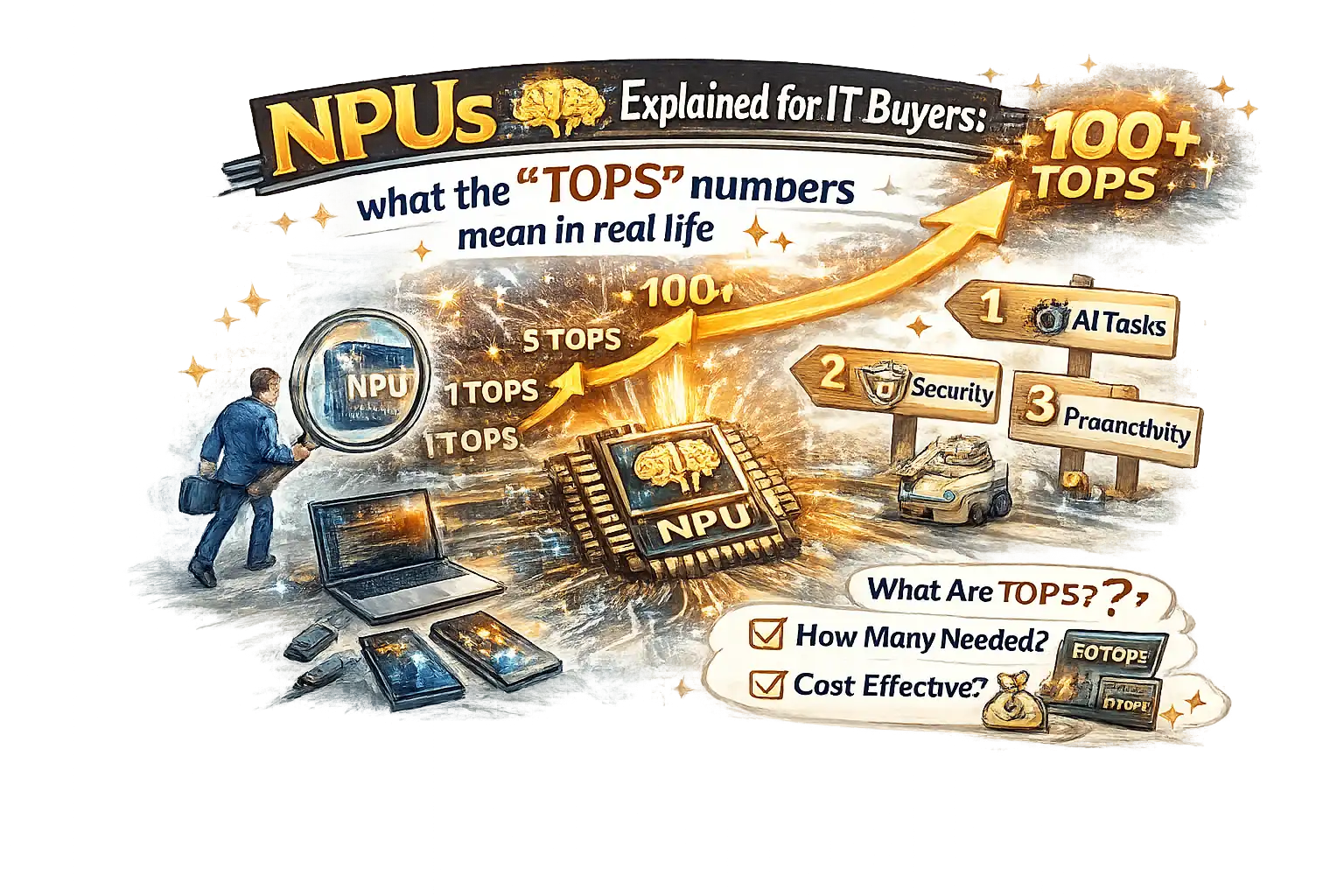
NPUs have moved from “nice-to-have” silicon to a line item that shows up in laptop RFPs, VDI refresh debates, and endpoint security roadmaps. Yet the number most often used to describe them—TOPS—can be misleading when treated like GHz or core counts. For IT buyers, the practical question is not “How many TOPS does this NPU have?” but “What workloads will it accelerate, at what latency, with what power and software constraints, and for how long in the lifecycle of the device?”
This article translates TOPS into procurement language: what it measures, what it hides, and how to test real-world value for enterprise endpoints. The goal is to help you make decisions that survive both vendor marketing and the fast-moving AI software stack.
Why NPUs exist on PCs and endpoints
Enterprise endpoints now run more AI features than most teams realize. Some are obvious, like meeting transcription, background blur, and “studio” audio cleanup. Others hide inside security products, browser features, image processing pipelines, accessibility tools, or even OS-level experiences. Traditionally, these tasks ran on CPU or GPU. That works, but it burns power, steals GPU time from graphics workloads, and can create noisy performance cliffs on thin-and-light machines under battery constraints.
The NPU’s job is to handle common AI inference workloads efficiently: low latency, sustained throughput, and minimal power draw. In procurement terms, the NPU is an “efficiency accelerator.” When it works well, you get longer battery life during AI-heavy collaboration, fewer thermal events, more predictable foreground performance, and potentially better privacy because more processing can remain on-device.
What TOPS actually means
TOPS stands for “trillions of operations per second.” In theory, it’s a throughput metric: how many arithmetic operations the accelerator can execute each second. In marketing, it often becomes shorthand for “AI performance,” but that’s only sometimes true.
The first trap is the word “operation.” Vendors may count different kinds of math as an “op.” Some count integer operations (common for quantized inference). Others emphasize floating-point operations, or present multiple figures for different precisions (INT8, INT4, FP16, etc.). The second trap is that TOPS is usually a peak number, measured under ideal conditions that do not resemble your endpoints running Teams, a browser with 30 tabs, EDR, DLP, VPN, and an encrypted disk.
Treat TOPS like “peak network bandwidth on a switch.” Useful, but only as a starting point. Your experience will depend on the entire path: software frameworks, model precision, memory bandwidth, driver maturity, scheduler behavior, and whether your target apps can even use the NPU.
Peak TOPS vs effective TOPS
Peak TOPS is the maximum theoretical throughput under a specific precision and clock/power envelope. Effective TOPS is what your workload achieves in practice. Effective throughput can be dramatically lower due to bottlenecks that have nothing to do with raw compute.
Common reasons effective performance drops:
Model memory traffic dominates compute. Many modern models move a lot of data. If the accelerator is waiting on memory, more compute units (and more peak TOPS) won’t help much.
Operator coverage is incomplete. If your model uses layers the NPU runtime doesn’t accelerate, those layers fall back to CPU/GPU, introducing stalls and copy overhead.
Precision mismatch. If the NPU’s headline TOPS assumes INT8 but your stack runs FP16, or you can’t quantize without quality loss, you may never reach the advertised tier.
Thermal and power constraints. Thin laptops may not sustain the peak number for long. Sustained AI sessions behave more like “continuous load” than a burst benchmark.
System contention. Real endpoints are busy. Background services, video decode, encryption, and security inspection can steal cycles or increase latency.
Precision is the hidden multiplier behind TOPS
The same silicon can have very different TOPS figures depending on numeric precision. Lower-precision math (like INT8 or INT4) can run many more operations per cycle than higher-precision floating point. This is why you might see vendors advertise a large TOPS number “for INT8” while FP16 or FP32 figures are much smaller.
For IT buyers, the key is to ask: what precision does the workload actually use? Many enterprise use cases—speech enhancement, transcription, small language models for summarization, or vision models for webcam effects—can run well quantized. Other workloads, especially custom models or high-accuracy scenarios, may require higher precision, or at least careful calibration to maintain quality.
A practical procurement takeaway: if the vendor’s TOPS headline is tied to a precision you cannot practically deploy, that number is not relevant to your environment.
Latency matters as much as throughput
TOPS is throughput, not latency. Many endpoint AI experiences are latency-sensitive: the model must respond quickly to user input, microphone streams, or camera frames. A device with higher TOPS can still feel worse if it has higher end-to-end latency due to scheduling overhead, framework inefficiencies, or frequent CPU fallbacks.
In real life, users notice latency before they notice throughput. If background blur starts late, if noise suppression “pumps,” if captions lag, or if local summarization takes long enough that the user clicks away, the NPU value proposition collapses—even if the chip can brag about peak TOPS.
Memory bandwidth: the quiet limiter
AI inference is often constrained by memory bandwidth and cache behavior. The accelerator needs to fetch weights and activations quickly. If the NPU shares memory with the CPU and GPU, the system can become memory-contention bound under mixed workloads.
This is why two devices with similar TOPS can behave differently in sustained workloads. One might have a better memory subsystem, more efficient on-chip caching, or fewer interconnect penalties between the NPU and main memory. Procurement teams rarely get a clean “AI memory bandwidth” number, so the safest approach is to benchmark representative workloads under real endpoint conditions.
Software stack reality: can your apps use the NPU?
The NPU is only valuable when your software can target it. In enterprise deployments, this hinges on the OS, drivers, runtimes, and application support.
Your checklist should include:
Runtime availability. Is there a stable inference runtime that supports the NPU and integrates cleanly with your management and patch processes?
Framework compatibility. Do your workloads run via common frameworks (for example, ONNX-based pipelines or vendor-provided SDKs), or are they locked to a stack that prefers GPU?
Application readiness. Are the collaboration and productivity apps your users rely on actually offloading to the NPU on your OS build? “Supports NPU” in a release note is not the same as “offloads consistently in your tenant configuration.”
Driver maturity and regression risk. Accelerators are driver-sensitive. If your environment emphasizes stability, you need a clear update strategy and rollback plan.
Enterprise telemetry. Can you measure whether the NPU is engaged? If you can’t observe offload behavior, you can’t validate value or troubleshoot user complaints.
Interpreting vendor numbers without getting trapped
When vendors present TOPS, assume it is a best-case, peak scenario. Your job is to translate it into procurement-grade questions:
What precision is used for the advertised TOPS figure?
Is that precision realistic for the models we run, at our required quality?
What is the sustained performance under continuous inference, and at what power draw?
Does the system throttle under typical enterprise loads?
How does performance change when the system is on battery, connected to VPN, and running EDR?
What percentage of the model graph runs on the NPU versus CPU/GPU fallback?
Can we validate NPU engagement and utilization with built-in or vendor tools?
If a vendor cannot answer these without hand-waving, treat TOPS as a marketing label rather than an engineering metric.
Real-life scenarios where NPUs help enterprise IT
The strongest value cases tend to be always-on, low-to-medium complexity inference that runs all day and competes with user workloads.
Collaboration enhancements are a common win: background effects, auto-framing, gaze correction, and audio cleanup can run continuously during meetings. When that workload moves off CPU/GPU, you often see lower fan noise, fewer stutters, and more predictable battery behavior.
On-device transcription and captioning can reduce cloud dependency and improve responsiveness for users in low-bandwidth environments. It can also help organizations that prefer to minimize audio data leaving the endpoint.
Lightweight local summarization, rewriting assistance, and semantic search over small local corpora can be feasible when models are compact and quantized. The NPU can make these workflows feel “instant” without spiking CPU usage.
Camera pipelines and image processing for field workers or support teams—document capture, blur detection, auto-cropping—often benefit from consistent, low-power inference.
Some security analytics can also benefit, especially patterns that map to inference-like pipelines. However, buyers should validate claims carefully because security vendors may choose GPU or CPU for operational reasons, or rely on cloud scoring.
Where TOPS won’t save you
Large, general-purpose generative models are not automatically “solved” by an NPU. If you expect desktop-class local generation for complex tasks, you may still need GPU acceleration, more memory, and a stack tuned for that workload. Many “big model” experiences are still dominated by memory capacity, memory bandwidth, and software optimization rather than raw TOPS.
NPUs are best seen as efficiency engines for specific inference classes, not magic hardware that replaces GPUs for every AI need.
A procurement-friendly way to compare NPU platforms
Instead of ranking devices by TOPS alone, build a comparison matrix that reflects enterprise reality.
Workload fit: list the AI experiences your users actually run today and the ones you expect to standardize over the next 12–24 months.
Offload verification: confirm whether each workload uses the NPU reliably on your chosen OS build.
Latency and responsiveness: measure user-visible outcomes, not just throughput.
Sustained performance: test a 20–30 minute continuous session, not a short benchmark.
Battery impact: compare watt-hours consumed for the same “meeting + AI effects” scenario.
Thermal behavior: track fan curves and throttling events during realistic multitasking.
Manageability: ensure drivers and runtimes integrate with your patch cadence, endpoint management, and security controls.
Supportability: evaluate tooling, logging, and vendor responsiveness when inference fails or offload regresses.
How to benchmark NPUs in a way that maps to business outcomes
A useful benchmark strategy for IT organizations has three layers.
Start with a representative app workflow. For example, a video call with background effects enabled, captions on, and a realistic multitasking profile in the background. Measure CPU usage, GPU usage, battery drain per hour, and user-visible responsiveness.
Add a controlled inference test. Use a small set of models you can legally run and repeat. The goal is not to publish a score, but to compare platforms under identical conditions: same model, same precision, same batch size, same runtime configuration.
Finish with stress and regression testing. Run the same scenarios after driver updates, OS patches, and application updates. NPUs are new enough that regressions are a real operational cost.
If you can’t establish a repeatable “golden path” test, you’ll struggle to justify premium hardware costs because you won’t be able to prove the performance or power improvements.
Security, privacy, and governance implications
On-device AI can reduce data exposure by keeping processing local, but it also changes your endpoint risk model. You now have model assets, caches, and potentially sensitive embeddings on client devices. This intersects with your disk encryption, DLP, and incident response playbooks.
IT teams should ask:
Where are model files stored, and how are they updated?
What telemetry is generated, and can it be controlled under enterprise policies?
Can sensitive outputs be prevented from being indexed or cached locally?
How do you validate that an “on-device” feature is truly on-device under your configuration?
NPUs make it easier to run models locally, but governance still requires disciplined configuration management and auditability.
Lifecycle planning: avoid buying for today’s demo
NPU adoption is moving fast, and enterprise refresh cycles are slow. The biggest risk is buying endpoints optimized for a demo workload that your organization will not standardize, while missing the capabilities that will matter in year two or three of the device lifecycle.
Prioritize platforms with strong software ecosystem support, stable driver delivery, and observability. A slightly lower TOPS number on a mature, well-supported platform can outperform a higher TOPS part in enterprise reality if the runtime and app ecosystem are stronger.
Also consider cross-vendor portability. If your internal tools can target common model formats and runtimes, you reduce lock-in and improve your ability to switch hardware in future refreshes.
A practical interpretation guide for TOPS in enterprise buying
Treat TOPS as a rough ceiling, not a promise. Higher can help, but only if the workload can use the precision and operators that unlock that ceiling, and only if the platform sustains the performance within your power and thermal envelopes.
In practice, TOPS becomes meaningful when you can map it to:
The models and features you plan to standardize across the fleet
The precision you can deploy without quality regressions
A repeatable benchmark that measures latency, sustained performance, and battery impact
Operational support: drivers, runtime updates, telemetry, and policy controls
If a device wins on those, the TOPS number will feel “real.” If it only wins on a spec sheet, you will pay for silicon that sits idle.
Closing perspective for IT teams
NPUs are becoming a standard part of endpoint architecture, but procurement success depends on refusing to buy on headline numbers. TOPS is not a universal score. It is a peak throughput figure that varies with precision, model structure, memory behavior, and software maturity.
The IT buyer’s advantage is discipline: define your target workloads, validate offload, measure latency and battery impact, and require observability. When you do that, NPUs become easier to evaluate than they look. You stop debating marketing claims and start comparing outcomes: quieter meetings, longer battery life, more stable user experience, and a clearer path to on-device AI features that matter in enterprise operations.


 12975
12975  IT Pro