In stable times, connectivity is treated like a utility: always there, always improving, and mostly invisible. During war or severe conflict, that illusion disappears fast. Power becomes unreliable. Fiber routes get cut. Cell towers go dark. Border links become congested, restricted, or physically damaged. Even when links remain technically “up,” service quality can collapse under load, disruption, or policy changes.
For IT professionals, the challenge is not to “hack around” reality, but to design systems and operational practices that degrade gracefully, keep critical functions alive, and preserve trusted communications under stress. This is a resilience problem across layers: physical paths (underground cables and backbone links), routing and peering (how traffic finds a path), access networks (last mile and wireless), platform architecture (applications and data), and human operations (process, coordination, and incident response).
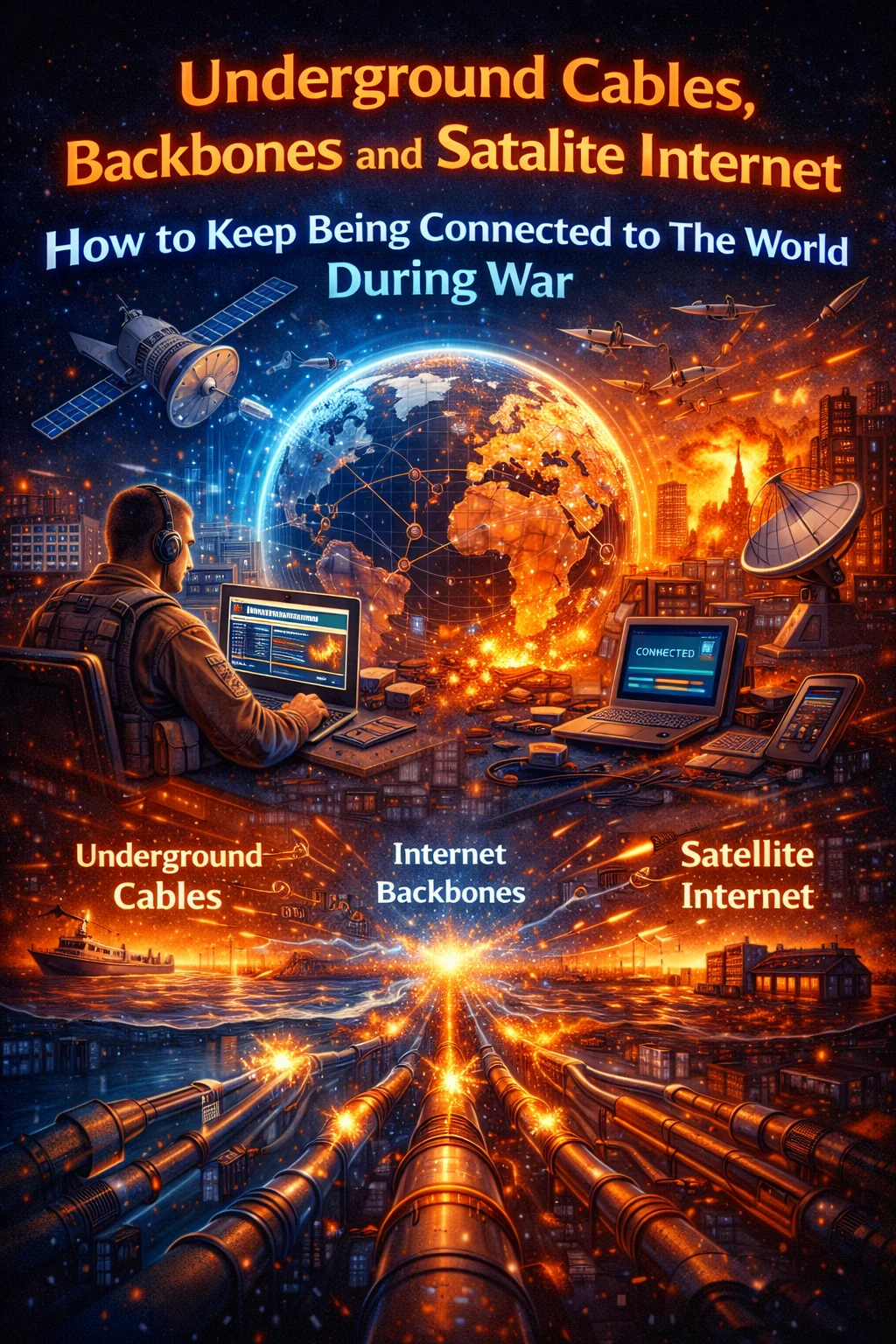
This article explains how underground fiber, core backbones, and satellite internet fit together in wartime connectivity, what failure modes to expect, and how to build a practical continuity posture for organizations without drifting into tactics that enable harm. The goal is reliable, lawful, and defensible connectivity for critical business services, public-facing platforms, and protected communications.
Connectivity Under Stress: What Actually Breaks
Conflict changes the threat model from “random outages” to “systemic disruption.” The most common patterns include physical damage to infrastructure, deliberate service restrictions, abrupt routing changes, power instability, and load spikes caused by population movement and information demand. Unlike normal outages, these failures are often correlated: a single incident can affect power, mobile access, fiber distribution, and transport simultaneously.
Underground fiber is often perceived as safe because it is buried, but it remains vulnerable at chokepoints: conduits, street crossings, bridges, metro aggregation sites, and long-haul junctions. “Backbone” networks—those high-capacity links connecting cities, regions, and international gateways—depend on a relatively small number of facilities where fiber routes converge, where carriers interconnect, and where routing policy is enforced. If those facilities are damaged, isolated, or politically constrained, the entire region’s connectivity can deteriorate quickly.
Satellite internet is different: it can bypass damaged terrestrial last-mile and cross-border routes, but it still depends on ground infrastructure, spectrum regulation, clear sky visibility, and a working power source at the terminal. Satellite is not magic, but it can be a powerful “path diversity” option when designed into a broader continuity plan.
Underground Cables: Strong Backbone, Fragile Chokepoints
Modern underground fiber networks are built in layers. Local distribution connects buildings to street cabinets or neighborhood nodes. Metro aggregation gathers traffic to central offices, carrier hotels, or data centers. Long-haul fiber carries aggregated traffic between cities and to international gateways. The deeper you go into the network, the fewer physical routes exist, and the higher the concentration risk becomes.
Underground fiber usually survives random storms better than aerial lines, but wartime disruption is not random. Physical damage tends to happen near known intersections of critical infrastructure: bridges, tunnels, rail corridors, central exchanges, and shared conduits. Even if a cable is buried, it often emerges at buildings and facilities that are easier to impact. Repair times can also expand dramatically due to safety constraints, permit restrictions, or limited access to materials and crews.
For IT operations, the practical takeaway is route diversity. Buying “two internet circuits” is not enough if both terminate in the same building, traverse the same metro rings, or ultimately converge at the same upstream provider and gateway. True resilience requires diversity in the physical path, the provider, and the upstream routing domain.
When evaluating terrestrial circuits for continuity, insist on clarity around physical diversity where feasible: separate last-mile entry points, separate metro aggregation, and separate long-haul corridors. Where carriers cannot guarantee path diversity, treat the circuits as partially redundant and plan additional options at higher layers.
Internet Backbones: Peering, Gateways, and Routing Reality
“Backbone” usually refers to high-capacity transport and core routing that connects major networks. In peaceful conditions, traffic flows across multiple interconnect points: internet exchanges (IXPs), carrier interconnect facilities, and private peering. During conflict, those relationships can change rapidly. Networks may withdraw routes, filter traffic, prioritize government or emergency services, or become isolated due to physical loss of a few interconnect nodes.
From an enterprise standpoint, the most important concept is that the internet is not one network; it is many networks stitched together by routing policy. When routing policy shifts, your “reachable services” can change even if your local link is up. A service hosted in one country might remain reachable while another becomes slow or unreachable. Some CDN edges may go offline, and DNS resolution may still work while application paths fail.
This is why multi-homing and geographic hosting diversity matter. If you can advertise your public services through multiple providers and maintain alternative hosting regions, you can survive disruptions that isolate a single carrier, a single data center region, or a single cross-border corridor.
For IT professionals who manage public-facing infrastructure, resilience is less about squeezing the last milliseconds of latency and more about maintaining at least one reliable path to critical services—identity, customer portals, communications, and essential data access.
Subsea and Cross-Border Links: The Global “Arteries”
The world’s international connectivity heavily depends on subsea cables and cross-border terrestrial fiber. Regions often have only a few high-capacity international paths, even if they appear to have many retail ISPs. During conflict, international bandwidth can become constrained due to damage, rerouting, or policy decisions. If traffic is forced onto longer paths, latency increases and packet loss rises, which can make modern encrypted protocols and real-time applications feel unreliable.
This directly impacts cloud dependencies. Applications that require constant back-and-forth with distant cloud regions will degrade quickly under high latency and loss. Systems that can continue operating locally—caching, local authentication fallback, local queues, offline-first workflows—tend to survive longer.
The simplest strategic shift is to treat “international internet” as a scarce resource during conflict and architect critical workloads to tolerate constrained external bandwidth, including the possibility of intermittent connectivity.
Satellite Internet: What It Is and When It Helps
Satellite connectivity is often discussed as a single category, but it includes several architectures. Geostationary satellites (GEO) sit far from Earth and typically have higher latency, but can offer broad coverage and stable links. Medium Earth orbit (MEO) and low Earth orbit (LEO) constellations reduce latency and can provide high throughput, but require more complex tracking and depend on constellation and ground network availability.
The core advantage of satellite during war is path diversity. It can bypass damaged local fiber and mobile infrastructure, and it can sometimes bypass congested or disrupted terrestrial backbones. For continuity planning, satellite is best treated as an alternate “egress path” for critical traffic rather than a full replacement for fiber in normal operations.
Satellite has real constraints: it still needs power at the endpoint, clear placement for the terminal, workable network management, and compliance with local regulations. It can also be affected by congestion, service limits, and dependency on remote ground stations and interconnect agreements.
For IT teams, the practical question is not “satellite or fiber,” but “how do we integrate satellite into our failover design without breaking security, identity, and governance?” That integration is where the real engineering work lives.
Design Principles for Staying Connected When Everything Degrades
Resilience is built by assuming partial failure. During conflict, you may have electricity but no mobile signal, mobile but no international routes, or intermittent connectivity that comes and goes unpredictably. Systems that require “perfect internet” tend to fail dramatically. Systems that can tolerate delay, loss, and temporary disconnection tend to remain useful.
Strong continuity programs focus on diversity, simplification, and prioritization. Diversity means multiple independent paths. Simplification means reducing moving parts and dependencies. Prioritization means keeping essential functions alive while pausing non-essential services.
- Path diversity: combine at least two distinct access methods when feasible (separate fiber providers, fixed wireless, or satellite as a contingency path), and validate that they do not share the same physical chokepoints.
- Control plane resilience: make sure DNS, identity, and key management still function when the network is impaired or segmented.
- Application tolerance: design apps to handle timeouts, retries, and queues safely; avoid brittle synchronous dependencies across long-distance links.
- Data survivability: ensure critical data is replicated across regions and that local copies exist for operational continuity.
- Operational clarity: define what “minimum viable service” means, and rehearse how to switch into that mode quickly.
Multi-ISP, Multi-Region, and Multi-Cloud: Practical Redundancy Without Fantasy
For enterprise networks, the first step is multi-provider access with verifiable diversity. A second fiber circuit from the same carrier family may not provide meaningful redundancy if it shares ducts, metro rings, or upstream gateways. When possible, use carriers that have different backbone footprints and different international upstream relationships.
At the hosting level, distribute critical services across at least two regions that are unlikely to fail together. If your organization operates in or near a conflict zone, consider hosting public-facing services and core identity outside the zone while keeping a local operational footprint that can function in reduced connectivity mode.
Multi-cloud can help, but it also increases complexity. In wartime conditions, complexity becomes an outage multiplier. If you pursue multi-cloud, do it selectively: replicate only the services that truly need it, standardize deployment and observability, and avoid fragile cross-cloud coupling that collapses when latency spikes.
The best architecture is often a “two-home” model: merge a stable external home for core identity and customer-facing services with a local home for operational continuity, connected by replication that tolerates delay.
DNS, Identity, and Trust: The Hidden Single Points of Failure
Many organizations focus on link redundancy and forget the control plane. DNS outages or misconfigurations can render services unreachable even when servers are healthy. Identity systems can fail when they depend on a single region or a single upstream provider. Certificate and key management can become a crisis if renewal requires external access that disappears.
For continuity, treat DNS and identity as tier-one systems. Use robust, reputable DNS providers with geographic diversity, and ensure you have documented procedures for emergency changes. Design authentication to fail safely: preserve security while enabling minimal access for essential operations under controlled conditions. Where appropriate, support temporary degraded modes for internal tools that do not expose sensitive data externally.
Secure communications also depend on trust anchors. Plan for how you will maintain certificates, secrets, and access control during prolonged instability. Your goal is not just connectivity, but trustworthy connectivity.
Security in Wartime Networks: More Noise, Less Visibility
Conflict zones often bring increased cyber pressure: phishing campaigns, disinformation, opportunistic malware, credential theft, and denial-of-service attempts. Meanwhile, your visibility can decline due to degraded telemetry, reduced staffing, and unstable connectivity to centralized logging and SIEM systems.
Defensive posture should prioritize hardening and simplicity. Reduce exposed surfaces, tighten administrative access, enforce strong authentication, and ensure backups and recovery paths are tested. Preserve secure remote access, but avoid adding last-minute tools that are not vetted and monitored. If you must adopt new connectivity methods like satellite failover, integrate them into your security controls rather than creating an unmanaged “side door.”
A resilient security stance during war is about minimizing surprise: consistent configuration management, clear access policies, and a small set of dependable tools that work even when bandwidth is limited.
Bandwidth Triage: Keep Critical Services Alive
When capacity drops, bandwidth management becomes a business continuity skill. Video meetings, large updates, and non-critical synchronization can consume scarce upstream bandwidth and starve critical traffic. The organizations that stay operational are the ones that decide, ahead of time, what matters most.
Build an explicit list of “continuity services” that must remain reachable: identity, internal communications, incident coordination, key business applications, and public status pages. Ensure these services have lower bandwidth modes, aggressive caching, and graceful degradation options. Optimize update and patch strategies to avoid saturating links during crisis windows.
For public-facing sites, use caching and CDN strategies that reduce origin load and tolerate increased latency. Consider static fallbacks for key pages, including operational updates and contact channels, so your organization can communicate even if dynamic systems are impaired.
Power and Facilities: No Network Survives a Dead Battery
Connectivity depends on power: routers, switches, modems, access points, and endpoints all require stable electricity. During war, power instability is often the dominant constraint, not fiber availability. The most elegant failover design fails if the equipment cannot stay powered.
Continuity planning should include layered power resilience for network-critical gear. At minimum, ensure core routing, firewall, and access equipment can run through short outages, and that you have a plan for longer interruptions. Separate “critical networking” power from non-essential loads where possible, and make sure monitoring and management access remain available when the rest of the building is dark.
Also consider environmental resilience: overheating can silently kill equipment when HVAC fails. Simple operational controls—reducing load, shutting down non-critical equipment, preserving airflow—can keep the network alive longer.
Operational Preparedness: Runbooks, Roles, and Communications
In a crisis, teams don’t rise to the occasion as much as they fall to the level of their preparation. Wartime connectivity requires a clear operating model: who makes network changes, how incidents are escalated, what “good enough” service looks like, and how you communicate status internally and externally.
Build runbooks that assume poor connectivity. Store them offline and in multiple locations. Define a minimal set of tools required for remote management and incident coordination. Establish a clear status communication method that can work over limited bandwidth and intermittent access.
Most importantly, rehearse failover. A continuity plan that has never been executed is not a plan; it is a hope. Regularly test switching between providers, switching to alternate regions, and operating in degraded application modes. The point is to remove uncertainty before real uncertainty arrives.
Integrating Satellite as a Continuity Path Without Breaking Everything
If you add satellite internet for resilience, treat it as part of your managed network, not as an ad-hoc consumer link. Your security controls, monitoring, and routing policies should still apply. You want predictable behavior: which traffic uses satellite, under what conditions, and how you prevent sensitive operations from drifting onto an unmanaged path.
A common pattern is to reserve satellite for essential services when terrestrial links fail or become unusable. That may mean prioritizing identity and communications, or keeping a small set of operational systems reachable from outside. Another pattern is to use satellite at remote sites where terrestrial circuits are unreliable, while central sites remain on fiber.
Whatever the pattern, document it, monitor it, and ensure it remains compliant with your organization’s policies and local regulations. Resilience should strengthen governance, not bypass it.
Data Strategy: Replication, Backups, and Offline-First Thinking
“Being connected” is not only about internet access; it is about maintaining access to critical information and workflows. During conflict, you should expect that cloud dashboards, identity portals, and third-party SaaS tools may become slow or unreachable. If your business processes depend on real-time external APIs, the business can stall even if staff have an internet link.
Build a data strategy that supports intermittent operation. Replicate critical data across regions, and maintain local operational datasets where justified. Ensure backups are stored in more than one location and that restoration procedures are tested. Consider offline-first features for key internal tools, so staff can continue working through outages and sync changes when connectivity returns.
The best continuity posture treats the network as variable and makes the business less fragile to that variability.
What “Success” Looks Like: A Realistic Wartime Connectivity Goal
No design guarantees perfect connectivity during war. The realistic goal is controlled continuity: essential services remain reachable, communication channels remain trustworthy, data remains safe, and operations can continue in degraded mode. When conditions improve, systems should recover smoothly without creating new security gaps or data inconsistencies.
Underground cables and backbones provide the best performance when they are intact, but they concentrate risk at chokepoints. Satellite can provide valuable path diversity, but it must be integrated thoughtfully and powered reliably. The real solution is layered resilience: diverse paths, resilient control plane, tolerant applications, survivable data, and disciplined operations.
For IT professionals, this is the work: designing systems that stay useful when the world becomes unstable, and doing it in a way that is ethical, compliant, and focused on protecting people, organizations, and critical services.


 13001
13001  IT Pro