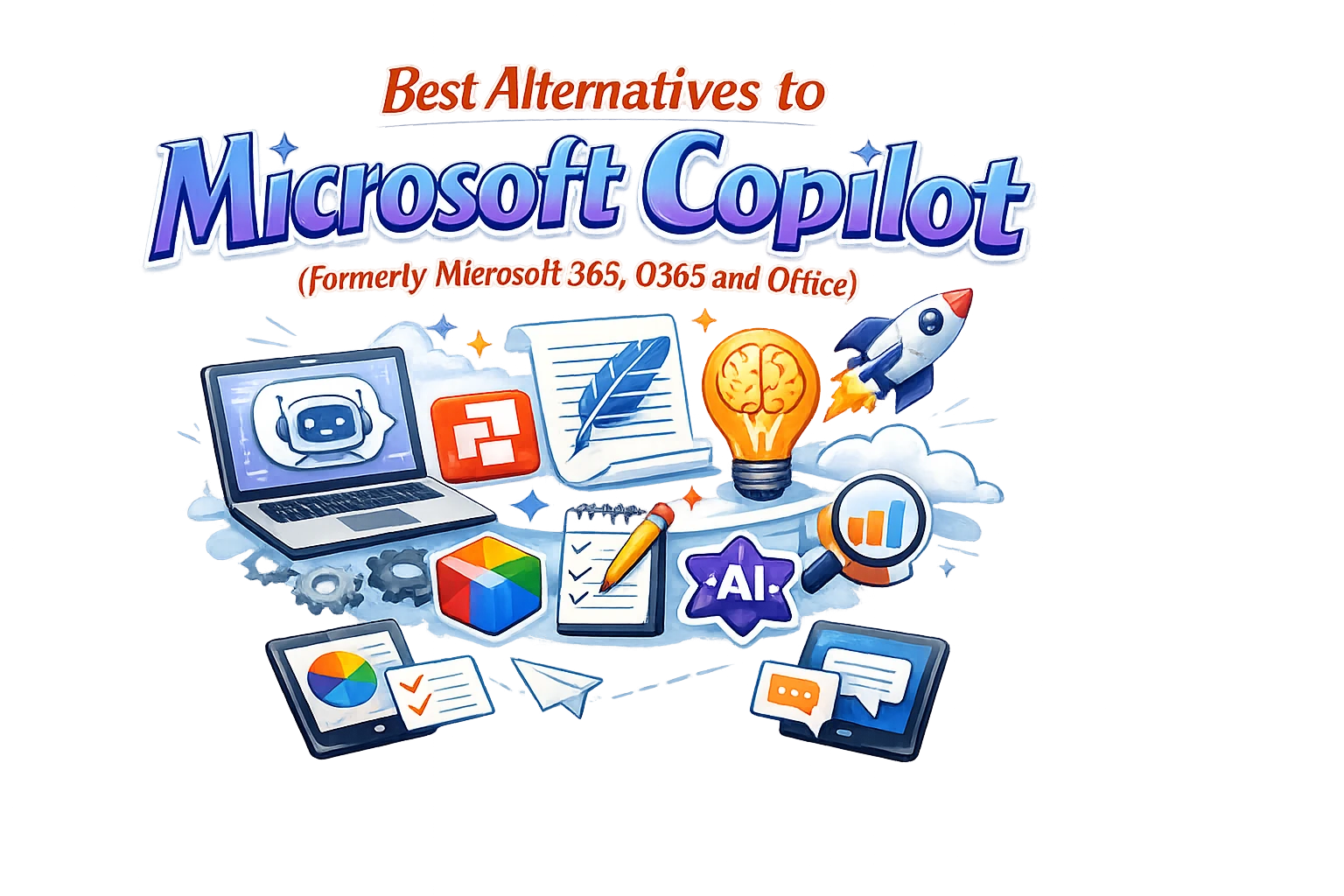
Best Alternatives for Microsoft Office (Formerly Microsoft 365, O365 and now Microsoft Copilot)
For IT teams, “Office” is rarely just a set of desktop apps. In many environments it is a bundle of identity, collaboration, endpoint posture, compliance controls, retention policies, and a decades-long archive of files, templates, and macros. That is why evaluating alternatives is less about finding a word processor and more about choosing an operating model for productivity: cloud-first, hybrid, or self-hosted; collaboration-first or compatibility-first; privacy-first or ecosystem-first.
The recent “Copilot” branding shift is also changing procurement conversations. Some organizations want productivity tooling without AI add-ons; others want AI but prefer a different provider; many simply want predictable licensing and clearer boundaries around data exposure. Regardless of the motive, a strong alternative strategy starts with a clean separation: replacing Office applications is one decision; replacing the broader Microsoft 365 stack is a different decision.
Google Workspace
Google Workspace is the most common “suite-to-suite” alternative when the priority is real-time collaboration and browser-native workflows. It tends to fit organizations that have already standardized on modern identity and device management patterns and want a simple operational posture: fewer thick clients, fewer plug-ins, and fewer local state issues.
From an IT perspective, Workspace is strongest when you treat it as a platform rather than a set of apps. Centralized admin, consistent policy surfaces, and strong integration hooks make it suitable for automation-heavy environments. Where migrations succeed, it is usually because teams explicitly move toward “Docs-first” collaboration and stop treating Microsoft file formats as the internal source of truth.
Watch-outs are predictable: high-fidelity formatting for complex Word and PowerPoint documents can be uneven, and Excel-heavy workflows that rely on complex features, macros, or entrenched templates may require either redesign or a compatibility layer. External collaboration is typically excellent, but file-exchange with partners still living in Microsoft formats requires a clear operational policy so teams do not burn time “fixing formatting” instead of doing work.
Workspace is a good fit when your success metric is collaboration speed and reduced client complexity, and when leadership is willing to standardize on Workspace-native formats for day-to-day creation.
Zoho Workplace
Zoho Workplace is often selected by IT teams that want a full productivity bundle with a different cost curve and a broad ecosystem behind it. The “single pane” approach appeals to organizations that want mail, chat, meetings, file storage, and office editors under one administrative umbrella, without rebuilding everything from separate vendors.
Where Zoho tends to do well is in pragmatic deployments: small-to-mid enterprises, distributed teams, and organizations that want a predictable suite that is “good at everything” rather than “best at one thing.” For IT, the decision point is usually less about editing features and more about governance, integration, and support expectations: how identity is managed, how audit and retention align with policy, and how the vendor’s roadmap matches your compliance commitments.
Zoho Workplace is a credible suite alternative when you want a consolidated stack and you value vendor diversity without jumping all the way to self-hosting.
ONLYOFFICE Docs
ONLYOFFICE is frequently shortlisted when the key requirement is Microsoft-format fidelity without committing to the Microsoft ecosystem. It is especially attractive in environments that want online collaborative editing but also want deployment control, including self-hosted or private-cloud models.
For IT professionals, ONLYOFFICE is less a “replacement app” and more an architecture component: it can sit behind your own storage, integrate with collaboration platforms, and allow teams to work in familiar-looking editors while your organization controls where documents live. That separation of editor and repository is powerful for governance, data residency, and segmentation strategies.
The practical question is how deeply your organization relies on advanced Excel features or VBA. Many organizations succeed with ONLYOFFICE by formally deprecating macros, migrating high-risk spreadsheet logic into managed systems, and treating the remaining spreadsheets as simpler calculation artifacts rather than business-critical applications.
ONLYOFFICE fits well when you want collaboration with strong Office-format compatibility and you prefer to control storage, identity, and network boundaries.
Nextcloud Hub
Nextcloud Hub is a strong option when your strategy is “bring productivity to our infrastructure” rather than “move productivity to a public cloud.” It is primarily a content collaboration platform with file sync/share, groupware, communications, and workflow capabilities, and it can be paired with online document editors to create a full collaboration experience.
For IT, the appeal is control: data location, network segmentation, key management choices, and the ability to align the platform with internal policies. This is especially relevant in regulated industries, sovereign deployments, and environments with strong data-residency constraints.
Nextcloud deployments succeed when they are treated like real infrastructure, not “a file server with a web UI.” That means capacity planning, performance testing, HA design, backup and restore drills, patch governance, and clearly defined support ownership. If you can operationalize it, Nextcloud becomes a flexible foundation for a modern productivity layer.
Nextcloud Hub is ideal for organizations that want to reduce vendor concentration risk, maintain tighter sovereignty over data, and can support a platform lifecycle like any other business-critical system.
Collabora Online
Collabora Online is a popular online editing layer in self-hosted and controlled environments, commonly deployed alongside content platforms such as Nextcloud. It enables browser-based document editing while allowing IT to keep the storage and access control model in-house or within a tightly controlled private cloud.
In practical terms, Collabora Online helps close the usability gap that appears when an organization adopts a sovereign content platform but users still expect “click a file and edit together in the browser.” This is the workflow users compare against Microsoft and Google. When you can deliver it with your own hosting model, adoption becomes far easier.
The key IT question is integration quality and lifecycle management: authentication, SSO, editor performance at scale, document compatibility expectations, and how you handle upgrades without interrupting business workflows.
LibreOffice
LibreOffice remains one of the strongest “desktop-first” alternatives for organizations that want to reduce licensing dependency, maintain offline capability, and avoid the operational coupling that comes with a cloud suite. It is widely deployed in environments that favor open standards and value long-term document accessibility.
For IT professionals, LibreOffice is often a governance decision. If your organization can standardize on open formats for internal documents and treat Microsoft formats as interchange formats rather than the canonical store, LibreOffice becomes a stable long-term base. That approach can meaningfully improve exit options and reduce the cost of future platform changes.
The success factor is managing expectations around compatibility and automation. Complex Excel workbooks and VBA-heavy processes are rarely “drop-in.” Many organizations handle this by separating spreadsheet “documents” from spreadsheet “applications,” migrating critical spreadsheet apps into managed services or low-code platforms, and leaving LibreOffice for the document tier.
LibreOffice is an excellent fit when offline support, openness, and predictable long-term access to documents are high priorities.
SoftMaker Office
SoftMaker Office is a strong commercial alternative for organizations that want a traditional desktop suite with a focus on compatibility and a vendor posture that emphasizes privacy. It is often evaluated by IT teams that want a paid product with conventional support expectations, without stepping into a large cloud ecosystem.
This category is particularly relevant for environments that still value a “fat client” experience, including VDI scenarios, controlled endpoint builds, and organizations that want straightforward rollout mechanics. SoftMaker can be useful where LibreOffice is acceptable but leadership prefers a commercial vendor relationship and a specific compatibility profile.
SoftMaker Office fits well when you want a desktop suite replacement with predictable vendor support and a privacy-oriented stance, while keeping migration complexity lower than a full suite replatforming.
WPS Office
WPS Office is commonly adopted for its familiar UX, strong multi-device experience, and broad file-format compatibility. It can be appealing in mixed device fleets where mobile editing and built-in PDF tooling are high-frequency needs.
For IT professionals, the evaluation tends to be less about editing capability and more about risk management: procurement terms, telemetry posture, cloud synchronization behavior, data residency options, and whether enterprise controls align with internal policy. If WPS is deployed, it is typically with a deliberate configuration baseline and clear rules about which documents can sync to which locations.
WPS Office can be a practical Office-like experience when compatibility and device coverage are top priorities, provided your governance model is explicit and enforced.
Apple iWork
iWork is best evaluated as an “Apple-first productivity layer” rather than a universal Microsoft Office clone. For organizations with significant macOS and iOS adoption, it can reduce dependency on third-party office suites for many everyday workflows while keeping collaboration simple through Apple’s ecosystem.
The core IT question is interoperability and standardization. If your external-facing documents must be delivered in strict Microsoft formats with complex layouts, iWork might become a conversion step rather than a canonical authoring tool. Many teams succeed by defining where iWork is the right tool and where Microsoft-compatible editing remains required.
iWork fits organizations that want a clean, native experience on Apple devices and can formalize export workflows for partner and customer document exchange.
Proton for Business
Proton’s business suite is increasingly evaluated by organizations that treat privacy and data minimization as first-order requirements. Instead of competing head-to-head on “every Office feature,” the value proposition is a workspace posture that is explicitly designed to reduce exposure to breaches, surveillance, and unwanted data reuse.
For IT professionals, the decision is usually architectural: Proton can serve as a secure layer for high-sensitivity workflows and for organizations that want a tighter privacy model by default. It is most effective when you identify which workloads need privacy-first controls and which workloads can remain in a mainstream collaboration suite.
When Proton is positioned thoughtfully, it becomes a strong component in a tiered productivity strategy, where confidentiality requirements vary by team, project, or document classification.
A practical decision framework for IT
Alternatives work best when the selection criteria are explicit and measurable. In productivity platform projects, “users like it” is not sufficient, and “it opens files” is not a migration strategy. A durable framework ties tooling to business risk and operational reality.
File compatibility and fidelity
Identify the documents that actually matter: external templates, legal artifacts, investor decks, regulated forms, executive reporting spreadsheets, and the handful of files that have become business processes. Validate fidelity on those artifacts, not on marketing examples. If macros, add-ins, or deeply nested spreadsheets are part of the workload, define an explicit policy for how those will be retired, replaced, or isolated.
Identity, access, and endpoint posture
SSO integration, conditional access, MFA enforcement, device trust, and role design are where IT wins or loses time. A suite that creates identity exceptions becomes expensive quickly. In mixed environments, prefer tools that integrate cleanly with your IdP and allow policy to be consistent across SaaS and self-hosted components.
Security, auditability, and compliance controls
If you have retention, legal hold, eDiscovery, or DLP requirements, map those to concrete controls: audit logs you can actually export, retention that is enforceable and testable, classification that is operationally usable, and administrative boundaries that match your org structure. If you cannot prove enforcement in a tabletop exercise, assume you will not be able to prove it during an incident.
Support model and operational ownership
Cloud suites shift operational load to vendor support and admin configuration. Self-hosted stacks shift the load to your infrastructure practice. Hybrid splits the difference but can become the hardest option if ownership is ambiguous. Decide who owns patching, uptime SLAs, backups, restore testing, and user support pathways before you pilot.
A useful internal artifact is a one-page “productivity platform contract” that states the canonical file formats, how documents are classified, where each class of documents may live, and how teams collaborate with external parties. Alternatives become far easier to run when policy is written in operational language instead of aspirational language.
Migration patterns that actually work
Most failed Office replacement projects are not failures of software; they are failures of scope control. A successful migration usually adopts one of these patterns and commits to it operationally.
Collaboration-first replatforming
Organizations choose a cloud suite and standardize on its native document formats for internal creation. Microsoft formats become exchange formats for partners. This pattern is common with Google Workspace and can also apply to other suites when leadership enforces a clean standardization decision.
Compatibility-first substitution
Organizations keep Microsoft formats as canonical but replace the editing layer to reduce licensing dependence or to change deployment posture. This pattern often uses ONLYOFFICE or a desktop suite replacement such as LibreOffice or SoftMaker, and it tends to succeed when macro-heavy artifacts are explicitly isolated or retired.
Sovereign collaboration stack
Organizations deploy a self-hosted platform and pair it with an online editor to approach the usability of public-cloud suites while keeping control of data location and access. Nextcloud Hub combined with an online editor is a common realization of this pattern. The operational requirement is higher, but so is the control.
Across these patterns, change management matters. IT should assume a non-trivial learning curve for users, create clear “how we work now” guidance, and establish a support channel that can answer common issues like format conversion, sharing settings, and collaboration etiquette.
Interoperability rules that reduce tickets
The fastest way to generate helpdesk load is to let every team decide its own file format rules. A small set of interoperability policies can prevent an endless stream of “format broke” incidents.
Many IT organizations succeed by defining a default internal authoring format, a default external sharing format, and a small set of exceptions for specialized use. They also define where PDFs are the final artifact, where editable documents are required, and what “final” means for controlled documents.
The goal is not perfection; it is predictability. When teams know which tool and which format is expected for each class of work, the platform becomes calmer, support becomes easier, and migrations stop feeling like constant friction.
What “best” looks like in real organizations
There is no universal “best alternative” to Microsoft Office because organizations are optimizing for different constraints. A practical selection usually aligns to one dominant priority.
If collaboration speed is the primary metric, a cloud suite with native real-time coauthoring is typically the best move. If exit options, sovereignty, and data residency dominate, a self-hosted collaboration platform with an online editor is often the strongest path. If file compatibility and minimal disruption matter most, a compatibility-focused editor layer or desktop suite replacement tends to win.
The most durable approach is to decide what your organization is truly trying to optimize and then choose the platform that makes that objective easiest to enforce. When “best” is defined operationally, the product choice becomes much clearer.
Tip for IT leaders: Run a pilot where success is measured by policy compliance, interoperability outcomes, and reduced operational exceptions. If your pilot only measures “user preference,” it will not predict enterprise outcomes.


 12965
12965  IT Pro