IT professionals are used to thinking in layers: hardware, networks, software, identity, policy, and operations. Space is easy to ignore because it feels “above” the stack. Yet a growing amount of what we call “the internet,” “the cloud,” and “global timing” depends on orbital infrastructure. The Kessler effect is a reminder that even a highly advanced system can tip from resilient to fragile when density and velocity combine in the wrong way.
This article explains the Kessler effect in practical terms, then translates it into risk language that makes sense for architects, SREs, CISOs, networking teams, and business continuity owners. The goal is not fear, but preparedness: understanding what the failure mode looks like, what signals to monitor, and how to design operational guardrails in a world where orbital services are no longer optional.
What the Kessler effect actually means
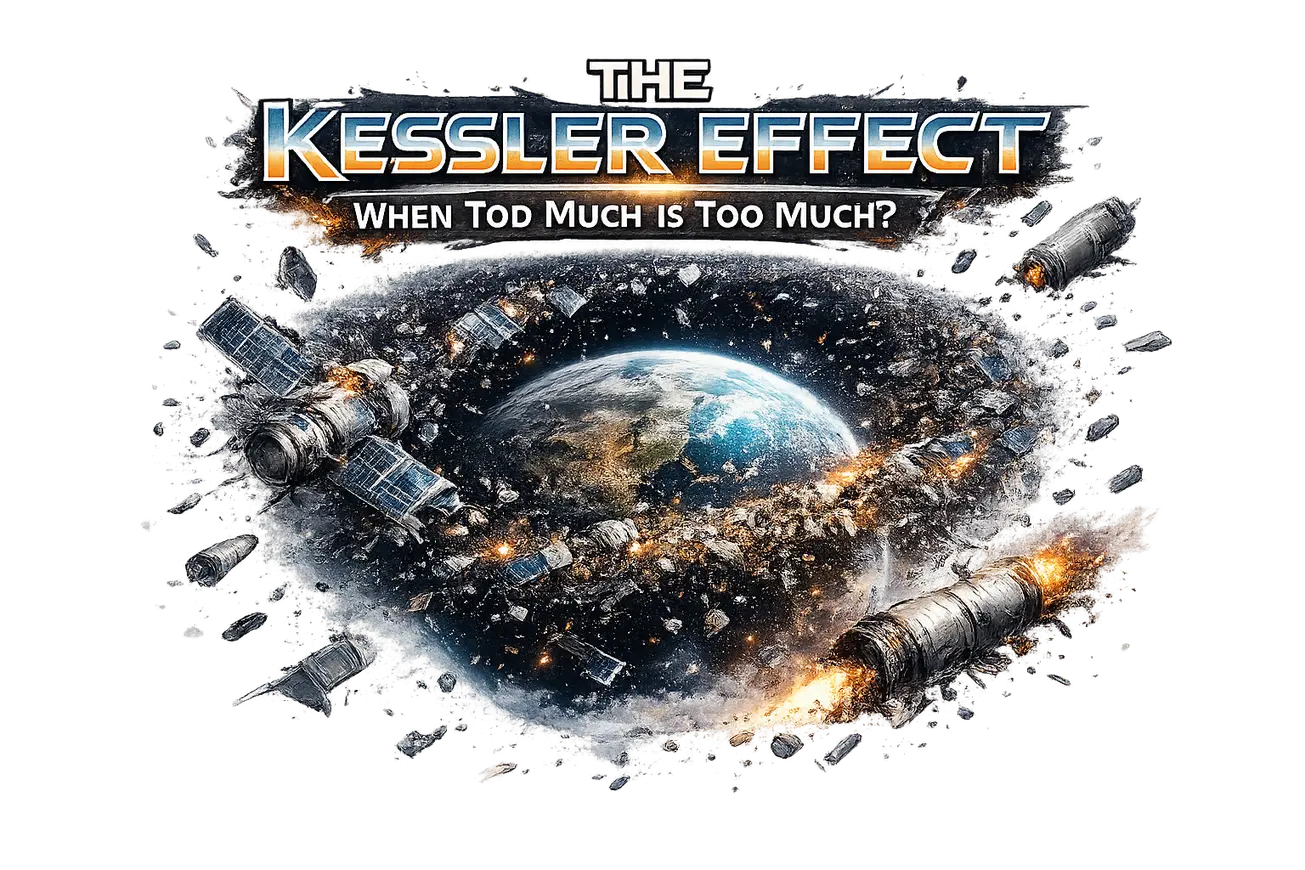
The Kessler effect is a scenario where space debris becomes so abundant in a particular orbital band that collisions generate more debris than can naturally decay or be removed. Each collision creates fragments; fragments increase the probability of future collisions; future collisions create even more fragments. It’s a compounding feedback loop, similar in shape to cascading failures you may recognize from distributed systems.
The phrase “runaway cascade” is often used, but it helps to be specific. In low Earth orbit (LEO), objects travel at extraordinary speeds relative to each other. At those velocities, even small fragments can disable satellites, and a single collision can create a cloud of debris that intersects many orbits. Over time, a crowded orbital region can become hazardous enough that routine operations are forced into constant avoidance maneuvers, and eventually the region becomes economically or technically impractical to use.
Importantly, the Kessler effect is not about one dramatic event “ending space.” It is about an environment that becomes increasingly hostile to reliable, long-lived operations. It’s gradual in outcome, but can be abrupt in trigger if enough mass and density align.
Why IT should care about orbital congestion
Many organizations already depend on space whether they realize it or not. Satellite systems contribute to global communications, remote connectivity, maritime and aviation links, emergency response, broadcasting, Earth observation, and navigation. Even when your application traffic rides fiber, your timing often rides satellites, and timing is a quiet dependency for authentication, logging, forensics, financial systems, and distributed databases.
Think of space as an upstream provider with unique constraints: high latency links, limited spectrum, strict power budgets, and a physical environment where maintenance is not a truck roll. It’s also a shared medium: congestion is not only “your” problem. If orbital regions become risky, the impacts can show up as reduced service availability, degraded coverage, longer lead times for replacement capacity, increased costs, and more frequent operational anomalies.
For IT professionals, the Kessler effect is best understood as a systemic risk to a set of critical “platform services” that live off-planet. In the same way you don’t ignore a looming BGP routing crisis or a major DNS dependency, you should not ignore the physical layer of space when so many business processes assume it will keep working.
The physics of “too much is too much”
In datacenters, density drives efficiency until it drives failure: too many tenants on a noisy node, too many writes on a hot shard, too many packets on a saturated link. Space has its own version of density. Orbits are not infinite open lanes; they are constrained by altitude bands, inclinations, and mission needs. Certain shells in LEO are especially attractive because they offer lower latency and strong coverage, which encourages more launches into the same regions.
Once a region becomes crowded, the probability of close approaches increases. Operators rely on tracking networks and conjunction analysis to predict potential collisions and perform avoidance maneuvers. That works up to a point, but it has scaling limits. A higher object count increases the number of conjunction warnings. More warnings means more maneuver decisions. More maneuvers mean more fuel usage and shorter satellite lifetimes. Shorter lifetimes mean more replacement launches, which can increase congestion further.
This is a classic feedback loop. The “too much” threshold is not a single magic number; it’s the moment where the environment’s risk-reduction mechanisms no longer keep pace with the growth of risk. In IT terms, it’s when your backpressure fails, your queues grow faster than you can drain them, and the system starts amplifying its own failure.
The modern orbital environment: more constellations, more complexity
The past decade has seen a shift from a relatively small number of high-value satellites to large constellations of smaller satellites, especially in LEO. This changes the operational posture. Instead of protecting a handful of exquisite systems, the ecosystem now manages fleets where resilience comes from numbers, rapid replacement, and sophisticated ground operations.
From a reliability perspective, constellations can be robust to individual failures. From an environmental perspective, they increase object count, and object count is the variable the Kessler effect is most sensitive to. The industry invests heavily in collision avoidance, deorbit plans, and tracking improvements, but the macro trend remains: more actors, more launches, more shared risk, and more incentive to occupy popular orbital shells.
For IT leaders, the key observation is that your dependency chain is becoming more “cloud-like.” Many services you consume are built on top of satellite infrastructure you don’t directly control. That makes transparency and resilience planning essential.
Failure modes that look familiar to IT teams
The Kessler effect is a physical cascade, but its operational symptoms map neatly onto familiar classes of incidents. Thinking in these patterns helps teams build runbooks and business expectations without needing to become orbital engineers.
A service degradation scenario is the most likely early experience. You don’t see a complete shutdown; you see intermittent availability, variable performance, increased packet loss on certain links, and unpredictable regional behavior. This mirrors how capacity crunches appear in networks and cloud zones.
A capacity and replacement lag scenario follows. If operators must deorbit more frequently due to collision risk, or if satellites are lost unexpectedly, replenishment becomes a supply chain and scheduling problem. Launch capacity, payload integration, regulatory coordination, and manufacturing throughput are not infinite. Your “scale out” assumption may fail in the way hardware procurement fails when everyone needs the same GPU at the same time.
A cascading dependency scenario is where IT feels the impact sharply. Satellite systems support backhaul in remote locations, emergency failover, maritime connectivity, and timing. If those degrade, the blast radius can reach authentication flows, monitoring pipelines, log correlation, transaction ordering, and incident investigations.
Finally, there is a trust and integrity scenario. When a service becomes unreliable, the temptation is to “patch around” it quickly. That can lead to insecure failovers, weak configuration changes, disabled verification, or ad-hoc routing exceptions. Many major security incidents begin as resilience shortcuts taken under pressure.
Timing: the quiet dependency many teams underestimate
Accurate time underpins modern computing more than most people admit. Certificates have validity windows. Kerberos and many authentication methods rely on clock tolerances. Distributed tracing and log analysis assume coherent ordering. Financial systems and industrial control environments often require precise timing for compliance and safety.
Satellite navigation systems contribute timing signals that many infrastructures use directly or indirectly. Even if your core datacenter time comes from terrestrial sources, upstream providers, telecom operators, or edge environments may be dependent on satellite timing. When orbital services degrade, you may not “lose GPS” in a cinematic sense, but you may see increased time drift in places you don’t routinely audit.
For IT operations, the practical takeaway is simple: treat time as a critical service with redundancy and monitoring. Validate NTP sources, diversify timing inputs where possible, and ensure your incident response can cope with partial timing anomalies. If you’ve ever tried to do forensics on logs with skewed clocks, you already know why this matters.
Connectivity: when “backup links” become primary risk
Satellite connectivity is often positioned as the resilient fallback for fiber cuts, disasters, and remote operations. That is true, but it also means satellite links carry a special burden: they are expected to work when everything else is failing. If an orbital congestion event reduces availability, your fallback plan may degrade precisely when you need it most.
This is the same pattern as relying on a single region for disaster recovery or assuming an “out of band” management path that quietly shares the same failure domain as production. Resilience is not about having two links; it’s about having two links that fail differently.
IT teams can translate this into architecture decisions. If satellite backhaul is part of your continuity plan, document what services truly require it, what performance you need under stress, and what your alternatives are if satellite capacity is constrained. In some cases, the answer may be a mix of terrestrial wireless, multiple providers, caching, local autonomy at the edge, and degraded-mode application behavior.
Observability lessons: you can’t fix what you can’t see
Space operators live in a world of telemetry, tracking, and prediction. IT teams can adopt the mindset even if the data sources differ. If your organization depends on satellite services, add explicit observability for those dependencies. Track latency, jitter, packet loss, failover behavior, and error patterns by region and time of day. Watch for anomalies that correlate with known service notices, geomagnetic conditions, or maintenance windows.
The most common mistake is to treat satellite as a “black box ISP.” That leads to shallow troubleshooting and slow incident resolution. A better approach is to instrument the satellite path as a first-class network segment with its own SLOs, dashboards, and runbooks. If your org has multiple sites, create a small baseline dataset that shows what “normal” looks like, so that “weird but normal” does not trigger panic, and “quiet degradation” does not go unnoticed.
Also consider the human side. When a dependency is remote and unfamiliar, teams tend to improvise during incidents. Rehearsed procedures, vendor escalation paths, and clear decision thresholds are what keep improvisation from turning into chaos.
Security implications: resilience events create attacker opportunity
The Kessler effect is not a cyberattack, but it can create conditions that attackers exploit: confusion, degraded monitoring, rushed changes, and the need to reroute or reconfigure systems quickly. A disruption in satellite-enabled connectivity can reduce visibility into remote assets. If you depend on satellite for telemetry from critical sites, you may temporarily lose the data that would normally alert you to compromise.
There is also a supply-chain dimension. When replacement satellites and ground equipment become scarce or expensive, organizations may accept weaker procurement controls, rush vendor onboarding, or deploy unvetted firmware. Security leaders should anticipate this by tightening baselines now, so that future pressure doesn’t force risky shortcuts.
Finally, continuity planning must include identity and access patterns during degraded connectivity. If your IAM flows require always-on upstream access, remote sites may be forced into local accounts, shared credentials, or policy exceptions. Those exceptions become technical debt that attackers love.
Governance and shared responsibility: orbital space is a commons problem
The Kessler effect is, at its core, a shared-environment risk. No single organization owns an orbital shell the way a company owns a datacenter. This resembles the internet’s shared resources: IP address space, routing, DNS, certificate ecosystems, and open-source supply chains. Everyone benefits when the shared layer is healthy, and everyone suffers when incentives encourage overuse without accountability.
Space sustainability efforts include tracking standards, debris mitigation guidelines, post-mission disposal practices, collision-avoidance coordination, and emerging debris-removal approaches. The details vary across regions and regulators, but the direction is clear: the industry is attempting to turn “best effort” into enforceable norms.
For IT professionals, governance matters because it affects service predictability. Stronger norms and transparency can reduce systemic risk. Weak norms raise the probability that your dependencies become brittle over time. Even if you are not a space company, you are a consumer of space-enabled services, and consumers can influence markets by demanding evidence of responsible operations.
Practical risk translation for enterprise planning
A useful way to incorporate the Kessler effect into enterprise risk is to treat it like a “low-probability, high-impact, long-horizon” scenario with meaningful near-term precursors. You don’t need to predict an exact tipping point. You need to understand what exposure looks like and reduce brittleness.
Start by mapping dependencies. Identify where satellite services are used directly: remote branches, maritime links, mobile command units, backup connectivity, IoT deployments, emergency communications, and timing. Then identify indirect dependencies through vendors: telecom providers, cloud services, logistics platforms, mapping providers, and any system whose reliability assumptions include global coverage.
Next, evaluate your failure domains. If a satellite link is your “Plan B,” ensure Plan B doesn’t share the same hidden dependencies as Plan A. If timing is critical, ensure you have monitored redundancy. If remote operations require constant connectivity, consider edge autonomy strategies so that temporary degradation does not create unsafe states.
Finally, write down your degraded modes. The difference between a manageable incident and a business crisis is often whether the organization has agreed in advance on what “degraded but safe” looks like. That agreement turns panic into procedure.
Designing systems that tolerate orbital uncertainty
If you design for the assumption that orbital services will be perfect, you inherit their worst-case behavior. If you design for partial degradation, you gain leverage. Many of the patterns are the same ones you already use for unreliable networks and constrained links.
Caching and local-first design reduce dependence on continuous connectivity. If remote sites can continue core operations locally and sync later, satellite link instability becomes an inconvenience rather than a shutdown trigger. This is especially relevant for field service, logistics, industrial sites, and any environment where human safety or physical processes continue even when the network hiccups.
Queue-based integration helps too. Instead of hard-coupling workflows to immediate upstream responses, use durable messaging and idempotent processing. That way, link flaps don’t generate duplicate actions or inconsistent state.
Observability should be adaptive. If your telemetry pipeline depends on the same link that is failing, you need a lightweight fallback telemetry mode or local log retention with delayed export. The point is not to collect everything, but to preserve the minimum signals you need for safety and post-incident analysis.
Security controls should degrade safely. Favor policies and mechanisms that fail closed where appropriate, but also avoid designs that force operators into dangerous manual overrides. This is where tabletop exercises pay off: they reveal whether your “secure mode” is actually operationally survivable.
What to ask vendors and providers
Many IT teams purchase outcomes, not infrastructure. That’s fine, but the questions you ask determine how visible your risk really is. When satellite services are part of the value chain, vendor conversations should include more than bandwidth and coverage maps.
Ask about collision avoidance practices and operational coordination. Ask what happens when satellites are lost: how quickly capacity can be restored, and what prioritization policies apply under strain. Ask how service notices are communicated and whether there is an API or feed suitable for NOC integration.
Ask about timing dependencies, too. If a vendor provides services that rely on precise time, ask what redundancy exists and what monitoring they perform. If they claim “five nines,” ask what failure domains are excluded from that SLO, and whether orbital environment risk is explicitly considered.
The tone here matters. The goal is not to interrogate vendors, but to treat orbital dependency with the same maturity you already apply to cloud regions, upstream networks, and key SaaS providers.
Incident response mindset: runbooks for the sky
The Kessler effect is a strategic scenario, but its smaller precursors can show up as day-to-day incidents: unexplained degradations, increased failovers, regional anomalies, or prolonged vendor maintenance. Your incident response process should be ready to classify “orbital dependency degradation” the way you classify DNS issues or cloud service incidents.
Build a simple decision tree that answers: what symptoms indicate satellite-path issues, how to confirm quickly, when to fail over, when to throttle, and when to move into degraded mode. Define communication templates that explain impact in business language, because the root cause can sound exotic and invite misunderstanding.
Also plan for “long tail” incidents. A major orbital event may have aftereffects that persist: changing avoidance patterns, shifting coverage, and capacity constraints. Long incidents stress teams differently than short ones. Rotate on-call responsibly, preserve notes, and ensure postmortems produce actual architectural improvements rather than one-time patches.
So, is the Kessler effect inevitable?
“Inevitable” is the wrong word for IT planning. The correct question is whether the risk is rising, whether the mitigations are scaling fast enough, and whether your systems are designed to tolerate uncertainty. Industry efforts to improve tracking, coordination, deorbit compliance, and sustainable operations are real and growing. At the same time, incentives to deploy more infrastructure in popular orbits are also real.
The practical stance for IT professionals is to treat orbital congestion as a developing reliability variable, not a distant sci-fi plot. Like many infrastructure risks, it can remain abstract until a sequence of “rare” events compresses into a short window and suddenly becomes everyone’s problem.
A pragmatic closing: treat space like a shared critical platform
The Kessler effect is a warning about density, incentives, and feedback loops in a shared environment. IT has lived through this story before: email spam arms races, BGP incidents, certificate ecosystem shocks, and open-source supply chain fragility. Each time, the winners were the organizations that assumed the shared layer could wobble and designed for it.
Space-enabled services have become foundational enough that IT leaders should include them in risk registers, continuity plans, and architecture reviews. You don’t need to predict the future of orbital debris with precision. You need to reduce single points of failure, monitor your dependencies, demand transparency from providers, and ensure your systems can operate safely in degraded conditions.
When too much becomes too much, it rarely feels like a single moment. It feels like rising operational noise, more exceptions, more workarounds, and more surprises. The earlier you treat the orbital layer as part of your platform, the less likely your organization is to be surprised by the sky.

 12984
12984  IT Pro